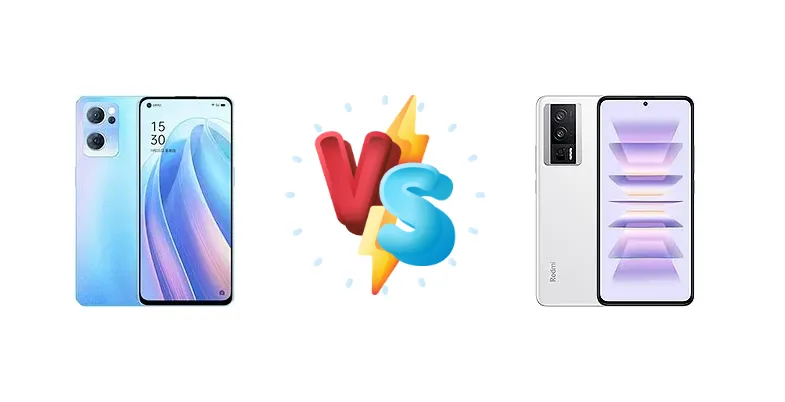
The Xiaomi Redmi K60 Pro and Oppo Reno7 5G (China variant) represent distinct approaches to the smartphone market. The K60 Pro aims for near-flagship performance at a competitive price, leveraging the Snapdragon 8 Gen 2. The Reno7 5G, meanwhile, focuses on a more balanced experience with the Snapdragon 778G, potentially prioritizing efficiency and a lower price point. This comparison dissects their key differences to determine which device best suits your needs.
🏆 Quick Verdict
For most users, the Xiaomi Redmi K60 Pro is the superior choice. Its Snapdragon 8 Gen 2 chipset delivers significantly faster performance, crucial for demanding tasks and gaming. While the Reno7 5G offers a respectable experience, the K60 Pro’s leap in processing power and faster 120W charging justify the price difference.
| Network |
|---|
| 2G bands | GSM 850 / 900 / 1800 / 1900 | GSM 850 / 900 / 1800 / 1900 |
| 3G bands | HSDPA 800 / 850 / 900 / 1700(AWS) / 1900 / 2100 | HSDPA 800 / 850 / 900 / 1700(AWS) / 2100 |
| 4G bands | 1, 2, 3, 4, 5, 7, 8, 28, 34, 38, 39, 40, 41 | 1, 3, 4, 5, 8, 18, 19, 26, 34, 38, 39, 40, 41, 42 |
| 5G bands | 1, 28, 41, 77, 78 SA/NSA | 1, 3, 5, 8, 28, 38, 41, 77, 78 SA/NSA |
| Speed | HSPA, LTE, 5G | HSPA, LTE, 5G |
| Technology | GSM / CDMA / HSPA / EVDO / LTE / 5G | GSM / CDMA / HSPA / CDMA2000 / LTE / 5G |
| | CDMA2000 1xEV-DO | CDMA2000 1x |
| Launch |
|---|
| Announced | 2021, November 25 | 2022, December 27 |
| Status | Available. Released 2021, December 03 | Available. Released 2023, January 01 |
| Body |
|---|
| Dimensions | 156.8 x 72.1 x 7.6 mm (6.17 x 2.84 x 0.30 in) | 162.8 x 75.4 x 8.6 mm or 8.9 mm |
| SIM | Nano-SIM + Nano-SIM | Nano-SIM + Nano-SIM |
| Weight | 185 g (6.53 oz) | 201 g or 205 g (7.09 oz) |
| Display |
|---|
| Protection | Corning Gorilla Glass 5 | - |
| Resolution | 1080 x 2400 pixels, 20:9 ratio (~409 ppi density) | 1440 x 3200 pixels, 20:9 ratio (~526 ppi density) |
| Size | 6.43 inches, 99.8 cm2 (~88.3% screen-to-body ratio) | 6.67 inches, 107.4 cm2 (~87.5% screen-to-body ratio) |
| Type | AMOLED, 90Hz, 430 nits (typ), 600 nits (HDR) | OLED, 68B colors, 120Hz, Dolby Vision, HDR10+, 1400 nits (peak) |
| Platform |
|---|
| CPU | Octa-core (1x2.4 GHz Cortex-A78 & 3x2.2 GHz Cortex-A78 & 4x1.9 GHz Cortex-A55) | Octa-core (1x3.2 GHz Cortex-X3 & 2x2.8 GHz Cortex-A715 & 2x2.8 GHz Cortex-A710 & 3x2.0 GHz Cortex-A510) |
| Chipset | Qualcomm SM7325 Snapdragon 778G 5G (6 nm) | Qualcomm SM8550-AB Snapdragon 8 Gen 2 (4 nm) |
| GPU | Adreno 642L | Adreno 740 |
| OS | Android 11, ColorOS 12 | Android 13, MIUI 14 |
| Memory |
|---|
| Card slot | No | No |
| Internal | 128GB 8GB RAM, 256GB 8GB RAM, 256GB 12GB RAM | 128GB 8GB RAM, 256GB 8GB RAM, 256GB 12GB RAM, 512GB 12GB RAM, 512GB 16GB RAM |
| | UFS 2.1 | UFS 4.0
UFS 3.1 - 128GB only |
| Main Camera |
|---|
| Features | LED flash, HDR, panorama | Color spectrum sensor, Dual-LED dual-tone flash, HDR, panorama |
| Single | 32 MP, f/2.4, 24mm (wide), 1/2.74", 0.8µm | - |
| Triple | 64 MP, f/1.7, 26mm (wide), 1/2.0", 0.7µm, PDAF
8 MP, f/2.2, 120˚ (ultrawide)
2 MP (macro) | 54 MP, f/1.9, (wide), 1/1.49", 1.0µm, PDAF, OIS
8 MP, 118˚ (ultrawide), 1/4.0", 1.12µm
2 MP (macro) |
| Video | 4K@30fps, 1080p@30/60/120fps, gyro-EIS | 8K@24fps, 4K@30/60fps, 1080p@30/60/120/240/960fps, 720p@1920fps, gyro-EIS |
| Selfie camera |
|---|
| Features | Panorama | HDR |
| Single | 32 MP, f/2.4, 24mm (wide), 1/2.74", 0.8µm | 16 MP, (wide), 1/3.06", 1.0µm |
| Video | 1080p@30fps, gyro-EIS | 1080p@30/60/120fps |
| Sound |
|---|
| 3.5mm jack | No | No |
| 35mm jack | No | No |
| Loudspeaker | Yes | Yes, with stereo speakers |
| | - | 24-bit/192kHz audio |
| Comms |
|---|
| Bluetooth | 5.2, A2DP, LE, aptX HD | 5.3, A2DP, LE |
| Infrared port | - | Yes |
| NFC | Yes | Yes |
| Positioning | GPS, GLONASS, BDS, GALILEO, QZSS | GPS (L1+L5), GLONASS (G1), BDS (B1I+B2a+Bc), GALILEO (E1+E5a), QZSS (L1+L5), NavIC |
| Radio | No | Unspecified |
| USB | USB Type-C 2.0, OTG | USB Type-C 2.0, OTG |
| WLAN | Wi-Fi 802.11 a/b/g/n/ac/6, dual-band, Wi-Fi Direct | Wi-Fi 802.11 a/b/g/n/ac/6e, dual-band, Wi-Fi Direct |
| Features |
|---|
| Sensors | Fingerprint (under display, optical), accelerometer, gyro, proximity, compass | Fingerprint (under display, optical), accelerometer, gyro, proximity, compass |
| Battery |
|---|
| Charging | 60W wired
5W reverse wired | 120W wired, PD3.0, QC3+, 100% in 19 min
30W wireless |
| Type | Li-Po 4500 mAh | Li-Po 5000 mAh |
| Misc |
|---|
| Colors | Black, Blue, Gold, Red (New Year Edition) | Black, White, Mint, Champion Black |
| Models | PFJM10 | 22127RK46C |
| Price | About 380 EUR | About 460 EUR |
Oppo Reno7 5G (China)
- More affordable price point
- Potentially more refined software experience (ColorOS)
- Good all-around performance for everyday tasks
- Significantly slower processor than the K60 Pro
- Slower charging speeds (60W vs 120W)
- Less capable ISP for image processing
Xiaomi Redmi K60 Pro
- Flagship-level performance with Snapdragon 8 Gen 2
- Ultra-fast 120W wired charging
- 30W wireless charging support
- Superior ISP for better image quality
- Higher price compared to the Reno7 5G
- MIUI software can be polarizing
Display Comparison
While display specifications aren't provided, both phones likely feature AMOLED panels given their market segments. However, the core difference lies in the processing power driving them. The Redmi K60 Pro, with its Snapdragon 8 Gen 2, can leverage the display’s capabilities more fully for smoother animations and faster response times in gaming. The Reno7 5G’s Snapdragon 778G, while capable, will exhibit a noticeable performance gap in graphically intensive applications. Bezels and color accuracy are likely comparable, but the K60 Pro’s superior GPU will be the deciding factor for visual fidelity.
Camera Comparison
Without detailed camera specs, we can infer differences based on chipset capabilities. The Snapdragon 8 Gen 2 in the K60 Pro includes a more advanced ISP (Image Signal Processor) capable of faster image processing, improved noise reduction, and better dynamic range. While both phones likely feature similar sensor configurations (main, ultrawide, potentially macro), the K60 Pro’s ISP will extract more detail and produce higher-quality images, especially in challenging lighting conditions. The Reno7 5G will still deliver acceptable results, but the K60 Pro offers a clear advantage in computational photography.
Performance
The performance disparity is the most significant factor. The Xiaomi Redmi K60 Pro’s Snapdragon 8 Gen 2 (4nm) is a generational leap over the Oppo Reno7 5G’s Snapdragon 778G (6nm). The 8 Gen 2 features a Cortex-X3 prime core clocked at 3.2 GHz, alongside Cortex-A715 and A710 performance cores, offering substantially higher single-core and multi-core scores. The Reno7 5G’s Cortex-A78 cores, while efficient, simply cannot compete. This translates to faster app loading times, smoother multitasking, and a far superior gaming experience on the K60 Pro. The 4nm process node of the 8 Gen 2 also contributes to better thermal efficiency, minimizing throttling during sustained workloads.
Battery Life
The Redmi K60 Pro’s 120W wired charging is a game-changer, promising a full charge in just 19 minutes. This is significantly faster than the Reno7 5G’s 60W charging. While battery capacity isn’t specified, the K60 Pro’s more efficient Snapdragon 8 Gen 2 chipset and faster charging mitigate any potential capacity disadvantage. The K60 Pro also supports 30W wireless charging, a feature absent on the Reno7 5G, adding further convenience. The Reno7 5G’s 5W reverse wired charging is a niche feature unlikely to sway purchasing decisions.
Buying Guide
Buy the Oppo Reno7 5G (China) if you prioritize a potentially more refined software experience (Oppo’s ColorOS) and are comfortable with a mid-range processor for everyday tasks. Buy the Xiaomi Redmi K60 Pro if you demand top-tier performance for gaming, video editing, or heavy multitasking, and value incredibly fast charging speeds and a more powerful chipset.
Frequently Asked Questions
❓ Does the Xiaomi Redmi K60 Pro get noticeably hot during extended gaming sessions?
The Snapdragon 8 Gen 2 is known for its improved thermal efficiency compared to previous generations. While some heat is inevitable during prolonged gaming, the K60 Pro’s cooling system (details not provided) should effectively manage temperatures and prevent significant throttling, offering a consistently smooth gaming experience.
❓ Is the difference in performance between the Snapdragon 778G and 8 Gen 2 noticeable in everyday tasks like browsing and social media?
For basic tasks like browsing, social media, and email, the difference won’t be dramatically apparent. However, the Snapdragon 8 Gen 2 will offer snappier app launches and smoother transitions, even in these scenarios. The real benefit becomes clear when multitasking or running demanding applications.
❓ Does the Redmi K60 Pro support global ROM updates, or is it primarily focused on the Chinese market?
The Redmi K60 Pro was initially released primarily for the Chinese market. However, Xiaomi often releases global ROMs for its devices, and community-supported custom ROMs are also available. Checking Xiaomi’s official website or forums for the latest update information is recommended.