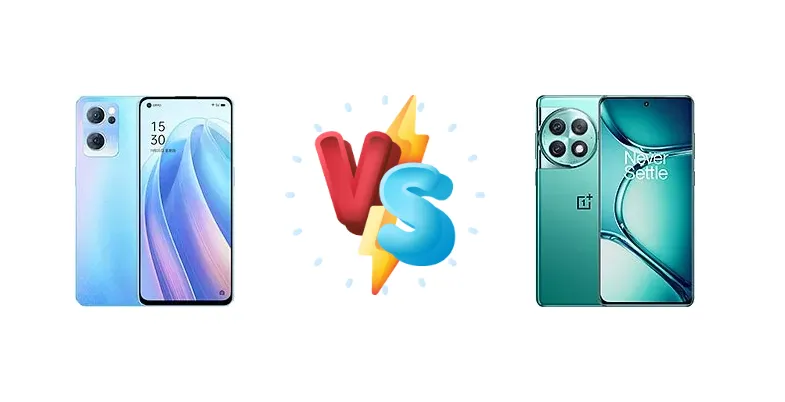
The OnePlus Ace 2 Pro and Oppo Reno7 5G (China variant) represent distinct approaches to the smartphone market. The Reno7 5G aims for a balance of features and affordability, while the Ace 2 Pro aggressively targets performance enthusiasts. This comparison dissects their core differences, focusing on the impact of their respective chipsets and charging technologies.
🏆 Quick Verdict
For most users, the OnePlus Ace 2 Pro is the superior device, offering a significantly more powerful Snapdragon 8 Gen 2 processor and blazing-fast 150W charging. However, the Reno7 5G remains a compelling option for budget-conscious buyers who prioritize efficiency and don't require top-tier gaming performance.
| Network |
|---|
| 2G bands | GSM 850 / 900 / 1800 / 1900 | GSM 850 / 900 / 1800 / 1900 |
| 3G bands | HSDPA 800 / 850 / 900 / 1700(AWS) / 1900 / 2100 | HSDPA 850 / 900 / 1700(AWS) / 2100 |
| 4G bands | 1, 2, 3, 4, 5, 7, 8, 28, 34, 38, 39, 40, 41 | 1, 3, 4, 5, 7, 8, 18, 19, 26, 28, 34, 38, 39, 40, 41 |
| 5G bands | 1, 28, 41, 77, 78 SA/NSA | 1, 3, 5, 8, 28, 41, 77, 78 SA/NSA |
| Speed | HSPA, LTE, 5G | HSPA, LTE, 5G |
| Technology | GSM / CDMA / HSPA / EVDO / LTE / 5G | GSM / CDMA / HSPA / LTE / 5G |
| | CDMA2000 1xEV-DO | - |
| Launch |
|---|
| Announced | 2021, November 25 | 2023, August 16 |
| Status | Available. Released 2021, December 03 | Available. Released 2023, August 23 |
| Body |
|---|
| Build | - | Glass front (Asahi Glass), plastic frame, glass back (Gorilla Glass 5) |
| Dimensions | 156.8 x 72.1 x 7.6 mm (6.17 x 2.84 x 0.30 in) | 163.1 x 74.2 x 9 mm (6.42 x 2.92 x 0.35 in) |
| SIM | Nano-SIM + Nano-SIM | Nano-SIM + Nano-SIM |
| Weight | 185 g (6.53 oz) | 210 g (7.41 oz) |
| Display |
|---|
| Protection | Corning Gorilla Glass 5 | Asahi Glass |
| Resolution | 1080 x 2400 pixels, 20:9 ratio (~409 ppi density) | 1240 x 2772 pixels, 20:9 ratio (~451 ppi density) |
| Size | 6.43 inches, 99.8 cm2 (~88.3% screen-to-body ratio) | 6.74 inches, 109.2 cm2 (~90.3% screen-to-body ratio) |
| Type | AMOLED, 90Hz, 430 nits (typ), 600 nits (HDR) | AMOLED, 1B colors, 120Hz, HDR10+, 550 nits (typ), 1200 nits (HBM), 1600 nits (peak) |
| Platform |
|---|
| CPU | Octa-core (1x2.4 GHz Cortex-A78 & 3x2.2 GHz Cortex-A78 & 4x1.9 GHz Cortex-A55) | Octa-core (1x3.2 GHz Cortex-X3 & 2x2.8 GHz Cortex-A715 & 2x2.8 GHz Cortex-A710 & 3x2.0 GHz Cortex-A510) |
| Chipset | Qualcomm SM7325 Snapdragon 778G 5G (6 nm) | Qualcomm SM8550-AB Snapdragon 8 Gen 2 (4 nm) |
| GPU | Adreno 642L | Adreno 740 |
| OS | Android 11, ColorOS 12 | Android 13, ColorOS 13.1 |
| Memory |
|---|
| Card slot | No | No |
| Internal | 128GB 8GB RAM, 256GB 8GB RAM, 256GB 12GB RAM | 256GB 12GB RAM, 512GB 16GB RAM, 1TB 24GB RAM |
| | UFS 2.1 | - |
| Main Camera |
|---|
| Features | LED flash, HDR, panorama | Color spectrum sensor, LED flash, HDR, panorama |
| Single | 32 MP, f/2.4, 24mm (wide), 1/2.74", 0.8µm | - |
| Triple | 64 MP, f/1.7, 26mm (wide), 1/2.0", 0.7µm, PDAF
8 MP, f/2.2, 120˚ (ultrawide)
2 MP (macro) | 50 MP, f/1.8, 24mm (wide), 1/1.56", 1.0µm, PDAF, OIS
8 MP, f/2.2, 16mm, 112˚ (ultrawide), 1/4.0", 1.12µm
2 MP (macro) |
| Video | 4K@30fps, 1080p@30/60/120fps, gyro-EIS | 4K@30/60fps, 1080p@30/60/120/240fps, gyro-EIS, OIS |
| Selfie camera |
|---|
| Features | Panorama | HDR |
| Single | 32 MP, f/2.4, 24mm (wide), 1/2.74", 0.8µm | 16 MP, f/2.4, 26mm (wide), 1/3.09", 1.0µm |
| Video | 1080p@30fps, gyro-EIS | 1080p@30fps |
| Sound |
|---|
| 3.5mm jack | No | - |
| 35mm jack | No | No |
| Loudspeaker | Yes | Yes, with stereo speakers |
| Comms |
|---|
| Bluetooth | 5.2, A2DP, LE, aptX HD | 5.3, A2DP, LE, aptX HD |
| Infrared port | - | Yes |
| NFC | Yes | Yes |
| Positioning | GPS, GLONASS, BDS, GALILEO, QZSS | GPS (L1+L5), GLONASS (G1), BDS (B1I+B1c+B2a), GALILEO (E1+E5a), QZSS (L1+L5) |
| Radio | No | No |
| USB | USB Type-C 2.0, OTG | USB Type-C 2.0 |
| WLAN | Wi-Fi 802.11 a/b/g/n/ac/6, dual-band, Wi-Fi Direct | Wi-Fi 802.11 a/b/g/n/ac/6/7, dual-band |
| Features |
|---|
| Sensors | Fingerprint (under display, optical), accelerometer, gyro, proximity, compass | Fingerprint (under display, optical), accelerometer, gyro, proximity, compass |
| Battery |
|---|
| Charging | 60W wired
5W reverse wired | 150W wired |
| Type | Li-Po 4500 mAh | Li-Po 5000 mAh |
| Misc |
|---|
| Colors | Black, Blue, Gold, Red (New Year Edition) | Aurora Green, Titanium Gray |
| Models | PFJM10 | PJA110 |
| Price | About 380 EUR | About 380 EUR |
Oppo Reno7 5G (China)
- More affordable price point
- Good all-around performance for everyday tasks
- Efficient Snapdragon 778G chipset
- Significantly slower charging than the Ace 2 Pro
- Less powerful processor for demanding games and apps
OnePlus Ace 2 Pro
- Blazing-fast 150W charging
- Flagship-level performance with Snapdragon 8 Gen 2
- Superior thermal efficiency
- Higher price tag
- Potentially shorter battery life due to power-hungry processor
Display Comparison
While display specifications aren't provided, both phones likely feature OLED panels common in their respective price brackets. The key differentiator will be peak brightness and refresh rate. Given the Ace 2 Pro's flagship positioning, it likely boasts a higher peak brightness for better outdoor visibility and potentially an adaptive refresh rate (LTPO) for improved power efficiency. The Reno7 5G will likely offer a standard 120Hz panel, sufficient for smooth scrolling and video playback.
Camera Comparison
Without detailed camera specs, it's difficult to make a definitive judgment. However, the Ace 2 Pro, being a flagship, likely features a larger main sensor and more advanced image processing capabilities. The Reno7 5G likely focuses on a balanced camera system suitable for everyday photography. The Ace 2 Pro's ISP (Image Signal Processor) within the Snapdragon 8 Gen 2 will offer faster processing and potentially better low-light performance. We can assume the Ace 2 Pro will have more advanced video recording capabilities as well.
Performance
The performance gap is substantial. The OnePlus Ace 2 Pro's Snapdragon 8 Gen 2 (4nm) is a generational leap over the Oppo Reno7 5G's Snapdragon 778G 5G (6nm). The 8 Gen 2 utilizes the newer Cortex-X3 prime core clocked at 3.2GHz, alongside Cortex-A715 and A710 performance cores, offering significantly higher CPU and GPU performance. The 778G, while capable, relies on older Cortex-A78 cores. The 4nm process node of the 8 Gen 2 also translates to improved thermal efficiency, reducing the likelihood of throttling during sustained workloads. Gamers and power users will overwhelmingly benefit from the Ace 2 Pro's superior processing power.
Battery Life
The Ace 2 Pro's 150W wired charging is a game-changer. It can likely charge from 0-100% in under 20 minutes, a massive advantage over the Reno7 5G's 60W charging. While battery capacity isn't specified, the Ace 2 Pro's more efficient chipset and faster charging mitigate the impact of a potentially smaller battery. The Reno7 5G's 60W charging is still respectable, but the Ace 2 Pro offers a significantly faster top-up experience, crucial for users who frequently run out of power.
Buying Guide
Buy the Oppo Reno7 5G (China) if you need a reliable daily driver with good battery life and don't prioritize demanding mobile gaming or intensive multitasking. It's ideal for users who value a balanced experience and a lower price point. Buy the OnePlus Ace 2 Pro if you prefer uncompromising performance, lightning-fast charging, and are willing to pay a premium for a flagship-level experience, particularly if you're a mobile gamer or power user.
Frequently Asked Questions
❓ Will the Snapdragon 778G in the Reno7 5G struggle with graphically intensive games like Genshin Impact?
The Snapdragon 778G is capable of running Genshin Impact, but you'll likely need to lower the graphics settings to medium or low to maintain a stable frame rate. The Ace 2 Pro's Snapdragon 8 Gen 2 will handle Genshin Impact on maximum settings with ease.
❓ How long does it realistically take to fully charge the OnePlus Ace 2 Pro with the 150W charger?
OnePlus claims the Ace 2 Pro can charge from 1-100% in around 18 minutes. Real-world testing typically shows slightly longer times, around 20-25 minutes, but it's still significantly faster than the Reno7 5G's 60W charging.
❓ Is the difference in chipset performance noticeable for everyday tasks like browsing and social media?
For basic tasks, the difference won't be dramatically noticeable. Both phones will feel responsive. However, the Ace 2 Pro will handle multitasking and app switching much more smoothly, especially with numerous apps open.
❓ Does the OnePlus Ace 2 Pro get excessively hot during prolonged gaming sessions?
The Snapdragon 8 Gen 2 is more thermally efficient than previous generations, and OnePlus typically implements effective cooling solutions. While some heat is inevitable during intense gaming, the Ace 2 Pro is less prone to significant throttling compared to phones with older, less efficient chipsets.