
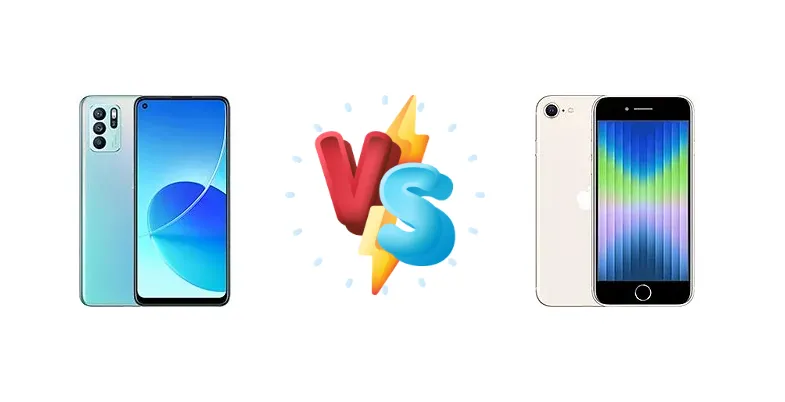
iPhone SE (2022) vs Oppo Reno6 Z: A Detailed Comparison of Two Budget Powerhouses
| Phones Images | |||||
|---|---|---|---|---|---|
|
🏆 Quick Verdict
For the average user prioritizing raw performance and long-term software support, the Apple iPhone SE (2022) is the clear winner. Its A15 Bionic chip delivers significantly faster processing speeds, despite the Reno6 Z’s advantages in charging and design. However, Android enthusiasts and those valuing a larger display will find the Reno6 Z a compelling alternative.
| PHONES | ||
|---|---|---|
| Phone Names | Oppo Reno6 Z | Apple iPhone SE (2022) |
| Network | ||
|---|---|---|
| 2G bands | GSM 850 / 900 / 1800 / 1900 | GSM 850 / 900 / 1800 / 1900 |
| 3G bands | HSDPA 850 / 900 / 1700(AWS) / 1900 / 2100 | HSDPA 850 / 900 / 1700(AWS) / 1900 / 2100 |
| 4G bands | 1, 2, 3, 4, 5, 7, 8, 18, 19, 20, 26, 28, 38, 39, 40, 41, 66 | 1, 2, 3, 4, 5, 7, 8, 12, 13, 17, 18, 19, 20, 25, 26, 28, 30, 32, 34, 38, 39, 40, 41, 42, 46, 48, 66 - A2783, A2784, A2785 |
| 5G bands | 1, 3, 5, 7, 8, 28, 38, 40, 41, 77, 78 SA/NSA | 1, 2, 3, 5, 7, 8, 12, 20, 25, 28, 30, 38, 40, 41, 48, 66, 77, 78, 79 SA/NSA/Sub6 - A2783, A2784, A2785, A2782 |
| Speed | HSPA, LTE, 5G | HSPA, LTE, 5G, EV-DO Rev.A 3.1 Mbps |
| Technology | GSM / HSPA / LTE / 5G | GSM / CDMA / HSPA / EVDO / LTE / 5G |
| - | 1, 2, 3, 5, 7, 8, 12, 20, 25, 28, 29, 30, 38, 40, 41, 48, 66, 71, 77, 78, 79 SA/NSA/Sub6 - A2595 | |
| Launch | ||
|---|---|---|
| Announced | 2021, July 20 | 2022, March 08 |
| Status | Available. Released 2021, August 14 | Available. Released 2022, March 18 |
| Body | ||
|---|---|---|
| Build | - | Glass front, glass back, aluminum frame |
| Dimensions | 160.2 x 73.4 x 7.9 mm (6.31 x 2.89 x 0.31 in) | 138.4 x 67.3 x 7.3 mm (5.45 x 2.65 x 0.29 in) |
| SIM | · Nano-SIM· Nano-SIM + Nano-SIM | Nano-SIM + eSIM |
| Weight | 173 g (6.10 oz) | 144 g (5.08 oz) |
| - | IP67 dust/water resistant (up to 1m for 30 min) Apple Pay (Visa, MasterCard, AMEX certified) | |
| Display | ||
|---|---|---|
| Protection | - | Ion-strengthened glass |
| Resolution | 1080 x 2400 pixels, 20:9 ratio (~411 ppi density) | 750 x 1334 pixels, 16:9 ratio (~326 ppi density) |
| Size | 6.4 inches, 98.9 cm2 (~84.1% screen-to-body ratio) | 4.7 inches, 60.9 cm2 (~65.4% screen-to-body ratio) |
| Type | AMOLED, 430 nits (typ), 600 nits (HDM), 800 nits (peak) | Retina IPS LCD, 625 nits (typ) |
| Platform | ||
|---|---|---|
| CPU | Octa-core (2x2.4 GHz Cortex-A76 & 6x2.0 GHz Cortex-A55) | Hexa-core (2x3.22 GHz Avalanche + 4x1.82 GHz Blizzard) |
| Chipset | Mediatek Dimensity 800U (7 nm) | Apple A15 Bionic (5 nm) |
| GPU | Mali-G57 MC3 | Apple GPU (4-core graphics) |
| OS | Android 11, upgradable to Android 12, ColorOS 12 | iOS 15.4, upgradable to iOS 26.1 |
| Memory | ||
|---|---|---|
| Card slot | microSDXC | No |
| Internal | 128GB 8GB RAM, 256GB 8GB RAM | 64GB 4GB RAM, 128GB 4GB RAM, 256GB 4GB RAM |
| - | NVMe | |
| Main Camera | ||
|---|---|---|
| Features | LED flash, HDR, panorama | Quad-LED dual-tone flash, HDR, panorama |
| Single | - | 12 MP, f/1.8 (wide), PDAF, OIS |
| Triple | 64 MP, f/1.7, 25mm (wide), PDAF 8 MP, f/2.2, 16mm, 119˚ (ultrawide), 1/4.0", 1.12µm 2 MP (macro) | - |
| Video | 4K@30fps, 1080p@30/120fps, gyro-EIS | 4K@24/30/60fps, 1080p@30/60/120/240fps, HDR, OIS, stereo sound rec. |
| Selfie camera | ||
|---|---|---|
| Features | HDR | HDR |
| Single | 32 MP, f/2.4, 24mm (wide) | 7 MP, f/2.2 |
| Video | 1080p@30fps | 1080p@30/120fps; gyro-EIS |
| Sound | ||
|---|---|---|
| 3.5mm jack | Yes | No |
| 35mm jack | Yes | No |
| Loudspeaker | Yes | Yes, with stereo speakers |
| Comms | ||
|---|---|---|
| Bluetooth | 5.1, A2DP, LE, aptX HD | 5.0, A2DP, LE |
| NFC | Yes (market/region dependent) | Yes |
| Positioning | GPS, GLONASS, BDS, GALILEO, QZSS | GPS, GLONASS, GALILEO, BDS, QZSS |
| Radio | Unspecified | No |
| USB | USB Type-C 2.0, OTG | Lightning, USB 2.0 |
| WLAN | Wi-Fi 802.11 a/b/g/n/ac, dual-band, Wi-Fi Direct | Wi-Fi 802.11 a/b/g/n/ac/6, dual-band, hotspot |
| Features | ||
|---|---|---|
| Sensors | Fingerprint (under display, optical), accelerometer, gyro, proximity, compass | Fingerprint (front-mounted), accelerometer, proximity, gyro, compass, barometer |
| Battery | ||
|---|---|---|
| Charging | 30W wired 5W reverse wired | 20W wired, 50% in 30 min 7.5W wireless (Qi) |
| Type | Li-Po 4310 mAh | Li-Ion 2018 mAh (6.96 Wh) |
| Misc | ||
|---|---|---|
| Colors | Black, Aurora | Midnight, Starlight, Red |
| Models | CPH2237 | A2783, A2595, A2785, A2782, A2784, iphone14,6 |
| Price | About 350 EUR | $ 119.84 / C$ 199.99 / £ 142.00 / € 173.00 |
| SAR | - | 0.98 W/kg (head) 0.99 W/kg (body) |
| SAR EU | - | 1.20 W/kg (head) 1.19 W/kg (body) |
| Tests | ||
|---|---|---|
| Battery life | - | Endurance rating 62h |
| Camera | - | Photo / Video |
| Display | - | Contrast ratio: 1424:1 (nominal) |
| Loudspeaker | - | -25.2 LUFS (Very good) |
| Performance | - | AnTuTu: 723486 (v9) GeekBench: 4629 (v5.1) GFXBench: 60fps (ES 3.1 onscreen) |
Oppo Reno6 Z
- Unmatched performance with the A15 Bionic chip
- Compact and pocketable design
- Long-term software support from Apple
- Outdated display with a 60Hz refresh rate
- Small screen size may not suit all users
- Limited battery capacity
Apple iPhone SE (2022)
- Faster 30W wired charging
- Larger display for enhanced media consumption
- More modern design aesthetic
- Significantly slower performance compared to the A15 Bionic
- Android software updates may be less frequent
- Dimensity 800U may struggle with demanding games
Display Comparison
Both devices feature a 1424:1 contrast ratio, suggesting similar image quality in terms of dynamic range. However, the iPhone SE (2022) boasts a measured peak brightness of 605 nits, which will provide better visibility in direct sunlight compared to the Reno6 Z (brightness data unavailable). The iPhone SE’s smaller 4.7-inch display results in a higher pixel density, offering a sharper image, while the Reno6 Z likely has a larger screen size, enhancing the viewing experience for videos and gaming. The iPhone SE’s 60Hz refresh rate is a notable drawback compared to the 90Hz or 120Hz panels increasingly common in the Android space, potentially resulting in less smooth scrolling.
Camera Comparison
Both devices offer photo and video capabilities, but detailed sensor information is limited for the Reno6 Z. The iPhone SE (2022) benefits from Apple’s renowned image processing pipeline, delivering consistently high-quality photos and videos. While the Reno6 Z may offer more versatile camera features (based on Oppo’s marketing), the A15 Bionic’s image signal processor (ISP) provides superior noise reduction and dynamic range. Without specific sensor size and aperture details for the Reno6 Z, it’s difficult to assess its low-light performance relative to the iPhone SE.
Performance
The Apple A15 Bionic (5nm) in the iPhone SE (2022) is in a different league than the Mediatek Dimensity 800U (7nm) found in the Oppo Reno6 Z. The A15’s hexa-core CPU, with its 3.22 GHz Avalanche cores, delivers significantly faster single-core and multi-core performance. The 5nm fabrication process also contributes to superior power efficiency and thermal management. While the Reno6 Z’s octa-core CPU is capable for everyday tasks, the A15 Bionic will handle demanding applications, such as video editing and graphically intensive games, with ease. The iPhone SE’s GPU also significantly outperforms the Reno6 Z’s, making it the superior choice for mobile gamers.
Battery Life
Both the iPhone SE (2022) and Oppo Reno6 Z achieve an endurance rating of 62 hours, suggesting comparable battery life under similar usage conditions. However, the charging speeds differ significantly. The Oppo Reno6 Z supports 30W wired charging, allowing for a faster top-up compared to the iPhone SE’s 20W charging (50% in 30 minutes). The Reno6 Z also offers 5W reverse wired charging, a feature absent on the iPhone SE. The iPhone SE (2022) does support 7.5W wireless charging (Qi), providing an alternative charging method, but it’s slower than the Reno6 Z’s wired charging.
Buying Guide
Buy the Oppo Reno6 Z if you need a larger display, faster 30W charging, and prefer the Android ecosystem. It’s ideal for media consumption and users who frequently transfer files without relying on iCloud. Buy the Apple iPhone SE (2022) if you prioritize unmatched performance in a compact form factor, seamless iOS integration, and guaranteed software updates for years to come. It’s the best choice for mobile gaming and users deeply invested in the Apple ecosystem.