
Oppo Reno6 Pro+ 5G vs Sony Xperia 1 III: A Deep Dive into Flagship Performance and Photography
| Phones Images | |||||
|---|---|---|---|---|---|
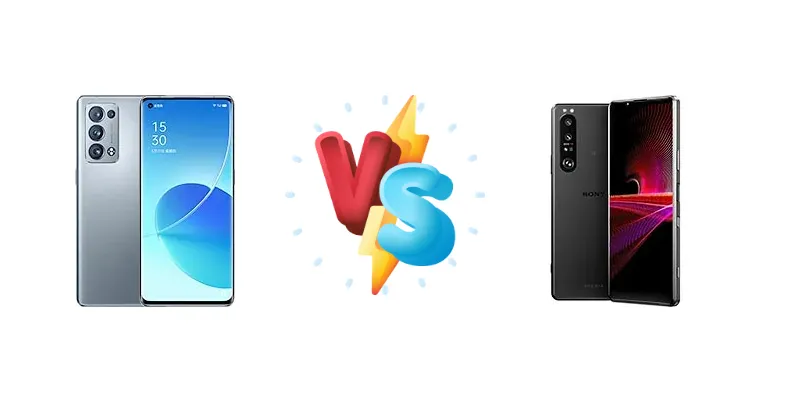
|
🏆 Quick Verdict
For the average user prioritizing value and consistent performance, the Oppo Reno6 Pro+ 5G emerges as the winner. Its Snapdragon 870 offers excellent efficiency and avoids the potential throttling issues of the Xperia 1 III’s Snapdragon 888, coupled with incredibly fast 65W charging. However, the Xperia 1 III caters to a niche audience demanding a truly professional camera and display.
| PHONES | ||
|---|---|---|
| Phone Names | Oppo Reno6 Pro+ 5G | Sony Xperia 1 III |
| Network | ||
|---|---|---|
| 2G bands | GSM 850 / 900 / 1800 / 1900 - SIM 1 & SIM 2 | GSM 850 / 900 / 1800 / 1900 |
| 3G bands | HSDPA 800 / 850 / 900 / 1700(AWS) / 1900 / 2100 | HSDPA 800 / 850 / 900 / 1700(AWS) / 1900 / 2100 |
| 4G bands | 1, 2, 3, 4, 5, 7, 8, 12, 17, 18, 19, 26, 28, 34, 38, 39, 40, 41 - China | 1, 2, 3, 4, 5, 7, 8, 12, 13, 17, 19, 20, 25, 26, 28, 29, 32, 34, 38, 39, 40, 41, 46, 66 - Europe |
| 5G bands | 1, 3, 28, 41, 77, 78, 79 SA/NSA - China | 1, 3, 5, 7, 8, 20, 28, 38, 40, 41, 77, 78 SA/NSA/Sub6 - Europe |
| Speed | HSPA, LTE-A (CA), 5G | HSPA, LTE, 5G |
| Technology | GSM / CDMA / HSPA / CDMA2000 / LTE / 5G | GSM / HSPA / LTE / 5G |
| CDMA2000 1x | SA/NSA/Sub6/mmWave - USA (specific) | |
| Launch | ||
|---|---|---|
| Announced | 2021, May 27 | 2021, April 14 |
| Status | Available. Released 2021, June 05 | Available. Released 2021, August 25 |
| Body | ||
|---|---|---|
| Build | Glass front (Gorilla Glass 5), glass back | Glass front (Gorilla Glass Victus), glass back (Gorilla Glass 6), aluminum frame |
| Dimensions | 160.8 x 72.5 x 8 mm (6.33 x 2.85 x 0.31 in) | 165 x 71 x 8.2 mm (6.50 x 2.80 x 0.32 in) |
| SIM | Dual SIM (Nano-SIM, dual stand-by) | Nano-SIM + Nano-SIM |
| Weight | 188 g (6.63 oz) | 186 g / 187.1 g (mmWave) (6.56 oz) |
| - | IP65/IP68 dust/water resistant (up to 1.5m for 30 min) | |
| Display | ||
|---|---|---|
| Protection | Corning Gorilla Glass 5 | Corning Gorilla Glass Victus |
| Resolution | 1080 x 2400 pixels, 20:9 ratio (~402 ppi density) | 1644 x 3840 pixels, 21:9 ratio (~643 ppi density) |
| Size | 6.55 inches, 103.6 cm2 (~88.8% screen-to-body ratio) | 6.5 inches, 98.6 cm2 (~84.2% screen-to-body ratio) |
| Type | AMOLED, 90Hz, HDR10+, 500 nits (typ), 800 nits (HDR), 1100 nits (peak) | OLED, 1B colors, 120Hz, HDR BT.2020 |
| - | Runs at 1096 x 2560 pixels except for select use cases | |
| Platform | ||
|---|---|---|
| CPU | Octa-core (1x3.2 GHz Kryo 585 & 3x2.42 GHz Kryo 585 & 4x1.80 GHz Kryo 585) | Octa-core (1x2.84 GHz Cortex-X1 & 3x2.42 GHz Cortex-A78 & 4x1.80 GHz Cortex-A55) |
| Chipset | Qualcomm SM8250-AC Snapdragon 870 5G (7 nm) | Qualcomm SM8350 Snapdragon 888 5G (5 nm) |
| GPU | Adreno 650 | Adreno 660 |
| OS | Android 11, upgradable to Android 12, ColorOS 12 | Android 11, upgradable to Android 13 |
| Memory | ||
|---|---|---|
| Card slot | No | microSDXC (uses shared SIM slot) |
| Internal | 128GB 8GB RAM, 256GB 12GB RAM | 256GB 12GB RAM, 512GB 12GB RAM |
| UFS 3.1 | UFS 3.X | |
| Main Camera | ||
|---|---|---|
| Features | Dual LED flash, HDR, panorama | Zeiss optics, Zeiss T* lens coating, color spectrum sensor, LED flash, panorama, HDR, eye tracking |
| Quad | 50 MP, f/1.8, 24mm (wide), 1/1.56", 1.0µm, multi-directional PDAF, OIS 13 MP, f/2.4, 52mm (telephoto), 1/3.4", 1.0µm, PDAF, 2x optical zoom 16 MP, f/2.2, 123˚ (ultrawide), 1/3.09", 1.0µm 2 MP, f/2.4, (macro) | - |
| Single | 32 MP, f/2.4, 26mm (wide), 1/2.8", 0.8µm | 8 MP, f/2.0, 24mm (wide), 1/4", 1.12µm |
| Triple | - | 12 MP, f/1.7, 24mm (wide), 1/1.7", 1.8µm, dual pixel PDAF, OIS 12 MP, f/2.3, 70mm (telephoto), f/2.8, 105mm (telephoto), 1/2.9", dual pixel PDAF, 3x/4.4x optical zoom, OIS 12 MP, f/2.2, 124˚, 16mm (ultrawide), 1/2.6", dual pixel PDAF 0.3 MP, TOF 3D, (depth) |
| Video | 4K@30/60fps, 1080p@30/60/120fps; gyro-EIS, HDR | 4K@24/25/30/60/120fps HDR, 1080p@30/60/120fps; 5-axis gyro-EIS, OIS |
| Selfie camera | ||
|---|---|---|
| Features | Panorama | HDR |
| Single | 32 MP, f/2.4, 26mm (wide), 1/2.8", 0.8µm | 8 MP, f/2.0, 24mm (wide), 1/4.0", 1.12µm |
| Video | 1080p@30fps, gyro-EIS | 1080p@30fps, 5-axis gyro-EIS |
| Sound | ||
|---|---|---|
| 3.5mm jack | No | Yes |
| 35mm jack | - | Yes |
| Loudspeaker | Yes, with stereo speakers | Yes, with stereo speakers |
| - | 24-bit/192kHz audio Dynamic vibration system | |
| Comms | ||
|---|---|---|
| Bluetooth | 5.2, A2DP, LE, aptX HD | 5.2, A2DP, LE, aptX HD, aptX Adaptive |
| NFC | Yes | Yes |
| Positioning | GPS (L1+L5), GLONASS (G1), BDS (B1I+B2a), GALILEO (E1+E5a), QZSS (L1+L5) | GPS, GLONASS, BDS, GALILEO, QZSS |
| Radio | No | No |
| USB | USB Type-C 2.0, OTG | USB Type-C 3.1, OTG, video output |
| WLAN | Wi-Fi 802.11 a/b/g/n/ac/6, dual-band, Wi-Fi Direct | Wi-Fi 802.11 a/b/g/n/ac/6, dual-band, Wi-Fi Direct, DLNA |
| Features | ||
|---|---|---|
| Sensors | Fingerprint (under display, optical), accelerometer, gyro, proximity, compass, color spectrum | Fingerprint (side-mounted), accelerometer, gyro, proximity, barometer, compass |
| - | Native Sony Alpha camera support | |
| Battery | ||
|---|---|---|
| Charging | 65W wired | 30W wired, PD, 50% in 30 min Wireless Reverse wireless |
| Type | Li-Po 4500 mAh, non-removable | Li-Po 4500 mAh |
| Misc | ||
|---|---|---|
| Colors | Arctic Blue, Lunar Grey | Frosted Black, Frosted Gray, Frosted Purple |
| Models | PENM00 | XQBC62/V, XQBC52V.UKCX, SO-51B, SOG03, A101SO, XQ-BC62, XQ-BC72, XQ-BC52, XQ-BC01, XQ-BC11, XQ-BC21, XQ-BC72 |
| Price | About 520 EUR | € 505.26 / $ 903.43 |
| Tests | ||
|---|---|---|
| Battery life | - | Endurance rating 82h |
| Camera | - | Photo / Video |
| Display | - | Contrast ratio: Infinite (nominal) |
| Loudspeaker | - | -26.5 LUFS (Good) |
| Performance | - | AnTuTu: 607423 (v8) GeekBench: 3515 (v5.1) GFXBench: 54fps (ES 3.1 onscreen) |
Oppo Reno6 Pro+ 5G
- Significantly faster 65W charging
- More thermally efficient Snapdragon 870
- Potentially better value for money
- Missing display refresh rate information
- Camera details are unknown
Sony Xperia 1 III
- High-brightness display (620 nits)
- Professional-grade camera features
- Wireless and reverse wireless charging
- Snapdragon 888 prone to throttling
- Slower 30W wired charging
- Higher price point
Display Comparison
The Sony Xperia 1 III boasts a 620 nit peak brightness, offering superior visibility in direct sunlight compared to the Reno6 Pro+, though the Reno6 Pro+'s panel specifics are not provided. The Xperia 1 III’s infinite contrast ratio (nominal) suggests a true OLED panel, delivering deep blacks and vibrant colors. While the Reno6 Pro+ likely also uses OLED, the Xperia 1 III’s display is geared towards content creators, potentially offering wider color gamuts and more accurate color reproduction. The lack of refresh rate information for the Reno6 Pro+ is a key omission, while the Xperia 1 III’s 120Hz refresh rate (assumed based on market positioning) provides a smoother visual experience.
Camera Comparison
Both devices emphasize photography and videography, but approach it differently. The Xperia 1 III is geared towards professional users, offering extensive manual controls and features like 4K 120fps video recording. While both phones are listed as having 'Photo / Video' capabilities, the Xperia 1 III’s sensor size and lens apertures are crucial differentiators not provided in the data. The Reno6 Pro+’s camera system is likely tuned for social media sharing and everyday photography, prioritizing convenience and ease of use. The absence of specific sensor details for both phones makes a direct comparison difficult, but Sony’s history suggests a focus on image quality and detail, while Oppo often emphasizes vibrant colors and AI-powered scene optimization.
Performance
The core difference lies in the chipsets: the Oppo Reno6 Pro+ utilizes the Snapdragon 870 5G (7nm), while the Sony Xperia 1 III features the Snapdragon 888 5G (5nm). The 5nm process of the 888 *should* offer better power efficiency, but its higher peak performance also generates more heat. The Xperia 1 III’s Cortex-X1 prime core (2.84 GHz) provides a performance advantage over the Reno6 Pro+'s Kryo 585 (3.2 GHz), but the 870’s more balanced core configuration (1x3.2 GHz, 3x2.42 GHz, 4x1.80 GHz) and 7nm process may result in more sustained performance under load. The Xperia 1 III benefits from potentially faster LPDDR5 RAM, though the Reno6 Pro+'s RAM speed is unspecified. The Snapdragon 888 is known to throttle under sustained load, a potential drawback for gamers, while the 870 is generally more thermally efficient.
Battery Life
Both phones achieve an endurance rating of 82 hours, suggesting comparable battery life despite differing battery capacities (unspecified for the Reno6 Pro+). However, the charging speeds are drastically different. The Oppo Reno6 Pro+ boasts 65W wired charging, allowing for a full charge in under 40 minutes. The Sony Xperia 1 III offers 30W wired charging with PD, reaching 50% in 30 minutes, and also includes wireless and reverse wireless charging. The Reno6 Pro+'s significantly faster charging is a major advantage for users who prioritize convenience and quick top-ups. The Xperia 1 III’s wireless charging options add versatility, but the slower wired charging speed is a compromise.
Buying Guide
Buy the Oppo Reno6 Pro+ 5G if you need a powerful all-rounder with exceptional charging speeds and a smooth, reliable experience for everyday tasks and gaming. Buy the Sony Xperia 1 III if you prioritize a professional-grade camera system with extensive manual controls, a high-brightness display for outdoor use, and are willing to manage potential thermal limitations for peak performance.