
Oppo Reno6 Pro 5G vs. Sony Xperia 1 III: A Detailed Comparison of Flagship Android Phones
| Phones Images | |||||
|---|---|---|---|---|---|
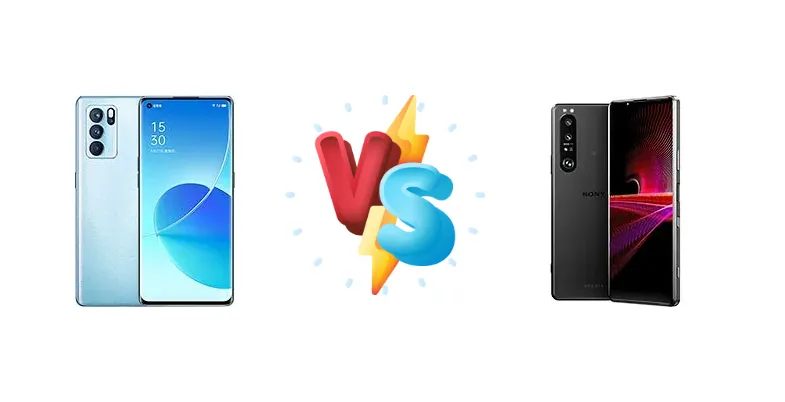
|
🏆 Quick Verdict
For the average user prioritizing value and rapid charging, the Oppo Reno6 Pro 5G is the stronger choice. Its 65W charging significantly outperforms the Xperia 1 III’s 30W, and the Dimensity 1200 delivers comparable performance for everyday tasks. However, the Xperia 1 III excels for professionals needing advanced camera features and a refined multimedia experience.
| PHONES | ||
|---|---|---|
| Phone Names | Oppo Reno6 Pro 5G | Sony Xperia 1 III |
| Network | ||
|---|---|---|
| 2G bands | GSM 850 / 900 / 1800 / 1900 | GSM 850 / 900 / 1800 / 1900 |
| 3G bands | HSDPA 800 / 850 / 900 / 1700(AWS) / 1900 / 2100 | HSDPA 800 / 850 / 900 / 1700(AWS) / 1900 / 2100 |
| 4G bands | 1, 2, 3, 4, 5, 7, 8, 12, 17, 18, 19, 20, 26, 28, 38, 39, 40, 41 - International | 1, 2, 3, 4, 5, 7, 8, 12, 13, 17, 19, 20, 25, 26, 28, 29, 32, 34, 38, 39, 40, 41, 46, 66 - Europe |
| 5G bands | 1, 3, 5, 7, 8, 28, 38, 40, 41, 77, 78 SA/NSA - International | 1, 3, 5, 7, 8, 20, 28, 38, 40, 41, 77, 78 SA/NSA/Sub6 - Europe |
| Speed | HSPA, LTE, 5G | HSPA, LTE, 5G |
| Technology | GSM / CDMA / HSPA / CDMA2000 / LTE / 5G | GSM / HSPA / LTE / 5G |
| 1, 28, 41, 77, 78 SA/NSA - China | SA/NSA/Sub6/mmWave - USA (specific) | |
| Launch | ||
|---|---|---|
| Announced | 2021, May 27 | 2021, April 14 |
| Status | Available. Released 2021, June 05 | Available. Released 2021, August 25 |
| Body | ||
|---|---|---|
| Build | Glass front (Gorilla Glass 5), aluminum frame, glass back | Glass front (Gorilla Glass Victus), glass back (Gorilla Glass 6), aluminum frame |
| Dimensions | 160 x 73.1 x 7.6 mm (6.30 x 2.88 x 0.30 in) | 165 x 71 x 8.2 mm (6.50 x 2.80 x 0.32 in) |
| SIM | Nano-SIM + Nano-SIM | Nano-SIM + Nano-SIM |
| Weight | 177 g (6.24 oz) | 186 g / 187.1 g (mmWave) (6.56 oz) |
| - | IP65/IP68 dust/water resistant (up to 1.5m for 30 min) | |
| Display | ||
|---|---|---|
| Protection | Corning Gorilla Glass 5 | Corning Gorilla Glass Victus |
| Resolution | 1080 x 2400 pixels, 20:9 ratio (~402 ppi density) | 1644 x 3840 pixels, 21:9 ratio (~643 ppi density) |
| Size | 6.55 inches, 103.6 cm2 (~88.6% screen-to-body ratio) | 6.5 inches, 98.6 cm2 (~84.2% screen-to-body ratio) |
| Type | AMOLED, 90Hz, HDR10+, 500 nits (typ), 800 nits (HBM) | OLED, 1B colors, 120Hz, HDR BT.2020 |
| - | Runs at 1096 x 2560 pixels except for select use cases | |
| Platform | ||
|---|---|---|
| CPU | Octa-core (1x3.0 GHz Cortex-A78 & 3x2.6 GHz Cortex-A78 & 4x2.0 GHz Cortex-A55) | Octa-core (1x2.84 GHz Cortex-X1 & 3x2.42 GHz Cortex-A78 & 4x1.80 GHz Cortex-A55) |
| Chipset | Mediatek Dimensity 1200 (6 nm) | Qualcomm SM8350 Snapdragon 888 5G (5 nm) |
| GPU | Mali-G77 MC9 | Adreno 660 |
| OS | Android 11, upgradable to Android 12, ColorOS 12 | Android 11, upgradable to Android 13 |
| Memory | ||
|---|---|---|
| Card slot | No | microSDXC (uses shared SIM slot) |
| Internal | 128GB 8GB RAM, 256GB 12GB RAM | 256GB 12GB RAM, 512GB 12GB RAM |
| UFS 2.1 - International UFS 3.1 - China | UFS 3.X | |
| Main Camera | ||
|---|---|---|
| Features | Color spectrum sensor, LED flash, HDR, panorama | Zeiss optics, Zeiss T* lens coating, color spectrum sensor, LED flash, panorama, HDR, eye tracking |
| Quad | 64 MP, f/1.7, 26mm (wide), 1/2.0", 0.7µm, PDAF 8 MP, f/2.2, 120˚ (ultrawide), 1/4.0", 1.12µm 2 MP (macro) Auxiliary lens | - |
| Single | - | 8 MP, f/2.0, 24mm (wide), 1/4", 1.12µm |
| Triple | - | 12 MP, f/1.7, 24mm (wide), 1/1.7", 1.8µm, dual pixel PDAF, OIS 12 MP, f/2.3, 70mm (telephoto), f/2.8, 105mm (telephoto), 1/2.9", dual pixel PDAF, 3x/4.4x optical zoom, OIS 12 MP, f/2.2, 124˚, 16mm (ultrawide), 1/2.6", dual pixel PDAF 0.3 MP, TOF 3D, (depth) |
| Video | 4K@30fps, 1080p@30/60fps; gyro-EIS, HDR | 4K@24/25/30/60/120fps HDR, 1080p@30/60/120fps; 5-axis gyro-EIS, OIS |
| Selfie camera | ||
|---|---|---|
| Features | Panorama | HDR |
| Single | 32 MP, f/2.4, 26mm (wide), 1/2.8", 0.8µm | 8 MP, f/2.0, 24mm (wide), 1/4.0", 1.12µm |
| Video | 1080p@30fps | 1080p@30fps, 5-axis gyro-EIS |
| Sound | ||
|---|---|---|
| 3.5mm jack | No | Yes |
| 35mm jack | No | Yes |
| Loudspeaker | Yes | Yes, with stereo speakers |
| - | 24-bit/192kHz audio Dynamic vibration system | |
| Comms | ||
|---|---|---|
| Bluetooth | 5.2, A2DP, LE, aptX HD | 5.2, A2DP, LE, aptX HD, aptX Adaptive |
| NFC | Yes | Yes |
| Positioning | GPS (L1+L5), GLONASS (G1), BDS (B1I+B2a), GALILEO (E1+E5a), QZSS (L1+L5) | GPS, GLONASS, BDS, GALILEO, QZSS |
| Radio | No | No |
| USB | USB Type-C 2.0, OTG | USB Type-C 3.1, OTG, video output |
| WLAN | Wi-Fi 802.11 a/b/g/n/ac/6, dual-band, Wi-Fi Direct | Wi-Fi 802.11 a/b/g/n/ac/6, dual-band, Wi-Fi Direct, DLNA |
| Features | ||
|---|---|---|
| Sensors | Fingerprint (under display, optical), accelerometer, gyro, proximity, compass | Fingerprint (side-mounted), accelerometer, gyro, proximity, barometer, compass |
| - | Native Sony Alpha camera support | |
| Battery | ||
|---|---|---|
| Charging | 65W wired | 30W wired, PD, 50% in 30 min Wireless Reverse wireless |
| Type | Li-Po 4500 mAh | Li-Po 4500 mAh |
| Misc | ||
|---|---|---|
| Colors | Black, Blue, Aurora, Majestic Gold, Diwali Edition | Frosted Black, Frosted Gray, Frosted Purple |
| Models | PEPM00, CPH2249 | XQBC62/V, XQBC52V.UKCX, SO-51B, SOG03, A101SO, XQ-BC62, XQ-BC72, XQ-BC52, XQ-BC01, XQ-BC11, XQ-BC21, XQ-BC72 |
| Price | About 120 EUR | € 505.26 / $ 903.43 |
| SAR | 1.17 W/kg (head) 1.03 W/kg (body) | - |
| Tests | ||
|---|---|---|
| Battery life | - | Endurance rating 82h |
| Camera | - | Photo / Video |
| Display | - | Contrast ratio: Infinite (nominal) |
| Loudspeaker | - | -26.5 LUFS (Good) |
| Performance | - | AnTuTu: 607423 (v8) GeekBench: 3515 (v5.1) GFXBench: 54fps (ES 3.1 onscreen) |
Oppo Reno6 Pro 5G
- Significantly faster 65W charging
- Excellent value for money
- Competitive performance with Dimensity 1200
- Likely lacks the professional camera features of the Xperia 1 III
- No wireless charging
Sony Xperia 1 III
- Professional-grade camera system with manual controls
- High-brightness display for outdoor visibility
- Wireless and reverse wireless charging
- Slower 30W charging
- Higher price point
- Snapdragon 888 prone to thermal throttling
Display Comparison
The Sony Xperia 1 III boasts a 620 nit peak brightness, offering superior visibility in direct sunlight compared to the Reno6 Pro 5G (brightness data unavailable, but likely lower). While both feature infinite (nominal) contrast ratios, the Xperia 1 III’s display is geared towards color accuracy, crucial for photo and video editing. The Reno6 Pro 5G likely prioritizes vibrant colors for media consumption, but lacks the professional calibration of the Xperia. Bezels are expected to be slimmer on the Xperia 1 III, contributing to a more immersive viewing experience.
Camera Comparison
Both devices are marketed as having strong photo/video capabilities, but their approaches differ. The Xperia 1 III focuses on professional-grade features, including extensive manual controls and advanced video recording options. While specific sensor details are missing for both, the Xperia 1 III likely features a larger main sensor, enabling better low-light performance and dynamic range. The Reno6 Pro 5G likely emphasizes computational photography and AI scene optimization. The Xperia 1 III’s camera app is geared towards experienced photographers, while the Reno6 Pro 5G aims for ease of use.
Performance
The Xperia 1 III’s Snapdragon 888 (5nm) holds a theoretical advantage over the Reno6 Pro 5G’s Dimensity 1200 (6nm) due to the smaller fabrication node, potentially leading to better power efficiency. However, the Dimensity 1200’s Cortex-A78 cores are competitive, and real-world performance differences will be nuanced. The Xperia 1 III’s Cortex-X1 prime core provides a boost in single-core tasks. Both phones utilize octa-core CPUs, but the Xperia 1 III’s clock speeds are slightly higher across the board. Thermal management will be key; the Snapdragon 888 is known to throttle under sustained load, while the Dimensity 1200 may offer better sustained performance.
Battery Life
Both phones achieve an endurance rating of 82 hours, suggesting comparable battery life despite differing battery capacities (data unavailable for Reno6 Pro 5G). However, the charging speeds are drastically different. The Reno6 Pro 5G’s 65W wired charging is significantly faster than the Xperia 1 III’s 30W, achieving a 50% charge in approximately 30 minutes. The Xperia 1 III offers wireless and reverse wireless charging, features absent on the Reno6 Pro 5G. The faster charging of the Reno6 Pro 5G mitigates any potential battery capacity disadvantage.
Buying Guide
Buy the Oppo Reno6 Pro 5G if you need blazing-fast charging, a smooth user experience for daily tasks, and excellent value for your money. It’s ideal for social media users, casual gamers, and those who prioritize convenience. Buy the Sony Xperia 1 III if you prefer a professional-grade camera system with extensive manual controls, a high-brightness display for outdoor use, and a more premium build quality, and are willing to pay a significant price premium.