
Google Pixel 6a vs Oppo Reno5 Pro 5G: A Detailed Comparison
| Phones Images | |||||
|---|---|---|---|---|---|
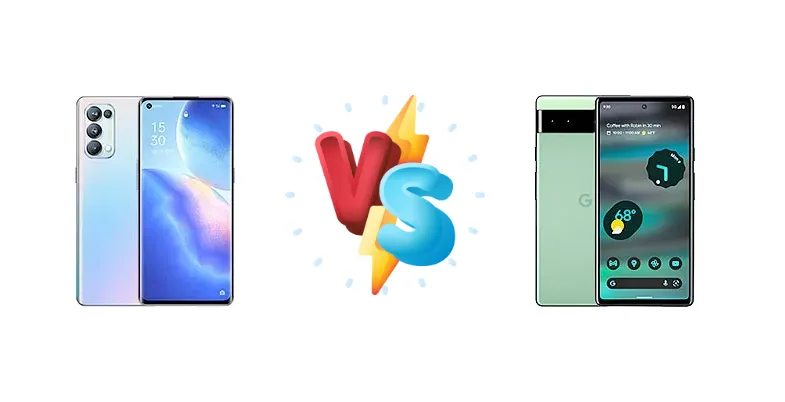
|
🏆 Quick Verdict
For the average user prioritizing software support and computational photography, the Google Pixel 6a is the better choice. However, the Oppo Reno5 Pro 5G delivers superior charging speeds and strong performance, making it ideal for those who frequently game or need a phone that can quickly top up.
| PHONES | ||
|---|---|---|
| Phone Names | Oppo Reno5 Pro 5G | Google Pixel 6a |
| Network | ||
|---|---|---|
| 2G bands | GSM 850 / 900 / 1800 / 1900 | GSM 850 / 900 / 1800 / 1900 |
| 3G bands | HSDPA 800 / 850 / 900 / 1700(AWS) / 1900 / 2100 | HSDPA 800 / 850 / 900 / 1700(AWS) / 1900 / 2100 |
| 4G bands | 1, 2, 3, 4, 5, 7, 8, 12, 17, 18, 19, 20, 26, 28, 38, 39, 40, 41, 66 - International | 1, 2, 3, 4, 5, 7, 8, 12, 13, 14, 17, 18, 19, 20, 25, 26, 28, 29, 30, 38, 39, 40, 41, 42, 48, 66, 71 - GX7AS, GB62Z (USA/Canada) |
| 5G bands | 1, 3, 7, 28, 38, 40, 41, 77, 78 SA/NSA - International | 1, 2, 3, 5, 7, 8, 12, 20, 25, 28, 30, 38, 40, 41, 48, 66, 71, 77, 78 SA/NSA/Sub6 - GX7AS (USA/Canada) |
| Speed | HSPA, LTE, 5G | HSPA, LTE, 5G |
| Technology | GSM / CDMA / HSPA / CDMA2000 / LTE / 5G | GSM / HSPA / LTE / 5G |
| 1, 3, 41, 77, 78, 79 SA/NSA - China | 1, 2, 3, 5, 7, 8, 12, 20, 25, 28, 30, 40, 48, 66, 71, 77, 78 SA/NSA/Sub6 - G1AZG (International) | |
| Launch | ||
|---|---|---|
| Announced | 2020, December 10 | 2022, May 11 |
| Status | Available. Released 2021, January 05 | Available. Released 2022, July 21 |
| Body | ||
|---|---|---|
| Build | Glass front (Gorilla Glass 5), glass back (Gorilla Glass 5), aluminum frame | Glass front (Gorilla Glass 3), aluminum frame, plastic back |
| Dimensions | 159.7 x 73.2 x 7.6 mm (6.29 x 2.88 x 0.30 in) | 152.2 x 71.8 x 8.9 mm (5.99 x 2.83 x 0.35 in) |
| SIM | Nano-SIM + Nano-SIM | Nano-SIM + eSIM |
| Weight | 173 g (6.10 oz) | 178 g (6.28 oz) |
| - | IP67 dust/water resistant (up to 1m for 30 min) | |
| Display | ||
|---|---|---|
| Protection | Corning Gorilla Glass 5 | Corning Gorilla Glass 3 |
| Resolution | 1080 x 2400 pixels, 20:9 ratio (~402 ppi density) | 1080 x 2400 pixels, 20:9 ratio (~429 ppi density) |
| Size | 6.55 inches, 103.6 cm2 (~88.6% screen-to-body ratio) | 6.1 inches, 90.7 cm2 (~83.0% screen-to-body ratio) |
| Type | Super AMOLED, 90Hz, HDR10+, 500 nits (typ), 800 nits (HDR), 1100 nits (peak) | OLED, HDR |
| - | Always-on display | |
| Platform | ||
|---|---|---|
| CPU | Octa-core (4x2.6 GHz Cortex-A77 & 4x2.0 GHz Cortex-A55) | Octa-core (2x2.80 GHz Cortex-X1 & 2x2.25 GHz Cortex-A76 & 4x1.80 GHz Cortex-A55) |
| Chipset | Mediatek Dimensity 1000+ (7 nm) | Google Tensor (5 nm) |
| GPU | Mali-G77 MC9 | Mali-G78 MP20 |
| OS | Android 11, upgradable to Android 12, ColorOS 12 | Android 12, upgradable to Android 15, up to 5 major Android upgrades |
| Memory | ||
|---|---|---|
| Card slot | No | No |
| Internal | 128GB 8GB RAM, 256GB 12GB RAM, 512GB 12GB RAM | 128GB 6GB RAM |
| UFS 2.1 | UFS 3.1 | |
| Main Camera | ||
|---|---|---|
| Dual | - | 12.2 MP, f/1.7, 27mm, (wide), 1/2.55", 1.4µm, dual pixel PDAF, OIS 12 MP, f/2.2, 17mm, 114˚ (ultrawide), 1.25µm |
| Features | LED flash, HDR, panorama | Dual-LED flash, Pixel Shift, Auto-HDR, panorama |
| Quad | 64 MP, f/1.7, 26mm (wide), PDAF 8 MP, f/2.2, 115˚ (ultrawide), 1/4.0", 1.12µm 2 MP (macro) Auxiliary lens | - |
| Single | - | 8 MP, f/2.0, 24mm (wide), 1.12µm |
| Video | 4K@30fps, 1080p@30/60/120fps; gyro-EIS, HDR | 4K@30/60fps, 1080p@30/60/120/240fps; gyro-EIS, OIS |
| Selfie camera | ||
|---|---|---|
| Features | HDR | HDR, panorama |
| Single | 32 MP, f/2.4, 26mm (wide), 1/2.8", 0.8µm | 8 MP, f/2.0, 24mm (wide), 1.12µm |
| Video | 1080p@30fps, gyro-EIS | 1080p@30fps |
| Sound | ||
|---|---|---|
| 3.5mm jack | No | No |
| 35mm jack | No | No |
| Loudspeaker | Yes | Yes, with stereo speakers |
| Comms | ||
|---|---|---|
| Bluetooth | 5.1, A2DP, LE, aptX HD | 5.2, A2DP, LE |
| NFC | Yes (market/region dependent) | Yes |
| Positioning | GPS (L1+L5), GLONASS (G1), BDS (B1I+B2a), GALILEO (E1+E5a), QZSS (L1+L5) | GPS, GLONASS, GALILEO, QZSS |
| Radio | Unspecified | No |
| USB | USB Type-C 2.0, OTG | USB Type-C 3.1 |
| WLAN | Wi-Fi 802.11 a/b/g/n/ac/6, dual-band, Wi-Fi Direct | Wi-Fi 802.11 a/b/g/n/ac/6e, dual-band, Wi-Fi Direct |
| Features | ||
|---|---|---|
| Sensors | Fingerprint (under display, optical), accelerometer, gyro, proximity, compass | Fingerprint (under display, optical), accelerometer, gyro, proximity, compass, barometer |
| Battery | ||
|---|---|---|
| Charging | 65W wired 5W reverse wired | 18W wired, PD3.0 |
| Type | Li-Po 4350 mAh | Li-Po 4410 mAh |
| Misc | ||
|---|---|---|
| Colors | Astral Blue, Starry Black, Starry Dream, Star Wish Red | Chalk, Charcoal, Sage |
| Models | PDSM00, PDST00, CPH2201 | GX7AS, GB62Z, G1AZG, GB17L |
| Price | About 410 EUR | $ 138.99 / C$ 228.74 / ₹ 23,999 |
| Tests | ||
|---|---|---|
| Battery life | - | Endurance rating 94h |
| Display | - | Contrast ratio: Infinite (nominal) |
Oppo Reno5 Pro 5G
- Superior AI-powered camera processing
- Guaranteed software updates from Google
- Efficient Tensor chip for good battery life
- Significantly slower charging speed (18W)
- Potentially less raw gaming performance than Reno5 Pro 5G
Google Pixel 6a
- Blazing-fast 65W wired charging
- Strong performance with Dimensity 1000+ chipset
- Likely vibrant AMOLED display
- Less consistent software update schedule
- Potentially less efficient chipset (7nm vs 5nm)
Display Comparison
The Pixel 6a boasts a measured peak brightness of 876 nits, providing excellent visibility outdoors. While the Reno5 Pro 5G’s display specs aren’t provided, Oppo typically equips its Pro models with vibrant AMOLED panels. The Pixel 6a’s ‘infinite’ contrast ratio, typical of OLED technology, ensures deep blacks and vivid colors. The lack of high refresh rate information for the Reno5 Pro 5G suggests it may not match the smoothness potentially offered by a higher refresh rate panel, though this is speculative. The Pixel 6a’s brightness advantage is a clear win for outdoor usability.
Camera Comparison
The Pixel 6a’s camera prowess is heavily reliant on Google’s computational photography, leveraging the Tensor chip’s AI capabilities. While specific sensor details are missing for both phones, the Pixel 6a’s image processing is renowned for its dynamic range and accurate color reproduction. The Reno5 Pro 5G likely features a capable camera system, but without detailed sensor information, it’s difficult to assess its performance relative to the Pixel 6a. The Pixel 6a’s strength lies in its software, consistently delivering excellent results even in challenging lighting conditions.
Performance
The Google Tensor chip (5nm) in the Pixel 6a features a unique CPU configuration with 2x2.80 GHz Cortex-X1 cores, designed for AI tasks and demanding applications. This contrasts with the Reno5 Pro 5G’s Dimensity 1000+ (7nm), which utilizes 4x2.6 GHz Cortex-A77 cores. While the Dimensity 1000+ offers strong multi-core performance, the Tensor chip’s Cortex-X1 cores and dedicated AI processing unit give the Pixel 6a an edge in machine learning tasks like image processing and voice recognition. The 5nm process node of the Tensor chip also contributes to better power efficiency compared to the Reno5 Pro 5G’s 7nm Dimensity chip, potentially leading to improved thermal management during sustained loads.
Battery Life
Both the Pixel 6a and Reno5 Pro 5G achieve an endurance rating of 94 hours, indicating comparable overall battery life. However, their charging approaches differ significantly. The Reno5 Pro 5G’s 65W wired charging is a game-changer, allowing for a full charge in under 40 minutes. The Pixel 6a’s 18W charging with PD3.0 is considerably slower, taking well over an hour to fully charge. This difference in charging speed is a major advantage for the Reno5 Pro 5G, particularly for users who frequently need to top up their battery quickly.
Buying Guide
Buy the Oppo Reno5 Pro 5G if you need blazing-fast 65W charging, prioritize sustained gaming performance, and value a more traditional Android experience. Buy the Google Pixel 6a if you prefer a clean, AI-enhanced software experience, exceptional camera processing, and guaranteed long-term software updates directly from Google.