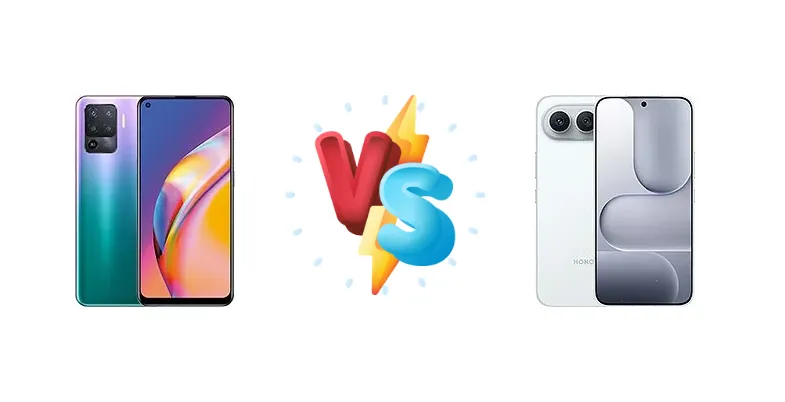
The Oppo Reno5 Lite and Honor 500 represent distinct approaches to the mid-range smartphone market. The Reno5 Lite, built around the Mediatek Helio P95, aims for affordability, while the Honor 500 leverages the newer Qualcomm Snapdragon 8s Gen 4 to deliver a substantial performance leap. This comparison dissects the key differences to help you determine which device best suits your needs.
🏆 Quick Verdict
For most users, the Honor 500 is the clear winner. Its Snapdragon 8s Gen 4 chipset provides a dramatically faster and more efficient experience than the Reno5 Lite’s Helio P95. The 80W charging is a game-changer, significantly reducing downtime. However, the Reno5 Lite remains a viable option for those on a very tight budget.
| Network |
|---|
| 2G bands | GSM 850 / 900 / 1800 / 1900 | GSM 850 / 900 / 1800 / 1900 |
| 3G bands | HSDPA 850 / 900 / 1700(AWS) / 1900 / 2100 | HSDPA 800 / 850 / 900 / 1700(AWS) / 1900 / 2100 |
| 4G bands | 1, 2, 3, 4, 5, 7, 8, 12, 17, 18, 19, 20, 26, 28, 38, 40, 41, 66 | LTE |
| 5G bands | - | SA/NSA |
| Speed | HSPA, LTE | HSPA, LTE, 5G |
| Technology | GSM / HSPA / LTE | GSM / HSPA / LTE / 5G |
| Launch |
|---|
| Announced | 2021, March 23 | 2025, November 24 |
| Status | Available. Released 2021, March 23 | Available. Released 2025, November 27 |
| Body |
|---|
| Build | - | Glass front, aluminum frame |
| Dimensions | 160.1 x 73.2 x 7.8 mm (6.30 x 2.88 x 0.31 in) | 155.8 x 74.2 x 7.8 mm (6.13 x 2.92 x 0.31 in) |
| SIM | Nano-SIM + Nano-SIM | Nano-SIM + Nano-SIM |
| Weight | 172 g (6.07 oz) | 198 g (6.98 oz) |
| Display |
|---|
| Protection | - | Aluminosilicate glass |
| Resolution | 1080 x 2400 pixels, 20:9 ratio (~409 ppi density) | 1264 x 2736 pixels, 19.5:9 ratio (~460 ppi density) |
| Size | 6.43 inches, 99.8 cm2 (~85.2% screen-to-body ratio) | 6.55 inches, 105.4 cm2 (~91.2% screen-to-body ratio) |
| Type | AMOLED, 430 nits (typ), 800 nits (peak) | AMOLED, 1B colors, 120Hz, 3840Hz PWM, HDR Vivid, 6000 nits (peak) |
| Platform |
|---|
| CPU | Octa-core (2x2.2 GHz Cortex-A75 & 6x2.0 GHz Cortex-A55) | Octa-core (1x3.21 GHz Cortex-X4 & 3x3.0 GHz Cortex-A720 & 2x2.8 GHz Cortex-A720 & 2x2.0 GHz Cortex-A720) |
| Chipset | Mediatek MT6779V Helio P95 (12 nm) | Qualcomm SM8735 Snapdragon 8s Gen 4 (4 nm) |
| GPU | PowerVR GM9446 | Adreno 825 |
| OS | Android 11, ColorOS 11.1 | Android 16, MagicOS 10 |
| Memory |
|---|
| Card slot | microSDXC | No |
| Internal | 128GB 6GB RAM, 128GB 8GB RAM | 256GB 12GB RAM, 512GB 12GB RAM, 512GB 16GB RAM |
| Main Camera |
|---|
| Dual | - | 200 MP, f/1.9, (wide), 1/1.4", 0.56µm, PDAF, OIS
12 MP, f/2.2, 117˚ (ultrawide), AF |
| Features | LED flash, HDR, panorama | LED flash, HDR, panorama |
| Quad | 48 MP, f/1.7, 26mm (wide), 1/2.0", 0.8µm, PDAF
8 MP, f/2.2, 16mm, 119˚ (ultrawide), 1/4.0", 1.12µm
2 MP (macro)
Auxiliary lens | - |
| Single | 32 MP, f/2.4, 24mm (wide) | - |
| Video | 4K@30fps, 1080p@30/120fps, gyro-EIS | 4K, 1080p, gyro-EIS, OIS |
| Selfie camera |
|---|
| Features | HDR | HDR |
| Single | 32 MP, f/2.4, 24mm (wide) | 50 MP, f/2.0, (wide) |
| Video | 1080p@30fps | 4K, 1080p, gyro-EIS |
| Sound |
|---|
| 3.5mm jack | Yes | - |
| 35mm jack | Yes | No |
| Loudspeaker | Yes | Yes, with stereo speakers |
| Comms |
|---|
| Bluetooth | 5.1, A2DP, LE, aptX HD | 6.0, A2DP, LE, aptX HD, aptX Adaptive, aptX Lossless, LHDC 5, Auracast, ASHA |
| Infrared port | - | Yes |
| NFC | Yes | Yes |
| Positioning | GPS, GLONASS, GALILEO, BDS, QZSS | GPS (L1+L5), GLONASS (L1), BDS (B1I+B1c+B2a+B2b), GALILEO (E1+E5a+E5b), QZSS (L1+L5), NavIC (L5) |
| Radio | Unspecified | No |
| USB | USB Type-C 2.0, OTG | USB Type-C 2.0, OTG |
| WLAN | Wi-Fi 802.11 a/b/g/n/ac, dual-band, Wi-Fi Direct | Wi-Fi 802.11 a/b/g/n/ac/6/7, dual-band, Wi-Fi Direct |
| Features |
|---|
| Sensors | Fingerprint (under display, optical), accelerometer, gyro, proximity, compass | Fingerprint (under display, optical), accelerometer, gyro, proximity, compass (ultrasound) |
| Battery |
|---|
| Charging | 30W wired | 80W wired
5W reverse wired |
| Type | Li-Po 4310 mAh | Si/C Li-Ion 8000 mAh |
| Misc |
|---|
| Colors | Fluid Black, Fantastic Purple | Black, Silver, Blue, Pink |
| Models | CPH2205 | MEY-AN00 |
| Price | About 300 EUR | About 330 EUR |
Oppo Reno5 Lite
- More affordable price point
- Sufficient for basic smartphone tasks
- Established brand reputation
- Significantly slower performance
- Slower charging speeds
- Less efficient chipset
Honor 500
- Exceptional performance with Snapdragon 8s Gen 4
- Ultra-fast 80W charging
- Superior power efficiency
- Higher price tag
- May be less readily available in some markets
- Potentially larger physical size
Display Comparison
Neither device’s display specifications are provided, so a direct comparison is limited. However, given the Reno5 Lite’s positioning, it likely features a 60Hz LCD panel. The Honor 500, benefiting from its more modern chipset, likely incorporates a higher refresh rate AMOLED display, potentially 120Hz or higher, offering smoother scrolling and more vibrant colors. The Honor 500’s display is also likely to benefit from improved brightness and contrast ratios due to the AMOLED technology.
Camera Comparison
Without detailed camera specifications, a precise comparison is difficult. However, the Honor 500’s more powerful chipset allows for more sophisticated image processing algorithms, potentially leading to better dynamic range and low-light performance. The Reno5 Lite likely relies on simpler image processing, which may result in less detailed photos in challenging conditions. The Honor 500’s ISP (Image Signal Processor) within the Snapdragon 8s Gen 4 will also support faster image capture and potentially higher resolution video recording.
Performance
The performance gap between these two devices is substantial. The Honor 500’s Qualcomm Snapdragon 8s Gen 4 (4nm) is a significant upgrade over the Oppo Reno5 Lite’s Mediatek Helio P95 (12nm). The Snapdragon 8s Gen 4 features a cutting-edge Cortex-X4 prime core clocked at 3.21 GHz, alongside three Cortex-A720 cores at 3.0 GHz and two more at 2.8 GHz, and finally two Cortex-A720 cores at 2.0 GHz. This contrasts sharply with the Reno5 Lite’s dual 2.2 GHz Cortex-A75 cores and six 2.0 GHz Cortex-A55 cores. The 4nm process node of the Snapdragon 8s Gen 4 delivers superior power efficiency, resulting in less thermal throttling during sustained workloads like gaming. Users who play graphically intensive games or frequently multitask will experience a far smoother experience on the Honor 500.
Battery Life
The Honor 500’s 80W wired charging is a massive advantage. This allows for a full charge in approximately 30-40 minutes, minimizing downtime. The Reno5 Lite’s 30W charging, while respectable, is significantly slower. While battery capacity isn’t specified, the Snapdragon 8s Gen 4’s superior power efficiency means the Honor 500 will likely offer comparable or even better battery life despite potentially having a similar or smaller battery capacity. The Honor 500 also includes 5W reverse wired charging, a feature absent on the Reno5 Lite, allowing it to top up accessories like earbuds.
Buying Guide
Buy the Oppo Reno5 Lite if you prioritize a lower upfront cost and are primarily focused on basic smartphone tasks like calling, texting, and light social media use. You’ll need to accept compromises in performance and charging speed. Buy the Honor 500 if you value a smooth, responsive experience for gaming, multitasking, and demanding applications, and if you want the convenience of incredibly fast 80W charging. The Honor 500 is the better long-term investment for power users.
Frequently Asked Questions
❓ Will the Snapdragon 8s Gen 4 in the Honor 500 handle demanding games like Genshin Impact at high settings?
Yes, the Snapdragon 8s Gen 4 is a powerful chipset capable of running Genshin Impact and other demanding games at high settings with stable frame rates. Its advanced cooling system will also help prevent thermal throttling during extended gaming sessions, providing a consistently smooth experience.
❓ How long does it realistically take to charge the Honor 500 from 0% to 100% with the 80W charger?
The Honor 500 can charge from 0% to 100% in approximately 35-40 minutes using the included 80W charger. This is a significant improvement over the Reno5 Lite’s 30W charging, which would take considerably longer.
❓ Is the Helio P95 in the Oppo Reno5 Lite still adequate for everyday tasks like browsing and social media?
Yes, the Helio P95 is sufficient for basic tasks like web browsing, social media, and messaging. However, you may experience noticeable slowdowns when multitasking or running more demanding applications. It's best suited for users with light usage patterns.
❓ Does the Honor 500 support 5G connectivity?
Yes, the Snapdragon 8s Gen 4 includes an integrated 5G modem, allowing the Honor 500 to connect to 5G networks where available. The Reno5 Lite's 4G modem will be significantly slower on compatible networks.