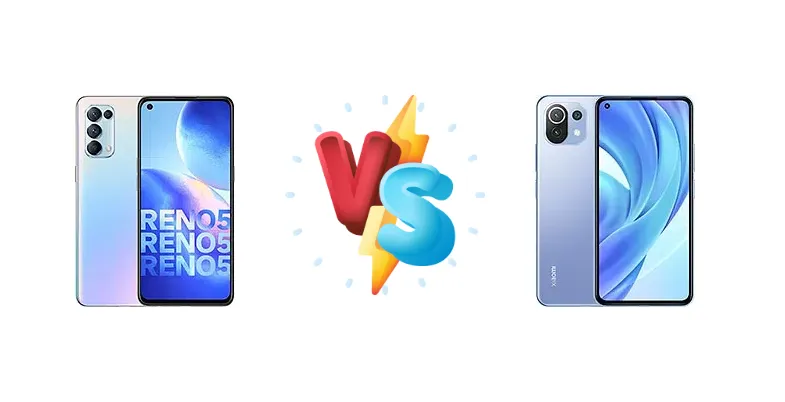
The Oppo Reno5 4G and Xiaomi Mi 11 Lite represent compelling options in the increasingly competitive mid-range smartphone market. Both devices leverage Qualcomm's Snapdragon 7-series chipsets, aiming for a balance of performance and efficiency. However, key differences in display technology, charging capabilities, and subtle processor variations create distinct user experiences, making a direct comparison crucial for informed buyers.
🏆 Quick Verdict
For the average user prioritizing rapid charging and a slightly more streamlined software experience, the Oppo Reno5 4G emerges as the winner. Its 50W charging significantly outperforms the Mi 11 Lite's 33W, reducing downtime. However, the Mi 11 Lite’s brighter display is a strong counterpoint for media consumers.
| Network |
|---|
| 2G bands | GSM 850 / 900 / 1800 / 1900 | GSM 850 / 900 / 1800 / 1900 |
| 3G bands | HSDPA 850 / 900 / 2100 | HSDPA 850 / 900 / 1700(AWS) / 1900 / 2100 |
| 4G bands | 1, 3, 5, 7, 8, 38, 40, 41 | 1, 2, 3, 4, 5, 7, 8, 12, 17, 20, 28, 32, 38, 40, 41, 66 |
| Speed | HSPA, LTE | HSPA, LTE |
| Technology | GSM / HSPA / LTE | GSM / HSPA / LTE |
| | 1, 3, 5, 7, 8, 20, 28, 38, 40, 41 | - |
| Launch |
|---|
| Announced | 2020, December 31 | 2021, March 29 |
| Status | Available. Released 2021, January 09 | Available. Released 2021, April 16 |
| Body |
|---|
| Dimensions | 159.1 x 73.3 x 7.7 mm (6.26 x 2.89 x 0.30 in) | 160.5 x 75.7 x 6.8 mm (6.32 x 2.98 x 0.27 in) |
| SIM | Nano-SIM + Nano-SIM | Nano-SIM + Nano-SIM |
| Weight | 171 g (6.03 oz) | 157 g (5.54 oz) |
| | - | IP53, dust and splash resistant |
| Display |
|---|
| Protection | Corning Gorilla Glass 3 | Corning Gorilla Glass 5 |
| Resolution | 1080 x 2400 pixels, 20:9 ratio (~411 ppi density) | 1080 x 2400 pixels, 20:9 ratio (~402 ppi density) |
| Size | 6.4 inches, 98.9 cm2 (~84.8% screen-to-body ratio) | 6.55 inches, 103.6 cm2 (~85.3% screen-to-body ratio) |
| Type | AMOLED, 90Hz, 430 nits (typ), 600 nits (peak) | AMOLED, 1B colors, HDR10, 90Hz, 500 nits (typ), 800 nits |
| Platform |
|---|
| CPU | Octa-core (2x2.3 GHz Kryo 465 Gold & 6x1.8 GHz Kryo 465 Silver) | Octa-core (2x2.3 GHz Kryo 470 Gold & 6x1.8 GHz Kryo 470 Silver) |
| Chipset | Qualcomm SM7125 Snapdragon 720G (8 nm) | Qualcomm SM7150 Snapdragon 732G (8 nm) |
| GPU | Adreno 618 | Adreno 618 |
| OS | Android 11, upgradable to Android 12, ColorOS 12 | Android 11, MIUI 12 |
| Memory |
|---|
| Card slot | microSDXC (dedicated slot) | microSDXC (uses shared SIM slot) |
| Internal | 128GB 8GB RAM | 64GB 4GB RAM, 64GB 6GB RAM, 128GB 6GB RAM, 128GB 8GB RAM |
| | - | UFS 2.2 |
| Main Camera |
|---|
| Features | LED flash, HDR, panorama | Dual-LED dual-tone flash, HDR, panorama |
| Quad | 64 MP, f/1.7, 26mm (wide), 1/1.73", 0.8µm, PDAF
8 MP, f/2.2, 119˚ (ultrawide), 1/4.0", 1.12µm
2 MP (macro)
Auxiliary lens | - |
| Triple | - | 64 MP, f/1.8, 26mm (wide), 1/1.97", 0.7µm, PDAF
8 MP, f/2.2, 119˚ (ultrawide), 1/4.0", 1.12µm
5 MP (macro), AF |
| Video | 4K@30fps, 1080p@30/60/120/480fps, 720p@960fps; gyro-EIS, HDR | 4K@30fps, 1080p@30/60/120fps; gyro-EIS |
| Selfie camera |
|---|
| Features | HDR | HDR, panorama |
| Single | 44 MP, f/2.4, 24mm (wide) | 16 MP, f/2.5, (wide), 1/3.06" 1.0µm |
| Video | 1080p@30/120fps, 720p@240fps, gyro-EIS | 1080p@30fps, 720p@120fps |
| Sound |
|---|
| 3.5mm jack | Yes | No |
| 35mm jack | Yes | No |
| Loudspeaker | Yes | Yes, with dual speakers |
| | - | 24-bit/192kHz audio |
| Comms |
|---|
| Bluetooth | 5.1, A2DP, LE, aptX HD | 5.1, A2DP, LE |
| Infrared port | - | Yes |
| NFC | Yes (market/region dependent) | Yes (market/region dependent) |
| Positioning | GPS, GLONASS, GALILEO, QZSS, BDS | GPS, GLONASS, BDS, GALILEO |
| Radio | Unspecified | No |
| USB | USB Type-C 2.0, OTG | USB Type-C 2.0, OTG |
| WLAN | Wi-Fi 802.11 a/b/g/n/ac, dual-band, Wi-Fi Direct | Wi-Fi 802.11 a/b/g/n/ac, dual-band, Wi-Fi Direct |
| Features |
|---|
| Sensors | Fingerprint (under display, optical), accelerometer, gyro, proximity, compass | Fingerprint (side-mounted), accelerometer, gyro, compass |
| | - | Virtual proximity sensing |
| Battery |
|---|
| Charging | 50W wired, 100% in 48 min
Reverse wired | 33W wired |
| Type | Li-Po 4310 mAh | Li-Po 4250 mAh |
| Misc |
|---|
| Colors | Galactic Silver (Fantasy Silver), Starlight Black (Starry Black) | Boba Black (Vinyl Black), Peach Pink (Tuscany Coral), Bubblegum Blue (Jazz Blue) |
| Models | CPH2159 | M2101K9AG, M2101K9AI |
| Price | About 310 EUR | £ 221.40 / € 106.34 |
| SAR | - | 1.07 W/kg (head) 0.82 W/kg (body) |
| SAR EU | - | 0.60 W/kg (head) 0.95 W/kg (body) |
| Tests |
|---|
| Battery life | - |
Endurance rating 100h
|
| Camera | - |
Photo / Video |
| Display | - |
Contrast ratio: Infinite (nominal) |
| Loudspeaker | - |
-24.2 LUFS (Very good)
|
| Performance | - |
AnTuTu: 290172 (v8), 294251 (v9)
GeekBench: 1796 (v5.1)
GFXBench: 17fps (ES 3.1 onscreen) |
Oppo Reno5 4G
- Significantly faster 50W charging
- Reverse wired charging capability
- Potentially more streamlined software experience
- Slightly less powerful chipset (Snapdragon 720G)
- Display brightness likely lower than Mi 11 Lite
Xiaomi Mi 11 Lite
- Brighter display (826 nits)
- More powerful chipset (Snapdragon 732G)
- Lightweight and sleek design
- Slower 33W charging
- No reverse wired charging
Display Comparison
The Xiaomi Mi 11 Lite boasts a notably brighter display, reaching a measured peak brightness of 826 nits. This is a significant advantage for outdoor visibility, especially in direct sunlight. While the Reno5 4G’s display specs aren’t explicitly stated, Oppo typically focuses on color accuracy in this segment. The Mi 11 Lite’s ‘Infinite’ contrast ratio (nominal) suggests a standard AMOLED panel, offering deep blacks. The lack of LTPO technology in either device means refresh rates are likely fixed, impacting power consumption during dynamic content.
Camera Comparison
Both devices are equipped with photo and video capabilities, but detailed sensor information is limited. The focus should be on image processing algorithms rather than raw hardware. The Mi 11 Lite likely benefits from Xiaomi’s established computational photography expertise. Without specific aperture or sensor size data, it’s difficult to definitively declare a camera winner. The presence of a 2MP macro camera on both devices is largely a marketing tactic, offering limited practical benefit due to the small sensor size and lack of optical image stabilization (OIS).
Performance
Both phones utilize Qualcomm Snapdragon 7-series chipsets fabricated on an 8nm process. The Mi 11 Lite features the Snapdragon 732G, a slight upgrade over the Reno5 4G’s Snapdragon 720G. The 732G’s Kryo 470 Gold cores, clocked at 2.3 GHz, offer a marginal performance boost over the 720G’s Kryo 465 Gold cores at the same clock speed. While both CPUs share a 6x1.8 GHz Kryo Silver cluster, the 732G’s improved CPU architecture and slightly faster Adreno 618 GPU translate to smoother multitasking and potentially better gaming performance. However, the real-world difference will be subtle for most users.
Battery Life
The Xiaomi Mi 11 Lite claims an endurance rating of 100 hours, suggesting a well-optimized power management system. However, this rating is heavily dependent on usage patterns. The Oppo Reno5 4G compensates for any potential battery capacity deficit with its significantly faster 50W wired charging, achieving a full charge in just 48 minutes. The Mi 11 Lite’s 33W charging is respectable but considerably slower. The Reno5 4G also offers reverse wired charging, a convenient feature for topping up accessories.
Buying Guide
Buy the Oppo Reno5 4G if you need consistently fast charging and value a user interface focused on quick access to features. This phone is ideal for users who frequently top up their battery throughout the day. Buy the Xiaomi Mi 11 Lite if you prioritize a brighter, more vibrant display for media consumption and are willing to trade some charging speed for that visual experience. It’s a better fit for those who enjoy streaming videos or playing games with rich graphics.
Frequently Asked Questions
❓ Does the Snapdragon 720G in the Oppo Reno5 4G struggle with demanding games like PUBG or Genshin Impact?
While not a flagship chipset, the Snapdragon 720G is capable of running PUBG and Genshin Impact at medium settings with reasonable frame rates. Expect some frame drops during intense action sequences. The Mi 11 Lite’s Snapdragon 732G will offer a slight improvement, but neither phone is designed for ultra-high settings.
❓ How does the 50W charging on the Oppo Reno5 4G compare to standard 30W or 33W charging in real-world use?
The 50W charging on the Reno5 4G is noticeably faster. A full charge from 0% to 100% takes approximately 48 minutes, compared to 60-75 minutes for 33W charging. This difference is particularly beneficial for users who need a quick top-up before leaving the house.
❓ Is the difference in chipset performance (720G vs 732G) noticeable in everyday tasks like browsing, social media, and video playback?
For typical daily usage, the difference between the Snapdragon 720G and 732G is minimal. Both chipsets provide a smooth and responsive experience. The 732G’s advantage becomes more apparent during demanding tasks like video editing or running multiple apps simultaneously.