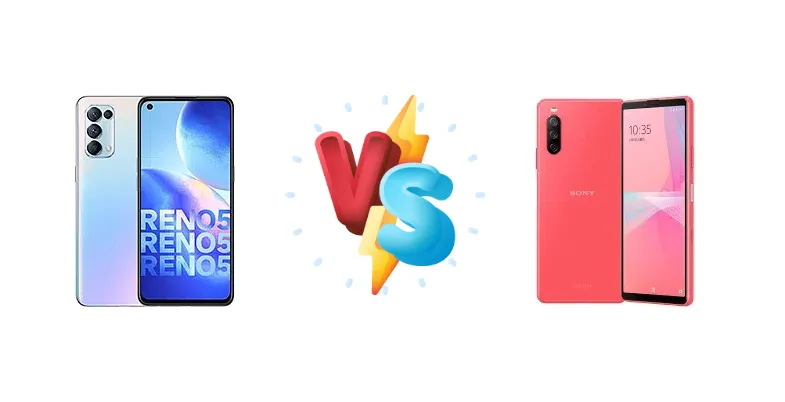
The Oppo Reno5 4G and Sony Xperia 10 III Lite represent distinct approaches to the mid-range smartphone market. The Reno5 prioritizes charging speed and a slightly more powerful chipset, while the Xperia 10 III Lite offers 5G connectivity and Sony’s signature image processing. This comparison dissects their key differences to determine which device delivers the best value.
🏆 Quick Verdict
For the average user prioritizing fast charging and a smoother overall experience, the Oppo Reno5 4G is the better choice. Its 50W charging significantly outperforms the Xperia 10 III Lite’s 30W, and the Snapdragon 720G offers a slight performance advantage in demanding tasks. However, the Xperia 10 III Lite’s 5G capability is a compelling feature for future-proofing.
| Network |
|---|
| 2G bands | GSM 850 / 900 / 1800 / 1900 | GSM 850 / 900 / 1800 / 1900 |
| 3G bands | HSDPA 850 / 900 / 2100 | HSDPA 850 / 1900 |
| 4G bands | 1, 3, 5, 7, 8, 38, 40, 41 | 1, 3, 4, 12, 18, 19, 38, 41 |
| 5G bands | - | 77, 78 SA/NSA |
| Speed | HSPA, LTE | HSPA, LTE, 5G |
| Technology | GSM / HSPA / LTE | GSM / HSPA / LTE / 5G |
| | 1, 3, 5, 7, 8, 20, 28, 38, 40, 41 | - |
| Launch |
|---|
| Announced | 2020, December 31 | 2021, August 20 |
| Status | Available. Released 2021, January 09 | Available. Released 2021, August 27 |
| Body |
|---|
| Build | - | Glass front (Gorilla Glass 6), glass back (Gorilla Glass 6), plastic frame |
| Dimensions | 159.1 x 73.3 x 7.7 mm (6.26 x 2.89 x 0.30 in) | 154 x 68 x 8.3 mm (6.06 x 2.68 x 0.33 in) |
| SIM | Nano-SIM + Nano-SIM | Nano-SIM + eSIM |
| Weight | 171 g (6.03 oz) | 169 g (5.96 oz) |
| Display |
|---|
| Protection | Corning Gorilla Glass 3 | Corning Gorilla Glass 6 |
| Resolution | 1080 x 2400 pixels, 20:9 ratio (~411 ppi density) | 1080 x 2520 pixels, 21:9 ratio (~457 ppi density) |
| Size | 6.4 inches, 98.9 cm2 (~84.8% screen-to-body ratio) | 6.0 inches, 84.1 cm2 (~80.3% screen-to-body ratio) |
| Type | AMOLED, 90Hz, 430 nits (typ), 600 nits (peak) | OLED, 1B colors, HDR |
| Platform |
|---|
| CPU | Octa-core (2x2.3 GHz Kryo 465 Gold & 6x1.8 GHz Kryo 465 Silver) | Octa-core (2x2.0 GHz Kryo 560 Gold & 6x1.7 GHz Kryo 560 Silver) |
| Chipset | Qualcomm SM7125 Snapdragon 720G (8 nm) | Qualcomm SM6350 Snapdragon 690 5G (8 nm) |
| GPU | Adreno 618 | Adreno 619 |
| OS | Android 11, upgradable to Android 12, ColorOS 12 | Android 11 |
| Memory |
|---|
| Card slot | microSDXC (dedicated slot) | microSDXC (uses shared SIM slot) |
| Internal | 128GB 8GB RAM | 64GB 6GB RAM |
| Main Camera |
|---|
| Features | LED flash, HDR, panorama | LED flash, HDR, panorama |
| Quad | 64 MP, f/1.7, 26mm (wide), 1/1.73", 0.8µm, PDAF
8 MP, f/2.2, 119˚ (ultrawide), 1/4.0", 1.12µm
2 MP (macro)
Auxiliary lens | - |
| Triple | - | 12 MP, f/1.8, 27mm (wide), 1/2.8", PDAF
8 MP, f/2.4, 54mm (telephoto), 1/4.0", PDAF, 2x optical zoom
8 MP, f/2.2, 16mm, 120˚ (ultrawide), 1/4.0" |
| Video | 4K@30fps, 1080p@30/60/120/480fps, 720p@960fps; gyro-EIS, HDR | 4K@30fps, 1080p@30fps |
| Selfie camera |
|---|
| Features | HDR | HDR |
| Single | 44 MP, f/2.4, 24mm (wide) | 8 MP, f/2.0, 24mm (wide), 1/4.0" |
| Video | 1080p@30/120fps, 720p@240fps, gyro-EIS | 1080p@30fps |
| Sound |
|---|
| 3.5mm jack | Yes | Yes |
| 35mm jack | Yes | Yes |
| Loudspeaker | Yes | Yes |
| Comms |
|---|
| Bluetooth | 5.1, A2DP, LE, aptX HD | 5.1, A2DP, LE, aptX HD |
| NFC | Yes (market/region dependent) | Yes |
| Positioning | GPS, GLONASS, GALILEO, QZSS, BDS | GPS, GLONASS, GALILEO, BDS, QZSS |
| Radio | Unspecified | No |
| USB | USB Type-C 2.0, OTG | USB Type-C 3.1, OTG, video output |
| WLAN | Wi-Fi 802.11 a/b/g/n/ac, dual-band, Wi-Fi Direct | Wi-Fi 802.11 a/b/g/n/ac, dual-band, Wi-Fi Direct |
| Features |
|---|
| Sensors | Fingerprint (under display, optical), accelerometer, gyro, proximity, compass | Fingerprint (side-mounted), accelerometer, proximity, compass |
| Battery |
|---|
| Charging | 50W wired, 100% in 48 min
Reverse wired | 30W wired, PD, QC |
| Type | Li-Po 4310 mAh | Li-Po 4500 mAh |
| Misc |
|---|
| Colors | Galactic Silver (Fantasy Silver), Starlight Black (Starry Black) | Black, White, Blue, Pink |
| Models | CPH2159 | XQ-BT44 |
| Price | About 310 EUR | About 370 EUR |
Oppo Reno5 4G
- Significantly faster 50W charging
- More powerful Snapdragon 720G processor
- Potentially better thermal management due to 4G focus
- Lacks 5G connectivity
- Camera image processing may be overly saturated for some users
Sony Xperia 10 III Lite
- 5G connectivity for future-proofing
- Sony’s natural image processing style
- Support for Power Delivery and Quick Charge
- Slower 30W charging
- Less powerful Snapdragon 690 processor
- Potential for thermal throttling under heavy load
Display Comparison
Neither device boasts a standout display. Both utilize 8nm chipsets, suggesting similar power draw and potential for display optimization. While specific display specs (resolution, panel type) are missing, the focus here is on performance. The lack of high refresh rate panels on either device suggests a focus on battery life over visual fluidity.
Camera Comparison
Without detailed camera sensor information, a direct comparison is limited. However, Sony’s image processing is renowned for its natural color reproduction, while Oppo often leans towards more vibrant, saturated images. The Xperia 10 III Lite likely benefits from Sony’s image signal processor (ISP) expertise, potentially delivering better dynamic range in challenging lighting conditions. The absence of OIS information for either device suggests a reliance on software stabilization. The Reno5’s chipset might offer slightly faster image processing speeds, but Sony’s algorithms could compensate for this.
Performance
The Oppo Reno5 4G’s Qualcomm SM7125 Snapdragon 720G (8nm) holds a clear advantage over the Sony Xperia 10 III Lite’s Snapdragon 690 5G (8nm). The 720G features a Kryo 465 Gold core clocked at 2.3 GHz, compared to the 690’s 2.0 GHz Kryo 560 Gold core. This translates to faster application loading and smoother multitasking. While both utilize an octa-core configuration with similar Kryo Silver efficiency cores, the higher clock speed of the Reno5’s performance cores provides a noticeable edge. The 690’s 5G modem adds complexity, potentially impacting thermal management under sustained load, while the 720G’s focus is purely on 4G optimization.
Battery Life
The Oppo Reno5 4G’s 50W wired charging is a significant advantage, achieving a 100% charge in just 48 minutes. The Sony Xperia 10 III Lite’s 30W charging, while supporting Power Delivery (PD) and Quick Charge (QC), is considerably slower. While battery capacity isn’t specified, the Reno5’s faster charging mitigates the impact of a potentially smaller battery. The 720G’s efficiency also contributes to better battery life under moderate use, offsetting the 10 III Lite’s 5G capability which is a known battery drain.
Buying Guide
Buy the Oppo Reno5 4G if you need rapid charging, a consistently responsive user interface, and don't heavily rely on 5G connectivity. It’s ideal for users who frequently top up their phones and value a smooth, everyday experience. Buy the Sony Xperia 10 III Lite if you prioritize 5G access for future network compatibility and prefer Sony’s minimalist software approach, accepting a slower charging experience and slightly less powerful processor.
Frequently Asked Questions
❓ Does the Snapdragon 690 in the Xperia 10 III Lite struggle with graphically intensive games like PUBG or Call of Duty?
The Snapdragon 690 is capable of running PUBG and Call of Duty, but you’ll likely need to lower graphics settings to achieve a consistently smooth frame rate. The Snapdragon 720G in the Reno5 4G offers a more comfortable gaming experience at higher settings due to its faster CPU and GPU.
❓ How much faster is the Oppo Reno5 4G's charging in real-world use compared to the Xperia 10 III Lite?
The Reno5 4G can go from 0% to 100% in approximately 48 minutes, while the Xperia 10 III Lite will take considerably longer – likely exceeding 90 minutes. This means you can quickly top up the Reno5 during a short break, whereas the Xperia 10 III Lite requires a more substantial charging period.
❓ Is the 5G connectivity on the Xperia 10 III Lite worth the potential trade-off in processor performance and charging speed?
That depends on your location and 5G network availability. If you live in an area with widespread 5G coverage and anticipate using 5G frequently, it’s a worthwhile consideration. However, if 5G isn’t readily available, the Reno5 4G’s superior performance and charging speed offer a more tangible benefit.