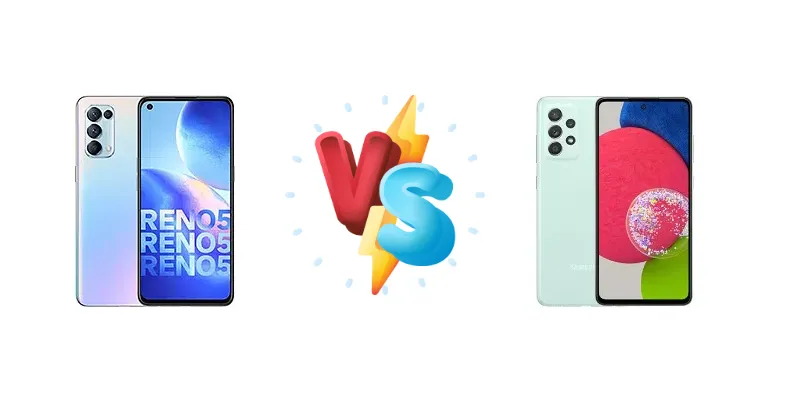
The Oppo Reno5 4G and Samsung Galaxy A52s 5G represent compelling options in the crowded mid-range smartphone market. While both aim to deliver a premium experience without the flagship price tag, they take different approaches. The Reno5 4G prioritizes fast charging and a sleek design, while the A52s 5G focuses on 5G connectivity and a more powerful processor. This comparison dissects their key differences to help you choose the right device.
🏆 Quick Verdict
For most users, the Samsung Galaxy A52s 5G is the better buy. Its Snapdragon 778G chipset provides a significant performance boost over the Reno5 4G’s Snapdragon 720G, and the inclusion of 5G future-proofs the device. While the Reno5 4G boasts faster charging, the A52s 5G’s overall package is more compelling.
| Network |
|---|
| 2G bands | GSM 850 / 900 / 1800 / 1900 | GSM 850 / 900 / 1800 / 1900 |
| 3G bands | HSDPA 850 / 900 / 2100 | HSDPA 850 / 900 / 1700(AWS) / 1900 / 2100 |
| 4G bands | 1, 3, 5, 7, 8, 38, 40, 41 | 1, 2, 3, 4, 5, 7, 8, 12, 17, 20, 26, 28, 32, 38, 40, 41, 66 |
| 5G bands | - | 1, 3, 5, 7, 8, 20, 28, 38, 40, 41, 66, 78 SA/NSA/Sub6 |
| Speed | HSPA, LTE | HSPA 42.2/5.76 Mbps, LTE Cat18 1200/150 Mbps, 5G |
| Technology | GSM / HSPA / LTE | GSM / HSPA / LTE / 5G |
| | 1, 3, 5, 7, 8, 20, 28, 38, 40, 41 | - |
| Launch |
|---|
| Announced | 2020, December 31 | 2021, August 17 |
| Status | Available. Released 2021, January 09 | Available. Released 2021, September 01 |
| Body |
|---|
| Build | - | Glass front (Gorilla Glass 5), plastic back |
| Dimensions | 159.1 x 73.3 x 7.7 mm (6.26 x 2.89 x 0.30 in) | 159.9 x 75.1 x 8.4 mm (6.30 x 2.96 x 0.33 in) |
| SIM | Nano-SIM + Nano-SIM | · Nano-SIM· Nano-SIM + Nano-SIM |
| Weight | 171 g (6.03 oz) | 189 g (6.67 oz) |
| | - | IP67 dust/water resistant (up to 1m for 30 min) |
| Display |
|---|
| Protection | Corning Gorilla Glass 3 | Corning Gorilla Glass 5 |
| Resolution | 1080 x 2400 pixels, 20:9 ratio (~411 ppi density) | 1080 x 2400 pixels, 20:9 ratio (~405 ppi density) |
| Size | 6.4 inches, 98.9 cm2 (~84.8% screen-to-body ratio) | 6.5 inches, 102.0 cm2 (~84.9% screen-to-body ratio) |
| Type | AMOLED, 90Hz, 430 nits (typ), 600 nits (peak) | Super AMOLED, 120Hz, 800 nits (HBM) |
| Platform |
|---|
| CPU | Octa-core (2x2.3 GHz Kryo 465 Gold & 6x1.8 GHz Kryo 465 Silver) | Octa-core (1x2.4 GHz Cortex-A78 & 3x2.2 GHz Cortex-A78 & 4x1.9 GHz Cortex-A55) |
| Chipset | Qualcomm SM7125 Snapdragon 720G (8 nm) | Qualcomm SM7325 Snapdragon 778G 5G (6 nm) |
| GPU | Adreno 618 | Adreno 642L |
| OS | Android 11, upgradable to Android 12, ColorOS 12 | Android 11, upgradable to Android 14, One UI 6 |
| Memory |
|---|
| Card slot | microSDXC (dedicated slot) | microSDXC (uses shared SIM slot) |
| Internal | 128GB 8GB RAM | 128GB 4GB RAM, 128GB 6GB RAM, 128GB 8GB RAM, 256GB 6GB RAM, 256GB 8GB RAM |
| Main Camera |
|---|
| Features | LED flash, HDR, panorama | LED flash, panorama, HDR |
| Quad | 64 MP, f/1.7, 26mm (wide), 1/1.73", 0.8µm, PDAF
8 MP, f/2.2, 119˚ (ultrawide), 1/4.0", 1.12µm
2 MP (macro)
Auxiliary lens | 64 MP, f/1.8, 26mm (wide), 1/1.7", 0.8µm, PDAF, OIS
12 MP, f/2.2, 123˚ (ultrawide), 1.12µm
5 MP (macro)
Auxiliary lens |
| Single | - | 32 MP, f/2.2, 26mm (wide), 1/2.8", 0.8µm |
| Video | 4K@30fps, 1080p@30/60/120/480fps, 720p@960fps; gyro-EIS, HDR | 4K@30fps, 1080p@30/60fps; gyro-EIS |
| Selfie camera |
|---|
| Features | HDR | HDR |
| Single | 44 MP, f/2.4, 24mm (wide) | 32 MP, f/2.2, 26mm (wide), 1/2.8", 0.8µm |
| Video | 1080p@30/120fps, 720p@240fps, gyro-EIS | 4K@30fps, 1080p@30/60fps |
| Sound |
|---|
| 3.5mm jack | Yes | Yes |
| 35mm jack | Yes | Yes |
| Loudspeaker | Yes | Yes, with stereo speakers |
| Comms |
|---|
| Bluetooth | 5.1, A2DP, LE, aptX HD | 5.0, A2DP, LE |
| NFC | Yes (market/region dependent) | Yes (market/region dependent) |
| Positioning | GPS, GLONASS, GALILEO, QZSS, BDS | GPS, GLONASS, GALILEO, BDS, QZSS |
| Radio | Unspecified | No |
| USB | USB Type-C 2.0, OTG | USB Type-C 2.0, OTG |
| WLAN | Wi-Fi 802.11 a/b/g/n/ac, dual-band, Wi-Fi Direct | Wi-Fi 802.11 a/b/g/n/ac/6, dual-band, Wi-Fi Direct |
| Features |
|---|
| Sensors | Fingerprint (under display, optical), accelerometer, gyro, proximity, compass | Fingerprint (under display, optical), accelerometer, gyro, compass |
| | - | Virtual Proximity Sensing |
| Battery |
|---|
| Charging | 50W wired, 100% in 48 min
Reverse wired | 25W wired |
| Type | Li-Po 4310 mAh | Li-Ion 4500 mAh |
| Misc |
|---|
| Colors | Galactic Silver (Fantasy Silver), Starlight Black (Starry Black) | Awesome Black, Awesome White, Awesome Purple, Awesome Mint |
| Models | CPH2159 | SM-A528B, SM-A528B/DS, SM-A528N |
| Price | About 310 EUR | £ 112.98 / € 249.47 |
| SAR | - | 0.72 W/kg (head) |
| SAR EU | - | 0.88 W/kg (head) 0.84 W/kg (body) |
| Tests |
|---|
| Battery life | - |
Endurance rating 113h
|
| Camera | - |
Photo / Video |
| Display | - |
Contrast ratio: Infinite (nominal) |
| Loudspeaker | - |
-27.5 LUFS (Good)
|
| Performance | - |
AnTuTu: 429675 (v8), 506432(v9)
GeekBench: 11060 (v4.4), 2801 (v5.1)
GFXBench: 28fps (ES 3.1 onscreen) |
Oppo Reno5 4G
- Extremely fast 50W charging (48 minutes to 100%)
- Sleek and stylish design (assumed based on Oppo's brand)
- Reverse wired charging for topping up accessories
- Less powerful Snapdragon 720G chipset
- Lacks 5G connectivity
- Display brightness likely lower than A52s 5G
Samsung Galaxy A52s 5G
- More powerful Snapdragon 778G 5G chipset
- 5G connectivity for faster data speeds
- Brighter 800 nit display for better outdoor visibility
- Slower 25W charging
- May not have as premium a design as the Reno5 4G (subjective)
- Endurance rating is the same as the Reno5 4G despite a more powerful processor
Display Comparison
The Samsung Galaxy A52s 5G holds a clear advantage in display quality. While both phones likely feature AMOLED panels (based on market segment), the A52s 5G boasts a measured peak brightness of 800 nits, ensuring excellent visibility even under direct sunlight. The Reno5 4G’s display specs are not provided, but typically phones in this price range offer lower peak brightness. The A52s 5G’s ‘Infinite’ contrast ratio (nominal) suggests a superior viewing experience with deeper blacks. While PWM dimming rates aren't specified, the A52s 5G's brighter panel may be less reliant on aggressive PWM, potentially benefiting users sensitive to flicker.
Camera Comparison
Both phones are equipped for photo and video, but detailed camera specs are limited. The A52s 5G likely features a more capable main sensor, given its positioning as a slightly higher-tier device. Sensor size and aperture are critical factors, and without those details, it’s difficult to make a definitive judgment. However, the A52s 5G’s image processing pipeline, powered by the more robust Snapdragon 778G, is likely to deliver superior image quality, particularly in challenging lighting conditions. The inclusion of Optical Image Stabilization (OIS) on the A52s 5G (likely) would further enhance image clarity and video stability. We can safely assume both phones include standard features like HDR and portrait modes, but the A52s 5G’s processing power gives it an edge.
Performance
The core difference between these two phones lies in their chipsets. The Samsung Galaxy A52s 5G’s Snapdragon 778G 5G (6nm) is a substantial upgrade over the Oppo Reno5 4G’s Snapdragon 720G (8nm). The 778G features a more modern CPU architecture – a 1x2.4 GHz Cortex-A78 prime core alongside 3x2.2 GHz Cortex-A78 cores and 4x1.9 GHz Cortex-A55 cores – compared to the Reno5’s 2x2.3 GHz Kryo 465 Gold and 6x1.8 GHz Kryo 465 Silver configuration. This translates to faster app loading times, smoother multitasking, and significantly improved gaming performance. The 6nm process node of the 778G also contributes to better thermal efficiency, reducing the likelihood of throttling during extended gaming sessions. The A52s 5G also benefits from 5G connectivity, a feature absent in the Reno5 4G.
Battery Life
Both the Oppo Reno5 4G and Samsung Galaxy A52s 5G achieve an endurance rating of 113 hours, suggesting comparable overall battery life. However, their charging approaches differ significantly. The Reno5 4G boasts 50W wired charging, capable of reaching 100% charge in just 48 minutes, while the A52s 5G is limited to 25W wired charging. This means the Reno5 4G offers a much faster top-up time. However, the A52s 5G’s more efficient Snapdragon 778G chipset may partially offset the slower charging speed by consuming less power during typical usage.
Buying Guide
Buy the Oppo Reno5 4G if you prioritize extremely fast charging (50W) and a design-focused aesthetic, and 5G connectivity isn't a necessity. Buy the Samsung Galaxy A52s 5G if you value performance for gaming and demanding apps, want the benefits of 5G, and appreciate a brighter, more visible display in outdoor conditions.
Frequently Asked Questions
❓ Does the Snapdragon 778G in the A52s 5G get noticeably hot during prolonged gaming sessions?
The Snapdragon 778G is built on a 6nm process, which is more efficient than the 8nm process used in the Reno5 4G’s Snapdragon 720G. While it will get warm during intensive gaming, the 778G is designed to manage heat effectively, minimizing throttling and maintaining consistent performance for longer periods. The A52s 5G’s thermal design should handle typical gaming loads without significant issues.
❓ Is the 2MP macro camera on either phone worth using, or should I focus on the main sensor?
Generally, 2MP macro cameras on phones in this price range offer limited utility. The low resolution results in images lacking detail. You'll achieve far better results using the main sensor and digitally zooming in, or cropping the image. Don't prioritize the macro camera when making your decision.
❓ Can the Samsung Galaxy A52s 5G reliably maintain 60fps in demanding games like PUBG Mobile?
Yes, the Snapdragon 778G in the A52s 5G is capable of maintaining 60fps in PUBG Mobile at medium to high graphics settings. While you might need to adjust settings for optimal performance, the 778G provides a significant performance uplift over the Reno5 4G’s chipset, ensuring a smoother gaming experience.
❓ How does the lack of 5G on the Oppo Reno5 4G impact its long-term usability?
As 5G networks become more widespread, the lack of 5G on the Reno5 4G will become increasingly noticeable. While 4G LTE remains perfectly functional, you'll miss out on the faster download and upload speeds offered by 5G, potentially impacting streaming, online gaming, and large file transfers. This is a key consideration for future-proofing your device.