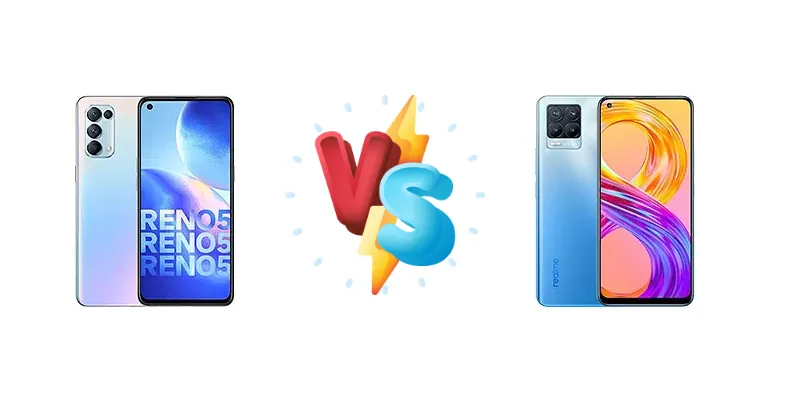
The Oppo Reno5 4G and Realme 8 Pro represent compelling options in the competitive mid-range smartphone market. Both leverage the Qualcomm Snapdragon 720G chipset and 50W fast charging, but diverge in their approach to camera systems and overall user experience. This comparison dissects their strengths and weaknesses to determine which device offers the best value.
🏆 Quick Verdict
For the average user prioritizing consistent performance and a slightly faster charging experience, the Realme 8 Pro emerges as the better choice. While both phones share the same chipset, the Realme 8 Pro’s endurance rating and marginally quicker full charge time provide a slight edge in daily usability.
| Network |
|---|
| 2G bands | GSM 850 / 900 / 1800 / 1900 | GSM 850 / 900 / 1800 / 1900 |
| 3G bands | HSDPA 850 / 900 / 2100 | HSDPA 850 / 900 / 2100 |
| 4G bands | 1, 3, 5, 7, 8, 38, 40, 41 | 1, 3, 5, 7, 8, 20, 28, 38, 40, 41 - International |
| Speed | HSPA, LTE | HSPA, LTE |
| Technology | GSM / HSPA / LTE | GSM / HSPA / LTE |
| | 1, 3, 5, 7, 8, 20, 28, 38, 40, 41 | 1, 3, 5, 8, 38, 40, 41 - Asia |
| Launch |
|---|
| Announced | 2020, December 31 | 2021, March 24 |
| Status | Available. Released 2021, January 09 | Available. Released 2021, March 25 |
| Body |
|---|
| Build | - | Glass front, plastic frame, plastic back |
| Dimensions | 159.1 x 73.3 x 7.7 mm (6.26 x 2.89 x 0.30 in) | 160.6 x 73.9 x 8.1 mm (6.32 x 2.91 x 0.32 in) |
| SIM | Nano-SIM + Nano-SIM | Nano-SIM + Nano-SIM |
| Weight | 171 g (6.03 oz) | 176 g (6.21 oz) |
| Display |
|---|
| Protection | Corning Gorilla Glass 3 | - |
| Resolution | 1080 x 2400 pixels, 20:9 ratio (~411 ppi density) | 1080 x 2400 pixels, 20:9 ratio (~411 ppi density) |
| Size | 6.4 inches, 98.9 cm2 (~84.8% screen-to-body ratio) | 6.4 inches, 98.9 cm2 (~83.3% screen-to-body ratio) |
| Type | AMOLED, 90Hz, 430 nits (typ), 600 nits (peak) | Super AMOLED, 430 nits (typ), 1000 nits (peak) |
| | - | Always-on display |
| Platform |
|---|
| CPU | Octa-core (2x2.3 GHz Kryo 465 Gold & 6x1.8 GHz Kryo 465 Silver) | Octa-core (2x2.3 GHz Kryo 465 Gold & 6x1.8 GHz Kryo 465 Silver) |
| Chipset | Qualcomm SM7125 Snapdragon 720G (8 nm) | Qualcomm SM7125 Snapdragon 720G (8 nm) |
| GPU | Adreno 618 | Adreno 618 |
| OS | Android 11, upgradable to Android 12, ColorOS 12 | Android 11, upgradable to Android 12, Realme UI 3.0 |
| Memory |
|---|
| Card slot | microSDXC (dedicated slot) | microSDXC (dedicated slot) |
| Internal | 128GB 8GB RAM | 128GB 6GB RAM, 128GB 8GB RAM |
| | - | UFS 2.1 |
| Main Camera |
|---|
| Features | LED flash, HDR, panorama | LED flash, HDR, panorama |
| Quad | 64 MP, f/1.7, 26mm (wide), 1/1.73", 0.8µm, PDAF
8 MP, f/2.2, 119˚ (ultrawide), 1/4.0", 1.12µm
2 MP (macro)
Auxiliary lens | 108 MP, f/1.9, 26mm (wide), 1/1.52", 0.7µm, PDAF
8 MP, f/2.3, 119˚, 16mm (ultrawide), 1/4.0", 1.12µm
2 MP (macro)
Auxiliary lens |
| Video | 4K@30fps, 1080p@30/60/120/480fps, 720p@960fps; gyro-EIS, HDR | 4K@30fps, 1080p@30/60/120/480fps, 720p@960fps, gyro-EIS |
| Selfie camera |
|---|
| Features | HDR | HDR, panorama |
| Single | 44 MP, f/2.4, 24mm (wide) | 16 MP, f/2.5, (wide), 1/3.0", 1.0µm |
| Video | 1080p@30/120fps, 720p@240fps, gyro-EIS | 1080p@30/120fps, gyro-EIS |
| Sound |
|---|
| 3.5mm jack | Yes | Yes |
| 35mm jack | Yes | Yes |
| Loudspeaker | Yes | Yes |
| | - | 24-bit/192kHz audio |
| Comms |
|---|
| Bluetooth | 5.1, A2DP, LE, aptX HD | 5.0, A2DP, LE |
| NFC | Yes (market/region dependent) | Yes (market/region dependent) |
| Positioning | GPS, GLONASS, GALILEO, QZSS, BDS | GPS, GLONASS, BDS |
| Radio | Unspecified | No |
| USB | USB Type-C 2.0, OTG | USB Type-C 2.0, OTG |
| WLAN | Wi-Fi 802.11 a/b/g/n/ac, dual-band, Wi-Fi Direct | Wi-Fi 802.11 a/b/g/n/ac, dual-band, Wi-Fi Direct |
| Features |
|---|
| Sensors | Fingerprint (under display, optical), accelerometer, gyro, proximity, compass | Fingerprint (under display, optical), accelerometer, gyro, proximity, compass |
| Battery |
|---|
| Charging | 50W wired, 100% in 48 min
Reverse wired | 50W wired, 50% in 17 min, 100% in 47 min |
| Type | Li-Po 4310 mAh | 4500 mAh |
| Misc |
|---|
| Colors | Galactic Silver (Fantasy Silver), Starlight Black (Starry Black) | Infinite Blue, Infinite Black, Punk Black, Illuminating Yellow |
| Models | CPH2159 | RMX3081 |
| Price | About 310 EUR | About 550 EUR |
| SAR | - | 1.10 W/kg (head) 0.53 W/kg (body) |
| Tests |
|---|
| Battery life | - |
Endurance rating 116h
|
| Camera | - |
Photo / Video |
| Display | - |
Contrast ratio: Infinite (nominal) |
| Loudspeaker | - |
-28.2 LUFS (Average)
|
| Performance | - |
AnTuTu: 286666 (v8)
GeekBench: 1678 (v5.1)
GFXBench: 16fps (ES 3.1 onscreen) |
Oppo Reno5 4G
- Potentially more refined software experience with ColorOS.
- Sleek and stylish design aesthetic.
- 50W fast charging for quick top-ups.
- Slightly slower full charge time compared to Realme 8 Pro.
- Less emphasis on camera features compared to Realme 8 Pro.
Realme 8 Pro
- Excellent battery endurance (116h rating).
- Faster 50W charging (47 minutes to 100%).
- Potentially superior camera performance based on Realme's marketing focus.
- Software experience may be less polished than Oppo's ColorOS.
- May lack the premium design feel of the Oppo Reno5 4G.
Display Comparison
Both the Oppo Reno5 4G and Realme 8 Pro feature displays with an 'Infinite' contrast ratio, suggesting deep blacks typical of AMOLED panels. However, specific details like peak brightness and color gamut coverage are absent. Given the market positioning, we can infer both displays target a similar level of visual fidelity, prioritizing vibrant colors and good viewing angles. The lack of high refresh rate panels (90Hz or 120Hz) is a common trade-off in this price segment, focusing instead on power efficiency.
Camera Comparison
The Realme 8 Pro distinguishes itself with a focus on camera capabilities, though specific sensor details beyond 'Photo / Video' are missing. The absence of information regarding sensor size and aperture makes a direct comparison difficult. However, Realme’s marketing historically emphasizes camera performance, suggesting a potentially more refined image processing pipeline. The Oppo Reno5 4G, while capable, typically prioritizes a balanced feature set rather than solely focusing on camera prowess. The inclusion of a 2MP macro camera on the Realme 8 Pro is likely a marketing feature with limited practical benefit, given the inherent limitations of such small sensors.
Performance
Both devices are powered by the Qualcomm SM7125 Snapdragon 720G (8 nm) with an identical CPU configuration: an octa-core setup featuring two 2.3 GHz Kryo 465 Gold cores and six 1.8 GHz Kryo 465 Silver cores. This means CPU performance will be virtually indistinguishable between the two. The real-world impact of this chipset is smooth multitasking and capable gaming at medium settings. Thermal management will likely be similar, with the 8nm process node offering reasonable efficiency. RAM configurations, not specified, will influence multitasking capabilities; higher RAM (6GB or 8GB) is preferable for demanding users.
Battery Life
The Realme 8 Pro boasts an endurance rating of 116 hours, indicating excellent battery life under typical usage scenarios. Both phones support 50W wired charging, but the Realme 8 Pro charges to 50% in 17 minutes and 100% in 47 minutes, while the Oppo Reno5 4G reaches 100% in 48 minutes. This slight difference in charging speed, coupled with the higher endurance rating, gives the Realme 8 Pro an advantage for users who prioritize minimizing downtime. The actual battery capacity (mAh) is not specified, but the endurance rating suggests the Realme 8 Pro has a more optimized power management system.
Buying Guide
Buy the Oppo Reno5 4G if you value a refined design aesthetic and potentially benefit from Oppo’s ColorOS software features. Buy the Realme 8 Pro if you prioritize maximizing battery life and appreciate a more straightforward Android experience, especially if you frequently capture photos and videos.
Frequently Asked Questions
❓ Does the Snapdragon 720G in either phone struggle with demanding games like PUBG or Call of Duty?
The Snapdragon 720G is capable of running PUBG and Call of Duty, but you'll likely need to stick to medium graphics settings for a consistently smooth experience. Expect some frame drops during intense action sequences. Neither phone is a dedicated gaming device, but the chipset is adequate for casual gaming.
❓ Is the 50W charging truly fast, and will it degrade the battery health over time?
50W charging is considered fast charging and will significantly reduce charging times compared to standard chargers. While fast charging *can* contribute to slightly faster battery degradation over the long term, modern smartphones employ battery protection mechanisms to mitigate this effect. The convenience of quick charging generally outweighs the minimal impact on battery lifespan.
❓ How does the software experience differ between Oppo's ColorOS and Realme UI?
ColorOS (Oppo) is generally considered more feature-rich and visually polished, but can also feel more bloated with pre-installed apps. Realme UI aims for a cleaner, closer-to-stock Android experience with fewer customizations. Preference is subjective; some users prefer the added features of ColorOS, while others appreciate the simplicity of Realme UI.