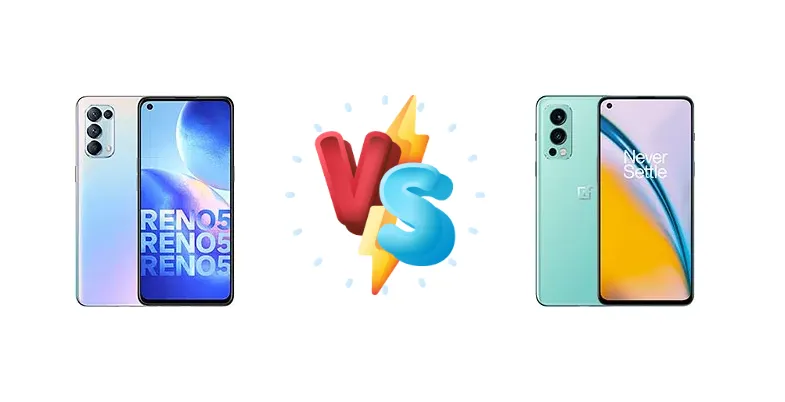
The Oppo Reno5 4G and OnePlus Nord 2 5G represent compelling options in the increasingly competitive mid-range smartphone market. While both aim to deliver a premium experience without the flagship price tag, they take distinctly different approaches to achieving this goal – one leveraging Qualcomm’s Snapdragon 720G, the other, MediaTek’s more powerful Dimensity 1200. This comparison dissects their key differences to help you choose the right phone for your needs.
🏆 Quick Verdict
For most users, the OnePlus Nord 2 5G emerges as the stronger contender. Its Mediatek Dimensity 1200 chipset provides a significant performance uplift over the Reno5 4G’s Snapdragon 720G, and its 65W charging is substantially faster. While both offer similar battery endurance, the Nord 2’s overall speed and future-proofing make it the better investment.
| Network |
|---|
| 2G bands | GSM 850 / 900 / 1800 / 1900 | GSM 850 / 900 / 1800 / 1900 |
| 3G bands | HSDPA 850 / 900 / 2100 | HSDPA 800 / 850 / 900 / 1700(AWS) / 1800 / 1900 / 2100 |
| 4G bands | 1, 3, 5, 7, 8, 38, 40, 41 | 1, 2, 3, 4, 5, 7, 8, 12, 17, 18, 19, 20, 26, 28, 32, 34, 38, 39, 40, 41, 66 - EU |
| 5G bands | - | 1, 3, 7, 8, 20, 28, 38, 41, 66, 78 SA/NSA - EU |
| Speed | HSPA, LTE | HSPA 42.2/5.76 Mbps, LTE Cat18 1200/150 Mbps, 5G |
| Technology | GSM / HSPA / LTE | GSM / HSPA / LTE / 5G |
| | 1, 3, 5, 7, 8, 20, 28, 38, 40, 41 | - |
| Launch |
|---|
| Announced | 2020, December 31 | 2021, July 22 |
| Status | Available. Released 2021, January 09 | Available. Released 2021, July 28 |
| Body |
|---|
| Build | - | Glass front (Gorilla Glass 5), glass back (Gorilla Glass 5), plastic frame |
| Dimensions | 159.1 x 73.3 x 7.7 mm (6.26 x 2.89 x 0.30 in) | 159.1 x 73.3 x 8.3 mm (6.26 x 2.89 x 0.33 in) |
| SIM | Nano-SIM + Nano-SIM | Nano-SIM + Nano-SIM |
| Weight | 171 g (6.03 oz) | 189 g (6.67 oz) |
| Display |
|---|
| Protection | Corning Gorilla Glass 3 | Corning Gorilla Glass 5 |
| Resolution | 1080 x 2400 pixels, 20:9 ratio (~411 ppi density) | 1080 x 2400 pixels, 20:9 ratio (~409 ppi density) |
| Size | 6.4 inches, 98.9 cm2 (~84.8% screen-to-body ratio) | 6.43 inches, 99.8 cm2 (~85.6% screen-to-body ratio) |
| Type | AMOLED, 90Hz, 430 nits (typ), 600 nits (peak) | Fluid AMOLED, 90Hz, HDR10+ |
| Platform |
|---|
| CPU | Octa-core (2x2.3 GHz Kryo 465 Gold & 6x1.8 GHz Kryo 465 Silver) | Octa-core (1x3.0 GHz Cortex-A78 & 3x2.6 GHz Cortex-A78 & 4x2.0 GHz Cortex-A55) |
| Chipset | Qualcomm SM7125 Snapdragon 720G (8 nm) | Mediatek Dimensity 1200 (6 nm) |
| GPU | Adreno 618 | Mali-G77 MC9 |
| OS | Android 11, upgradable to Android 12, ColorOS 12 | Android 11, upgradable to Android 13, OxygenOS 13 |
| Memory |
|---|
| Card slot | microSDXC (dedicated slot) | No |
| Internal | 128GB 8GB RAM | 128GB 6GB RAM, 128GB 8GB RAM, 256GB 8GB RAM, 256GB 12GB RAM |
| Main Camera |
|---|
| Features | LED flash, HDR, panorama | Dual-LED flash, HDR, panorama |
| Quad | 64 MP, f/1.7, 26mm (wide), 1/1.73", 0.8µm, PDAF
8 MP, f/2.2, 119˚ (ultrawide), 1/4.0", 1.12µm
2 MP (macro)
Auxiliary lens | - |
| Triple | - | 50 MP, f/1.9, 24mm (wide), 1/1.56", 1.0µm, PDAF, OIS
8 MP, f/2.3, 120˚ (ultrawide)
Auxiliary lens |
| Video | 4K@30fps, 1080p@30/60/120/480fps, 720p@960fps; gyro-EIS, HDR | 4K@30fps, 1080p@30/60/120fps, gyro-EIS |
| Selfie camera |
|---|
| Features | HDR | Auto HDR |
| Single | 44 MP, f/2.4, 24mm (wide) | 32 MP, f/2.5, (wide), 1/2.8", 0.8µm |
| Video | 1080p@30/120fps, 720p@240fps, gyro-EIS | 1080p@30fps, gyro-EIS |
| Sound |
|---|
| 3.5mm jack | Yes | No |
| 35mm jack | Yes | No |
| Loudspeaker | Yes | Yes, with stereo speakers |
| Comms |
|---|
| Bluetooth | 5.1, A2DP, LE, aptX HD | 5.2, A2DP, LE, aptX HD |
| NFC | Yes (market/region dependent) | Yes |
| Positioning | GPS, GLONASS, GALILEO, QZSS, BDS | GPS, GLONASS, GALILEO, BDS, SBAS, NavIC |
| Radio | Unspecified | No |
| USB | USB Type-C 2.0, OTG | USB Type-C 2.0, OTG |
| WLAN | Wi-Fi 802.11 a/b/g/n/ac, dual-band, Wi-Fi Direct | Wi-Fi 802.11 a/b/g/n/ac/6, dual-band, Wi-Fi Direct |
| Features |
|---|
| Sensors | Fingerprint (under display, optical), accelerometer, gyro, proximity, compass | Fingerprint (under display, optical), accelerometer, gyro, proximity, compass |
| Battery |
|---|
| Charging | 50W wired, 100% in 48 min
Reverse wired | 65W wired, PD, 100% in 30 min |
| Type | Li-Po 4310 mAh | Li-Po 4500 mAh |
| Misc |
|---|
| Colors | Galactic Silver (Fantasy Silver), Starlight Black (Starry Black) | Gray Sierra, Blue Haze, Green Wood, Pac-Man Edition |
| Models | CPH2159 | DN2101, DN2103 |
| Price | About 310 EUR | € 189.00 / $ 219.99 / £ 148.00 |
| Tests |
|---|
| Battery life | - |
Endurance rating 102h
|
| Camera | - |
Photo / Video |
| Display | - |
Contrast ratio: Infinite (nominal) |
| Loudspeaker | - |
-24.3 LUFS (Very good)
|
| Performance | - |
AnTuTu: 512164 (v8) | 598022 (v9)
GeekBench: 2792 (v5.1)
GFXBench: 38fps (ES 3.1 onscreen) |
Oppo Reno5 4G
- Sleek and lightweight design
- Reverse wired charging capability
- Potentially lower price point
- Less powerful Snapdragon 720G chipset
- Slower 50W charging compared to Nord 2
OnePlus Nord 2 5G
- Significantly faster Dimensity 1200 processor
- 65W SuperVOOC charging for rapid top-ups
- Brighter display for better outdoor visibility
- Lacks reverse wireless charging
- May be slightly more expensive than Reno5 4G
Display Comparison
The OnePlus Nord 2 5G boasts a brighter display, reaching a measured peak of 633 nits, compared to the Reno5 4G’s unspecified brightness. While both likely utilize AMOLED panels for vibrant colors, the Nord 2’s higher peak brightness translates to better visibility outdoors. The Nord 2’s ‘Infinite’ contrast ratio (nominal) suggests a superior black level performance, enhancing the viewing experience for videos and dark-mode applications. Bezels and color accuracy are not specified, but OnePlus generally delivers well-calibrated displays in this price range.
Camera Comparison
Both phones are advertised as capable photo and video devices, but specifics are limited. Without detailed sensor size information, it’s difficult to make a definitive judgment. However, the Dimensity 1200’s integrated ISP (Image Signal Processor) is more advanced than the Snapdragon 720G’s, potentially leading to better image processing, especially in low-light conditions. The absence of details regarding OIS (Optical Image Stabilization) on either phone makes it difficult to assess video stabilization capabilities. We can safely assume both phones include standard features like HDR and portrait modes, but the Nord 2’s superior processing power likely gives it an edge in computational photography.
Performance
The core difference lies in the chipsets. The OnePlus Nord 2 5G’s Mediatek Dimensity 1200, built on a 6nm process, is a substantial upgrade over the Oppo Reno5 4G’s Qualcomm Snapdragon 720G (8nm). The Dimensity 1200’s octa-core configuration – featuring a prime Cortex-A78 core clocked at 3.0 GHz alongside three additional A78 cores – provides significantly more processing power for demanding tasks. The Snapdragon 720G’s Kryo 465 Gold and Silver cores, while efficient, simply can’t match the raw performance of the Dimensity 1200. This translates to faster app loading times, smoother multitasking, and a more enjoyable gaming experience on the Nord 2 5G. The Nord 2 also benefits from potentially faster RAM speeds (LPDDR5 vs LPDDR4X, though not explicitly stated).
Battery Life
Both the Oppo Reno5 4G and OnePlus Nord 2 5G achieve an endurance rating of 102 hours, suggesting comparable real-world battery life. However, the charging speeds are drastically different. The Nord 2 5G’s 65W wired charging, with PD support, can fully charge the battery in just 30 minutes. The Reno5 4G’s 50W charging takes 48 minutes to reach 100%. This 18-minute difference is significant for users who prioritize quick top-ups. The Reno5 4G also offers reverse wired charging, a feature absent in the Nord 2’s specifications.
Buying Guide
Buy the Oppo Reno5 4G if you prioritize a sleek design and are primarily focused on everyday tasks like social media, browsing, and casual photography, and are on a tighter budget. Buy the OnePlus Nord 2 5G if you demand smoother multitasking, enjoy mobile gaming, value faster charging speeds, and want a phone that will remain responsive for years to come. The Nord 2 is the clear choice for power users.
Frequently Asked Questions
❓ Does the Mediatek Dimensity 1200 in the Nord 2 5G get excessively hot during prolonged gaming sessions?
While the Dimensity 1200 is a powerful chip, OnePlus has implemented effective thermal management solutions in the Nord 2 5G. Reports indicate that the phone handles demanding games like PUBG and Genshin Impact well, with only moderate temperature increases and minimal throttling. The 6nm process node also contributes to improved thermal efficiency compared to the Reno5 4G’s 8nm Snapdragon 720G.
❓ Is the 50W charging on the Oppo Reno5 4G slow enough to be a significant inconvenience?
While 50W charging is still relatively fast, the 18-minute difference in charging time compared to the Nord 2 5G’s 65W charging can be noticeable for users who frequently need to quickly top up their battery. If you prioritize minimizing downtime, the Nord 2 5G’s charging speed is a clear advantage.
❓ How does the Snapdragon 720G in the Reno5 4G handle multitasking compared to the Dimensity 1200 in the Nord 2 5G?
The Dimensity 1200’s more powerful CPU and GPU, coupled with potentially faster RAM, provide a significantly smoother multitasking experience. The Reno5 4G’s Snapdragon 720G can handle basic multitasking, but you may experience occasional lag or slowdowns when running multiple demanding apps simultaneously. The Nord 2 5G is better equipped for heavy users.