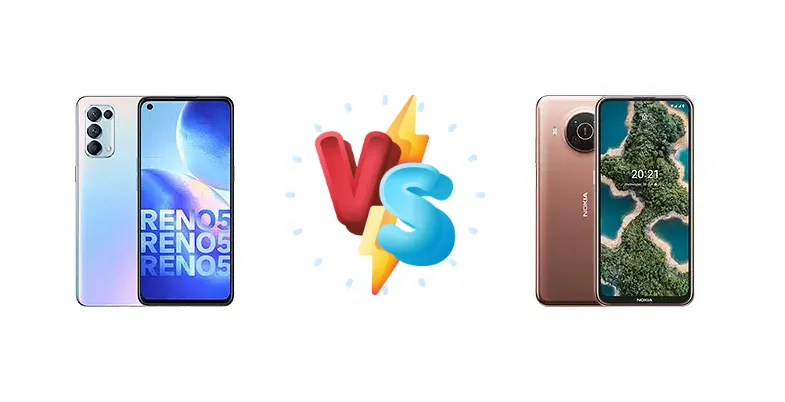
The Oppo Reno5 4G and Nokia X20 represent distinct approaches to the mid-range smartphone market. The Reno5 4G prioritizes charging speed and a more powerful processor, while the Nokia X20 focuses on a clean Android experience and 5G connectivity. This comparison dissects their key differences to help you determine which device best suits your needs.
🏆 Quick Verdict
For most users, the Oppo Reno5 4G emerges as the stronger choice. Its Snapdragon 720G chipset delivers noticeably better performance than the Snapdragon 480 in the Nokia X20, and the 50W charging is a game-changer. While the X20 offers 5G, the Reno5's overall experience is more refined.
| Network |
|---|
| 2G bands | GSM 850 / 900 / 1800 / 1900 | GSM 850 / 900 / 1800 / 1900 |
| 3G bands | HSDPA 850 / 900 / 2100 | HSDPA 850 / 900 / 1700(AWS) / 1900 / 2100 |
| 4G bands | 1, 3, 5, 7, 8, 38, 40, 41 | 1, 2, 3, 4, 5, 7, 8, 12, 20, 28, 66, 38, 39, 40, 41 |
| 5G bands | - | 1, 2, 3, 5, 7, 28, 38, 41, 66, 78 SA/NSA/Sub6 |
| Speed | HSPA, LTE | HSPA, LTE, 5G |
| Technology | GSM / HSPA / LTE | GSM / HSPA / LTE / 5G |
| | 1, 3, 5, 7, 8, 20, 28, 38, 40, 41 | - |
| Launch |
|---|
| Announced | 2020, December 31 | 2021, April 08 |
| Status | Available. Released 2021, January 09 | Available. Released 2021, May 12 |
| Body |
|---|
| Dimensions | 159.1 x 73.3 x 7.7 mm (6.26 x 2.89 x 0.30 in) | 168.9 x 79.7 x 9.1 mm (6.65 x 3.14 x 0.36 in) |
| SIM | Nano-SIM + Nano-SIM | · Nano-SIM· Nano-SIM + Nano-SIM |
| Weight | 171 g (6.03 oz) | 220 g (7.76 oz) |
| Display |
|---|
| Protection | Corning Gorilla Glass 3 | Corning Gorilla Glass 5 |
| Resolution | 1080 x 2400 pixels, 20:9 ratio (~411 ppi density) | 1080 x 2400 pixels, 20:9 ratio (~395 ppi density) |
| Size | 6.4 inches, 98.9 cm2 (~84.8% screen-to-body ratio) | 6.67 inches, 107.4 cm2 (~79.8% screen-to-body ratio) |
| Type | AMOLED, 90Hz, 430 nits (typ), 600 nits (peak) | IPS LCD, 450 nits (typ) |
| Platform |
|---|
| CPU | Octa-core (2x2.3 GHz Kryo 465 Gold & 6x1.8 GHz Kryo 465 Silver) | Octa-core (2x2.0 GHz Kryo 460 & 6x1.8 GHz Kryo 460) |
| Chipset | Qualcomm SM7125 Snapdragon 720G (8 nm) | Qualcomm SM4350 Snapdragon 480 5G (8 nm) |
| GPU | Adreno 618 | Adreno 619 |
| OS | Android 11, upgradable to Android 12, ColorOS 12 | Android 11, upgradable to Android 14 |
| Memory |
|---|
| Card slot | microSDXC (dedicated slot) | microSDXC (uses shared SIM slot) |
| Internal | 128GB 8GB RAM | 128GB 6GB RAM, 128GB 8GB RAM |
| Main Camera |
|---|
| Features | LED flash, HDR, panorama | Zeiss optics, LED flash, HDR, panorama |
| Quad | 64 MP, f/1.7, 26mm (wide), 1/1.73", 0.8µm, PDAF
8 MP, f/2.2, 119˚ (ultrawide), 1/4.0", 1.12µm
2 MP (macro)
Auxiliary lens | 64 MP, (wide), PDAF
5 MP, (ultrawide)
2 MP (macro)
Auxiliary lens |
| Single | - | 32 MP, (wide) |
| Video | 4K@30fps, 1080p@30/60/120/480fps, 720p@960fps; gyro-EIS, HDR | 1080p@30/60fps |
| Selfie camera |
|---|
| Features | HDR | - |
| Single | 44 MP, f/2.4, 24mm (wide) | 32 MP, (wide) |
| Video | 1080p@30/120fps, 720p@240fps, gyro-EIS | 1080p@30fps |
| Sound |
|---|
| 3.5mm jack | Yes | Yes |
| 35mm jack | Yes | Yes |
| Loudspeaker | Yes | Yes |
| Comms |
|---|
| Bluetooth | 5.1, A2DP, LE, aptX HD | 5.0, A2DP, LE, aptX HD |
| NFC | Yes (market/region dependent) | Yes |
| Positioning | GPS, GLONASS, GALILEO, QZSS, BDS | GPS, GLONASS, GALILEO |
| Radio | Unspecified | FM radio |
| USB | USB Type-C 2.0, OTG | USB Type-C 2.0, OTG |
| WLAN | Wi-Fi 802.11 a/b/g/n/ac, dual-band, Wi-Fi Direct | Wi-Fi 802.11 a/b/g/n/ac, dual-band, Wi-Fi Direct |
| Features |
|---|
| Sensors | Fingerprint (under display, optical), accelerometer, gyro, proximity, compass | Fingerprint (side-mounted), accelerometer, gyro, proximity |
| Battery |
|---|
| Charging | 50W wired, 100% in 48 min
Reverse wired | 18W wired |
| Type | Li-Po 4310 mAh | Li-Po 4470 mAh |
| Misc |
|---|
| Colors | Galactic Silver (Fantasy Silver), Starlight Black (Starry Black) | Midnight Sun, Nordic Blue |
| Models | CPH2159 | TA-1341, TA-1344 |
| Price | About 310 EUR | About 130 EUR |
| SAR | - | 1.04 W/kg (head) 0.62 W/kg (body) |
| SAR EU | - | 0.51 W/kg (head) 1.29 W/kg (body) |
Oppo Reno5 4G
- Faster 50W charging significantly reduces downtime.
- More powerful Snapdragon 720G chipset for smoother performance.
- Likely more vibrant and optimized camera processing.
- Lacks 5G connectivity.
- Software experience may be less 'clean' than Nokia's.
Nokia X20
- 5G connectivity for future-proofed data speeds.
- Stock Android experience with guaranteed updates.
- Durable build quality, typical of Nokia.
- Slower Snapdragon 480 chipset limits performance.
- Significantly slower 18W charging.
- Camera performance likely less refined than Oppo.
Display Comparison
Neither device boasts a standout display. While specific display specs (resolution, panel type) are missing, both utilize 8nm chipsets suggesting similar power constraints impacting display capabilities. The focus here isn't on cutting-edge visuals, but functional usability. Bezels are likely comparable given the market segment. Color accuracy will likely be tuned for vibrancy on the Reno5, typical of Oppo, while Nokia aims for more natural tones.
Camera Comparison
Without detailed camera specs, a direct comparison is limited. However, the Reno5’s brand positioning suggests a greater emphasis on camera quality. Oppo typically employs more aggressive image processing algorithms to produce vibrant, social media-ready photos. The X20, adhering to Nokia’s philosophy, likely prioritizes natural color reproduction. The absence of OIS information for either device suggests reliance on software stabilization. The presence of a 2MP macro lens on either device is largely a marketing tactic, offering minimal practical benefit.
Performance
The core difference lies in the chipsets. The Oppo Reno5 4G’s Snapdragon 720G (8nm) features a more powerful CPU configuration – octa-core with 2x2.3 GHz Kryo 465 Gold cores versus the Nokia X20’s Snapdragon 480 5G (8nm) with 2x2.0 GHz Kryo 460 cores. This translates to a tangible performance advantage for the Reno5 in demanding applications and multitasking. While both are 8nm, the Kryo 465 Gold cores in the Reno5 offer a higher clock speed and architectural improvements. The X20’s 5G modem adds connectivity, but at the cost of raw processing power. Gamers will find the Reno5 a more capable device.
Battery Life
The Nokia X20’s 18W charging is significantly slower than the Oppo Reno5 4G’s 50W charging, capable of reaching 100% in just 48 minutes. This difference is substantial for users who value quick top-ups. While battery capacity isn’t specified, the Reno5’s more efficient chipset and faster charging mitigate the impact of a potentially smaller battery. The X20 will require longer charging times, making it less convenient for users on the go.
Buying Guide
Buy the Oppo Reno5 4G if you prioritize smooth performance for everyday tasks and gaming, and value incredibly fast charging. This phone is ideal for users who frequently consume media and need a device that can keep up. Buy the Nokia X20 if 5G connectivity is a non-negotiable requirement and you prefer a stock Android experience with guaranteed software updates, even if it means sacrificing some processing power.
Frequently Asked Questions
❓ Will the Snapdragon 480 in the Nokia X20 struggle with graphically intensive games like PUBG Mobile?
Yes, the Snapdragon 480 is an entry-level 5G chipset. While it can run PUBG Mobile, you'll likely need to lower graphics settings to achieve a playable frame rate. The Reno5 4G’s Snapdragon 720G offers a significantly smoother gaming experience with higher graphical fidelity.
❓ How much faster is the 50W charging on the Oppo Reno5 4G compared to the 18W charging on the Nokia X20 in real-world use?
The difference is substantial. The Reno5 4G can go from 0-100% in approximately 48 minutes. The Nokia X20 will likely take over 2 hours to fully charge. This means you can quickly top up the Reno5 during short breaks, while the X20 requires a longer commitment to charging.
❓ Does the Nokia X20's 5G connectivity actually make a noticeable difference in everyday use?
Currently, the benefits of 5G are limited by network availability. In areas with strong 5G coverage, you'll experience faster download and upload speeds. However, in most locations, you'll primarily be connected to 4G LTE, minimizing the advantage of the X20's 5G modem.