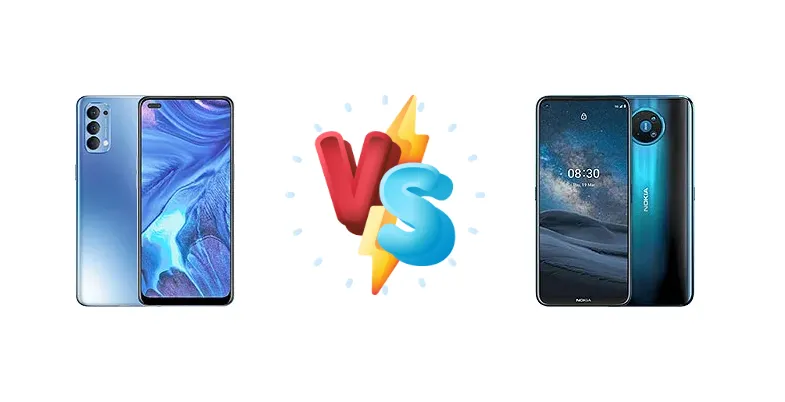
The mid-range 5G market is fiercely competitive, and the Oppo Reno4 and Nokia 8.3 5G represent compelling options. While both aim to deliver 5G connectivity at a reasonable price, they take different approaches to achieving this, primarily through their chipset choices and charging implementations. This comparison dives deep into the specifics to determine which phone offers the best value for your money.
🏆 Quick Verdict
For most users, the Nokia 8.3 5G emerges as the stronger choice. Its Snapdragon 765G chipset, built on a more efficient 7nm process, provides a noticeable performance edge, particularly in sustained workloads. While the Reno4 boasts faster 30W charging, the Nokia’s overall package offers a better balance of power and features.
| Network |
|---|
| 2G bands | GSM 850 / 900 / 1800 / 1900 | GSM 850 / 900 / 1800 / 1900 |
| 3G bands | HSDPA 850 / 900 / 2100 | HSDPA 850 / 900 / 1700(AWS) / 1900 / 2100 |
| 4G bands | 1, 3, 5, 7, 8, 38, 40, 41 | 1, 2, 3, 4, 5, 7, 8, 12, 13, 17, 20, 28, 32, 38, 39, 40, 41, 66, 71 |
| 5G bands | - | 1, 2, 3, 5, 7, 8, 28, 38, 40, 41, 66, 71, 78 SA/NSA |
| Speed | HSPA, LTE | HSPA 42.2/5.76 Mbps, LTE (4CA) Cat18 1200/150 Mbps, 5G 2.4/1.2 Gbps |
| Technology | GSM / HSPA / LTE | GSM / HSPA / LTE / 5G |
| Launch |
|---|
| Announced | 2020, July 29. Released 2020, August 05 | 2020, March 19. Released 2020, September 15 |
| Status | Discontinued | Discontinued |
| Body |
|---|
| Build | Glass front, plastic frame, plastic back | Glass front, plastic frame, glass back |
| Dimensions | 160.3 x 73.9 x 7.7 mm (6.31 x 2.91 x 0.30 in) | 171.9 x 78.6 x 9 mm (6.77 x 3.09 x 0.35 in) |
| SIM | Nano-SIM + Nano-SIM | · Nano-SIM· Nano-SIM + Nano-SIM |
| Weight | 165 g (5.82 oz) | 220 g (7.76 oz) |
| Display |
|---|
| Resolution | 1080 x 2400 pixels, 20:9 ratio (~411 ppi density) | 1080 x 2400 pixels, 20:9 ratio (~386 ppi density) |
| Size | 6.4 inches, 98.9 cm2 (~83.5% screen-to-body ratio) | 6.81 inches, 112.0 cm2 (~82.9% screen-to-body ratio) |
| Type | OLED, 430 nits (typ) | IPS LCD |
| Platform |
|---|
| CPU | Octa-core (2x2.3 GHz Kryo 465 Gold & 6x1.8 GHz Kryo 465 Silver) | Octa-core (1x2.4 GHz Kryo 475 Prime & 1x2.2 GHz Kryo 475 Gold & 6x1.8 GHz Kryo 475 Silver) |
| Chipset | Qualcomm SM7125 Snapdragon 720G (8 nm) | Qualcomm SM7250 Snapdragon 765G 5G (7 nm) |
| GPU | Adreno 618 | Adreno 620 |
| OS | Android 10, ColorOS 7.2 | Android 10, upgradable to Android 12, Android One |
| Memory |
|---|
| Card slot | microSDXC (dedicated slot) | microSDXC (uses shared SIM slot) |
| Internal | 128GB 8GB RAM | 64GB 6GB RAM, 64GB 8GB RAM, 128GB 8GB RAM |
| | UFS 2.1 | - |
| Main Camera |
|---|
| Features | LED flash, HDR, panorama | Zeiss optics, Dual-LED flash, panorama, HDR |
| Quad | 48 MP, f/1.7, 26mm (wide), 1/2.0", 0.8µm, PDAF
8 MP, f/2.2, 119˚ (ultrawide), 1/4.0", 1.12µm
2 MP (macro)
Auxiliary lens | 64 MP, f/1.9, (wide), 1/1.72", 0.8µm, PDAF
12 MP, f/2.2, 120˚ (ultrawide), 1/2.43", 1.4µm, AF
2 MP (macro)
Auxiliary lens |
| Video | 4K@30fps, 1080p@30/60fps, gyro-EIS | 4K@30/60fps, 1080p@30/240fps, 720p@960fps, gyro-EIS |
| Selfie camera |
|---|
| Features | HDR | Zeiss optics, HDR |
| Single | 32 MP, f/2.4, 26mm (wide), 1/2.8", 0.8µm | 24 MP, f/2.0, (wide), 1/2.8", 0.9µm |
| Video | 1080p@30fps | 1080p@30fps |
| Sound |
|---|
| 3.5mm jack | Yes | Yes |
| 35mm jack | Yes | Yes |
| Loudspeaker | Yes | Yes |
| Comms |
|---|
| Bluetooth | 5.1, A2DP, LE, aptX HD | 5.0, A2DP, EDR, LE |
| NFC | No | Yes |
| Positioning | GPS, GLONASS, BDS, GALILEO, QZSS | GPS, GLONASS, BDS |
| Radio | FM radio | FM radio |
| USB | USB Type-C 2.0, OTG | USB Type-C 2.0, OTG |
| WLAN | Wi-Fi 802.11 a/b/g/n/ac, dual-band, Wi-Fi Direct | Wi-Fi 802.11 a/b/g/n/ac, dual-band, Wi-Fi Direct |
| Features |
|---|
| Sensors | Fingerprint (under display, optical), accelerometer, gyro, proximity, compass | Fingerprint (side-mounted), accelerometer, gyro, proximity, compass |
| Battery |
|---|
| Charging | 30W wired, 50% in 20 min | 18W wired |
| Type | Li-Po 4015 mAh | Li-Po 4500 mAh |
| Misc |
|---|
| Colors | Galactic Blue, Space Black | Polar Night |
| Models | CPH2113 | TA-1243, TA-1251 |
| Price | About 330 EUR | About 470 EUR |
| SAR | - | 0.96 W/kg (head) 1.41 W/kg (body) |
| SAR EU | - | 0.96 W/kg (head) 1.41 W/kg (body) |
Oppo Reno4
- Faster 30W wired charging
- Potentially more vibrant AMOLED display (based on brand positioning)
- Sleek and lightweight design
- Less efficient Snapdragon 720G chipset
- Potential for more thermal throttling
- Older chipset architecture
Nokia 8.3 5G
- More efficient Snapdragon 765G chipset (7nm)
- Superior CPU performance with Kryo 475 Prime core
- Potential for longer battery life due to chipset efficiency
- Slower 18W wired charging
- Potentially less vibrant display (LCD likely)
- May have a less refined camera experience without detailed sensor data
Display Comparison
Neither Oppo nor Nokia provided display specs in the context data. However, given the Reno4’s focus on aesthetics, it likely features a higher-quality AMOLED panel with potentially better color accuracy. The Nokia 8.3 5G, positioned as a more practical device, may utilize an LCD panel. Bezels are likely comparable, typical of the mid-range segment. Without specific data, it's difficult to definitively declare a winner, but the Reno4’s brand positioning suggests a more visually appealing display.
Camera Comparison
Without detailed sensor information, a direct camera comparison is limited. However, the Nokia 8.3 5G’s chipset generally supports more advanced image signal processing (ISP) capabilities, potentially resulting in better dynamic range and low-light performance. The Reno4 likely focuses on software enhancements and portrait modes, leveraging Oppo’s established camera algorithms. The absence of sensor size data makes it impossible to assess detail capture, but the 765G’s ISP gives Nokia a slight edge in overall image quality potential.
Performance
The Nokia 8.3 5G’s Snapdragon 765G (7nm) holds a clear advantage over the Reno4’s Snapdragon 720G (8nm). The 765G’s 7nm process is more efficient, leading to lower temperatures and reduced throttling during demanding tasks like gaming. The CPU configuration also favors the Nokia, with a Kryo 475 Prime core at 2.4GHz versus the Reno4’s 2.3GHz Kryo 465 Gold cores. This translates to faster app loading times and smoother multitasking. While both utilize octa-core CPUs, the architectural improvements in the 765G provide a tangible performance boost.
Battery Life
The Reno4’s 30W wired charging is significantly faster than the Nokia 8.3 5G’s 18W charging. This means the Reno4 can achieve a 50% charge in approximately 20 minutes, while the Nokia will take considerably longer. However, the 7nm process of the Snapdragon 765G in the Nokia 8.3 5G contributes to better power efficiency, potentially offsetting the slower charging speed with longer battery life during typical usage. The Reno4’s faster charging is beneficial for quick top-ups, but the Nokia’s efficiency could lead to a more consistent all-day experience.
Buying Guide
Buy the Oppo Reno4 if you prioritize extremely fast charging and a sleek, lightweight design. Its 30W charging can top up the battery quickly, making it ideal for users constantly on the go. Buy the Nokia 8.3 5G if you value sustained performance, a more modern chipset architecture, and a cleaner Android experience with guaranteed updates – crucial for long-term usability.
Frequently Asked Questions
❓ Will the Snapdragon 765G in the Nokia 8.3 5G handle demanding games like PUBG Mobile smoothly?
Yes, the Snapdragon 765G is capable of running PUBG Mobile at high settings. Its Adreno 620 GPU and efficient 7nm process provide sufficient power for a smooth gaming experience, with less risk of overheating compared to the Reno4’s Snapdragon 720G.
❓ How much faster is the 30W charging on the Oppo Reno4 compared to the 18W charging on the Nokia 8.3 5G in real-world use?
The Reno4’s 30W charging can add approximately 50% charge in around 20 minutes, while the Nokia 8.3 5G’s 18W charging will take closer to 45-60 minutes to achieve the same. This difference is most noticeable when you need a quick power boost.
❓ Does the Nokia 8.3 5G receive regular software updates and security patches?
Nokia is known for its commitment to software updates. The Nokia 8.3 5G is part of Android One, guaranteeing at least three years of security updates and two major Android OS upgrades, providing long-term software support.