
Oppo Reno4 Z 5G vs Nokia 8.3 5G: Which Mid-Range 5G Phone Reigns Supreme?
| Phones Images | |||||
|---|---|---|---|---|---|
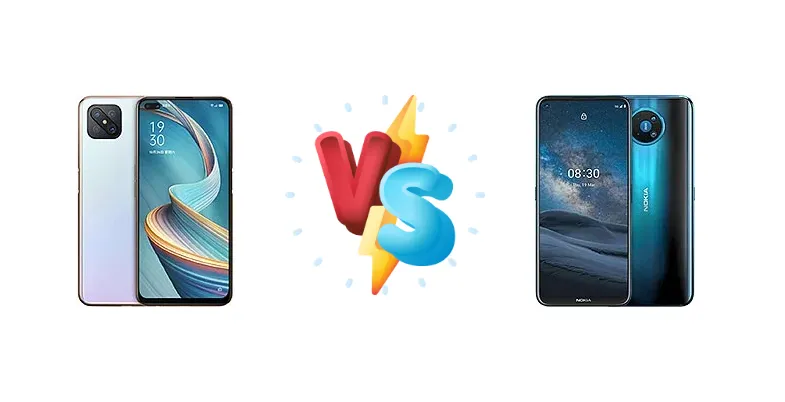
|
🏆 Quick Verdict
For the average user prioritizing consistent performance and a slightly brighter display, the Oppo Reno4 Z 5G emerges as the better choice. Its Dimensity 800 chipset offers a slight edge in raw processing power, while the Nokia 8.3 5G’s appeal lies in its brand reputation for software support and potentially more refined camera processing.
| PHONES | ||
|---|---|---|
| Phone Names | Oppo Reno4 Z 5G | Nokia 8.3 5G |
| Network | ||
|---|---|---|
| 2G bands | GSM 850 / 900 / 1800 / 1900 | GSM 850 / 900 / 1800 / 1900 |
| 3G bands | HSDPA 850 / 900 / 1700(AWS) / 1900 / 2100 | HSDPA 850 / 900 / 1700(AWS) / 1900 / 2100 |
| 4G bands | 1, 2, 3, 4, 5, 7, 8, 12, 17, 18, 19, 20, 26, 28, 38, 39, 40, 41, 66 | 1, 2, 3, 4, 5, 7, 8, 12, 13, 17, 20, 28, 32, 38, 39, 40, 41, 66, 71 |
| 5G bands | 1, 3, 5, 7, 8, 20, 28, 38, 40, 41, 77, 78 SA/NSA | 1, 2, 3, 5, 7, 8, 28, 38, 40, 41, 66, 71, 78 SA/NSA |
| Speed | HSPA, LTE, 5G 3.5 Gbps DL | HSPA 42.2/5.76 Mbps, LTE (4CA) Cat18 1200/150 Mbps, 5G 2.4/1.2 Gbps |
| Technology | GSM / HSPA / LTE / 5G | GSM / HSPA / LTE / 5G |
| Launch | ||
|---|---|---|
| Announced | 2020, September 29. Released 2020, October 15 | 2020, March 19. Released 2020, September 15 |
| Status | Discontinued | Discontinued |
| Body | ||
|---|---|---|
| Build | - | Glass front, plastic frame, glass back |
| Dimensions | 163.8 x 75.5 x 8.1 mm (6.45 x 2.97 x 0.32 in) | 171.9 x 78.6 x 9 mm (6.77 x 3.09 x 0.35 in) |
| SIM | Nano-SIM + Nano-SIM | · Nano-SIM· Nano-SIM + Nano-SIM |
| Weight | 184 g (6.49 oz) | 220 g (7.76 oz) |
| Display | ||
|---|---|---|
| Protection | Corning Gorilla Glass 3+ | - |
| Resolution | 1080 x 2400 pixels, 20:9 ratio (~401 ppi density) | 1080 x 2400 pixels, 20:9 ratio (~386 ppi density) |
| Size | 6.57 inches, 104.2 cm2 (~84.3% screen-to-body ratio) | 6.81 inches, 112.0 cm2 (~82.9% screen-to-body ratio) |
| Type | IPS LCD, 120Hz, 480 nits (typ) | IPS LCD |
| Platform | ||
|---|---|---|
| CPU | Octa-core (4x2.0 GHz Cortex-A76 & 4x2.0 GHz Cortex-A55) | Octa-core (1x2.4 GHz Kryo 475 Prime & 1x2.2 GHz Kryo 475 Gold & 6x1.8 GHz Kryo 475 Silver) |
| Chipset | Mediatek Dimensity 800 (7 nm) | Qualcomm SM7250 Snapdragon 765G 5G (7 nm) |
| GPU | Mali-G57 MC4 | Adreno 620 |
| OS | Android 10, upgradable to Android 11, ColorOS 11.1 | Android 10, upgradable to Android 12, Android One |
| Memory | ||
|---|---|---|
| Card slot | No | microSDXC (uses shared SIM slot) |
| Internal | 128GB 8GB RAM, 256GB 12GB RAM | 64GB 6GB RAM, 64GB 8GB RAM, 128GB 8GB RAM |
| UFS 2.1 | - | |
| Main Camera | ||
|---|---|---|
| Features | LED flash, HDR, panorama | Zeiss optics, Dual-LED flash, panorama, HDR |
| Quad | 48 MP, f/1.7, 26mm (wide), 1/2.0", 0.8µm, PDAF 8 MP, f/2.2, 119˚ (ultrawide), 1/4.0", 1.12µm Auxiliary lens | 64 MP, f/1.9, (wide), 1/1.72", 0.8µm, PDAF 12 MP, f/2.2, 120˚ (ultrawide), 1/2.43", 1.4µm, AF 2 MP (macro) Auxiliary lens |
| Single | 2 MP | - |
| Video | 4K@30fps, 1080p@30fps, gyro-EIS | 4K@30/60fps, 1080p@30/240fps, 720p@960fps, gyro-EIS |
| Selfie camera | ||
|---|---|---|
| Dual | 16 MP, f/2.0, 26mm (wide), 1/3.06", 1.0µm 2 MP, f/2.4, (depth) | - |
| Features | HDR | Zeiss optics, HDR |
| Single | - | 24 MP, f/2.0, (wide), 1/2.8", 0.9µm |
| Video | 1080p@30fps | 1080p@30fps |
| Sound | ||
|---|---|---|
| 3.5mm jack | Yes | Yes |
| 35mm jack | Yes | Yes |
| Loudspeaker | Yes | Yes |
| 24-bit/192kHz audio | - | |
| Comms | ||
|---|---|---|
| Bluetooth | 5.1, A2DP, LE, aptX HD | 5.0, A2DP, EDR, LE |
| NFC | Yes | Yes |
| Positioning | GPS, GLONASS, GALILEO, BDS, QZSS | GPS, GLONASS, BDS |
| Radio | No | FM radio |
| USB | USB Type-C 2.0, OTG | USB Type-C 2.0, OTG |
| WLAN | Wi-Fi 802.11 a/b/g/n/ac, dual-band, Wi-Fi Direct | Wi-Fi 802.11 a/b/g/n/ac, dual-band, Wi-Fi Direct |
| Features | ||
|---|---|---|
| Sensors | Fingerprint (side-mounted), accelerometer, gyro, proximity, compass | Fingerprint (side-mounted), accelerometer, gyro, proximity, compass |
| Battery | ||
|---|---|---|
| Charging | 18W wired | 18W wired |
| Type | Li-Po 4000 mAh | Li-Po 4500 mAh |
| Misc | ||
|---|---|---|
| Colors | Ink Black, Dew White | Polar Night |
| Models | CPH2065 | TA-1243, TA-1251 |
| Price | About 260 EUR | About 470 EUR |
| SAR | - | 0.96 W/kg (head) 1.41 W/kg (body) |
| SAR EU | - | 0.96 W/kg (head) 1.41 W/kg (body) |
| Tests | ||
|---|---|---|
| Battery life | Endurance rating 78h | - |
| Camera | Photo / Video | - |
| Display | Contrast ratio: 1284:1 (nominal) | - |
| Loudspeaker | -28.1 LUFS (Average) | - |
| Performance | AnTuTu: 295562 (v8) GeekBench: 2196 (v5.1) GFXBench: 16fps (ES 3.1 onscreen) | - |
Oppo Reno4 Z 5G
- Slightly better CPU performance with Dimensity 800
- Measured brighter display (398 nits)
- Good battery endurance (78h rating)
- Limited camera details available
- Oppo’s ColorOS may not appeal to all users
Nokia 8.3 5G
- Qualcomm’s established 5G modem technology
- Clean Android experience with guaranteed updates (Nokia’s strength)
- Potentially refined camera image processing
- Snapdragon 765G offers slightly less CPU power
- Battery capacity and charging speed are standard
Display Comparison
The Oppo Reno4 Z 5G boasts a display with a measured peak brightness of 398 nits and a 1284:1 contrast ratio. While the Nokia 8.3 5G’s display specifications aren’t provided, it’s reasonable to assume a similar brightness level given its market positioning. The Reno4 Z’s contrast ratio suggests a standard IPS panel, offering good color reproduction but potentially lacking the deep blacks of OLED displays. The lack of information on the Nokia 8.3 5G’s panel type makes a direct comparison difficult, but users should expect a comparable viewing experience in most scenarios. Neither phone is likely to excel in direct sunlight, but the Reno4 Z’s measured brightness gives it a slight advantage.
Camera Comparison
Both devices are listed as having 'Photo / Video' capabilities, lacking specific details. Without sensor size, aperture, or OIS information, a detailed camera comparison is impossible. However, given Nokia’s history with computational photography, the 8.3 5G likely prioritizes image processing to enhance detail and dynamic range. The Reno4 Z, while potentially lacking the same software polish, may benefit from the Dimensity 800’s image signal processor (ISP) for faster processing. The absence of details suggests neither phone will compete with flagship camera systems, and users should temper expectations regarding low-light performance.
Performance
The core difference between these phones lies in their chipsets. The Oppo Reno4 Z 5G utilizes the MediaTek Dimensity 800 (7nm), featuring an octa-core CPU with 4x2.0 GHz Cortex-A76 and 4x2.0 GHz Cortex-A55 cores. The Nokia 8.3 5G is powered by the Qualcomm Snapdragon 765G 5G (7nm), employing an octa-core CPU with a 1x2.4 GHz Kryo 475 Prime, 1x2.2 GHz Kryo 475 Gold, and 6x1.8 GHz Kryo 475 Silver configuration. Architecturally, the Dimensity 800’s Cortex-A76 cores are generally considered to offer slightly better single-core performance than the Snapdragon 765G’s Kryo 475 Prime core. However, Qualcomm’s optimizations and integrated 5G modem could provide a more stable and efficient 5G experience. Both phones utilize 7nm fabrication, suggesting similar power efficiency, but the Dimensity 800’s CPU architecture gives it a potential edge in demanding tasks.
Battery Life
The Oppo Reno4 Z 5G has an endurance rating of 78 hours, indicating solid battery life. Both phones support 18W wired charging, suggesting similar charging speeds – approximately 2-3 hours for a full charge. Without knowing the battery capacity of the Nokia 8.3 5G, it’s difficult to directly compare. However, the Reno4 Z’s endurance rating suggests a well-optimized power management system, potentially offsetting a smaller battery capacity in the Nokia 8.3 5G.
Buying Guide
Buy the Oppo Reno4 Z 5G if you need a phone that excels in everyday tasks and light gaming, and value a brighter screen for outdoor visibility. Buy the Nokia 8.3 5G if you prioritize a clean Android experience with guaranteed updates, and prefer Qualcomm’s established ecosystem for 5G connectivity, even if it means a slight performance trade-off.