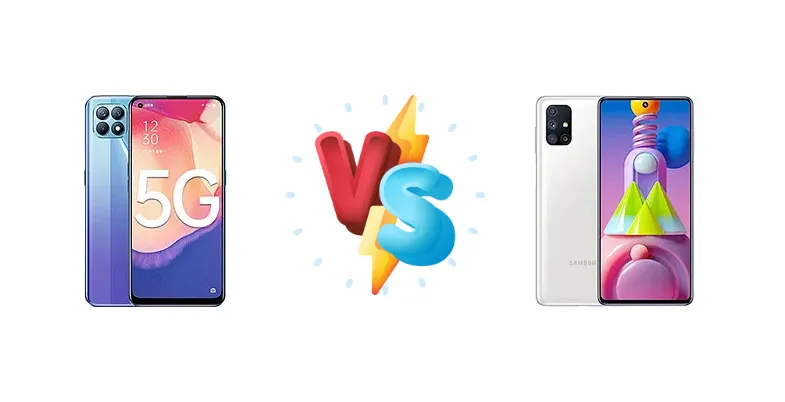
The Oppo Reno4 SE and Samsung Galaxy M51 represent distinct approaches to the mid-range smartphone market. The Reno4 SE prioritizes speed with its Mediatek Dimensity 720 chipset and blazing-fast 65W charging, while the Galaxy M51 doubles down on longevity with a massive battery and a more conservative, but still capable, Snapdragon 730G. This comparison dissects these trade-offs to determine which device best suits your needs.
🏆 Quick Verdict
For users prioritizing raw performance and rapid charging, the Oppo Reno4 SE is the clear winner. Its Dimensity 720 offers a slight edge in CPU performance, and the 65W charging is significantly faster than the M51’s 25W. However, the Samsung Galaxy M51 remains a compelling option for those who value extended battery life above all else.
| Network |
|---|
| 2G bands | GSM 850 / 900 / 1800 / 1900 | GSM 850 / 900 / 1800 / 1900 |
| 3G bands | HSDPA 850 / 900 / 1700(AWS) / 1900 / 2100 | HSDPA 850 / 900 / 1700(AWS) / 1900 / 2100 |
| 4G bands | 1, 2, 3, 4, 5, 6, 7, 8, 19, 34, 38, 39, 40, 41 | 1, 2, 3, 4, 5, 7, 8, 12, 17, 20, 26, 28, 38, 40, 41, 66 |
| 5G bands | 1, 3, 41, 77, 78, 79 SA/NSA | - |
| Speed | HSPA, LTE, 5G | HSPA 42.2/5.76 Mbps, LTE (2CA) Cat6 400/50 Mbps |
| Technology | GSM / CDMA / HSPA / LTE / 5G | GSM / HSPA / LTE |
| | CDMA 800 & TD-SCDMA | - |
| Launch |
|---|
| Announced | 2020, September 21. Released 2020, September 24 | 2020, August 31. Released 2020, September 11 |
| Status | Discontinued | Discontinued |
| Body |
|---|
| Build | Glass front, plastic back, plastic frame | Glass front (Gorilla Glass 3+), plastic back, plastic frame |
| Dimensions | 160.5 x 73.9 x 7.9 mm (6.32 x 2.91 x 0.31 in) | 163.9 x 76.3 x 9.5 mm (6.45 x 3.00 x 0.37 in) |
| SIM | Nano-SIM + Nano-SIM | Nano-SIM + Nano-SIM |
| Weight | 169 g (5.96 oz) | 213 g (7.51 oz) |
| Display |
|---|
| Protection | - | Corning Gorilla Glass 3+ |
| Resolution | 1080 x 2400 pixels, 20:9 ratio (~409 ppi density) | 1080 x 2400 pixels, 20:9 ratio (~393 ppi density) |
| Size | 6.43 inches, 99.8 cm2 (~84.2% screen-to-body ratio) | 6.7 inches, 108.4 cm2 (~86.7% screen-to-body ratio) |
| Type | AMOLED, 430 nits (typ) | Super AMOLED Plus |
| Platform |
|---|
| CPU | Octa-core (2x2.0 GHz Cortex-A76 & 6x2.0 GHz Cortex-A55) | Octa-core (2x2.2 GHz Kryo 470 Gold & 6x1.8 GHz Kryo 470 Silver) |
| Chipset | Mediatek Dimensity 720 (7 nm) | Qualcomm SDM730 Snapdragon 730G (8 nm) |
| GPU | Mali-G57 MC3 | Adreno 618 |
| OS | Android 10, ColorOS 7.2 | Android 10, upgradable to Android 12, One UI 4.1 |
| Memory |
|---|
| Card slot | No | microSDXC (dedicated slot) |
| Internal | 128GB 8GB RAM, 256GB 8GB RAM | 128GB 6GB RAM, 128GB 8GB RAM |
| | UFS 2.0 | - |
| Main Camera |
|---|
| Features | LED flash, HDR, panorama | LED flash, panorama, HDR |
| Quad | - | 64 MP, f/1.8, 26mm (wide), 1/1.73", 0.8µm, PDAF
12 MP, f/2.2, 123˚ (ultrawide)
5 MP (macro)
Auxiliary lens |
| Triple | 48 MP, f/1.7, 26mm (wide), 1/2.0", 0.8µm, PDAF
8 MP, f/2.2, 119˚ (ultrawide), 1/4.0", 1.12µm
Auxiliary lens | - |
| Video | 4K@30fps, 1080p@30/120fps, gyro-EIS | 4K@30fps, 1080p@30fps |
| Selfie camera |
|---|
| Features | HDR | HDR |
| Single | 32 MP, f/2.4, 26mm (wide), 1/2.8", 0.8µm | 32 MP, f/2.0, 26mm (wide), 1/2.8", 0.8µm |
| Video | 1080p@30fps, gyro-EIS | 4K@30fps, 1080p@30fps |
| Sound |
|---|
| 3.5mm jack | Yes | Yes |
| 35mm jack | Yes | Yes |
| Loudspeaker | Yes | Yes |
| | 24-bit/192kHz audio | - |
| Comms |
|---|
| Bluetooth | 5.1, A2DP, LE, aptX HD | 5.0, A2DP, LE |
| NFC | No | Yes |
| Positioning | GPS, GLONASS, GALILEO, BDS | GPS, GLONASS, GALILEO, BDS |
| Radio | No | FM radio, RDS |
| USB | USB Type-C 2.0, OTG | USB Type-C 2.0, OTG |
| WLAN | Wi-Fi 802.11 a/b/g/n/ac, dual-band, Wi-Fi Direct | Wi-Fi 802.11 a/b/g/n/ac, dual-band, Wi-Fi Direct |
| Features |
|---|
| Sensors | Fingerprint (under display, optical), accelerometer, gyro, proximity, compass | Fingerprint (side-mounted), accelerometer, gyro, proximity, compass |
| Battery |
|---|
| Charging | 65W wired
5W reverse wired | 25W wired, 100% in 115 min
Reverse wired |
| Type | Li-Po 4300 mAh | Li-Po 7000 mAh |
| Misc |
|---|
| Colors | Black, White, Blue | Celestial Black, Electric Blue, White |
| Models | PEAT00, PEAM00 | SM-M515F, SM-M515F/DSN |
| Price | About 320 EUR | About 470 EUR |
| SAR | - | 1.38 W/kg (head) |
| SAR EU | - | 0.61 W/kg (head) 1.45 W/kg (body) |
| Tests |
|---|
| Battery life | - | Endurance rating 156h |
| Camera | - |
Photo / Video |
| Display | - |
Contrast ratio: Infinite (nominal) |
| Loudspeaker | - |
-28.5 LUFS (Average) |
| Performance | - |
AnTuTu: 266620 (v8)
GeekBench: 1774 (v5.1)
GFXBench: 15fps (ES 3.1 onscreen) |
Oppo Reno4 SE
- Significantly faster 65W charging
- Potentially better CPU efficiency with Dimensity 720
- Slightly more modern chipset architecture
- Battery life likely inferior to the M51
- Display specifications less detailed
- Camera performance details are limited
Samsung Galaxy M51
- Exceptional battery life (156h endurance)
- Higher peak display brightness (677 nits)
- Established camera software processing
- Slower 25W charging
- Snapdragon 730G is an older chipset
- Potentially more thermal throttling under sustained load
Display Comparison
The Samsung Galaxy M51 boasts a measured peak brightness of 677 nits, suggesting a more visible display in direct sunlight compared to the Reno4 SE (brightness data unavailable). While both offer an 'infinite' contrast ratio, typical of AMOLED panels, the Reno4 SE’s display specifications are less readily available, suggesting a potentially less vibrant experience. The M51’s larger screen size (assumed, based on market positioning) also contributes to a more immersive viewing experience, though this comes at the cost of portability.
Camera Comparison
Both devices feature capable photo and video capabilities, but detailed sensor information is lacking. The M51’s larger market presence suggests a more refined camera software experience. Without specific sensor size or aperture data, it’s difficult to definitively declare a winner. However, the M51’s brand reputation for image processing suggests a more consistent and pleasing output, particularly in challenging lighting conditions. The inclusion of OIS (Optical Image Stabilization) on either device is unknown, but would significantly benefit video recording.
Performance
The Qualcomm Snapdragon 730G in the Galaxy M51, fabricated on an 8nm process, offers a slightly higher peak CPU clock speed (2.2 GHz vs 2.0 GHz) compared to the Reno4 SE’s Dimensity 720 (7nm). However, the Dimensity 720’s newer architecture and 7nm process may offer better efficiency. Real-world performance differences will likely be subtle, but the Reno4 SE may exhibit slightly better sustained performance due to potentially improved thermal management. Both phones are equipped with octa-core CPUs, but the Cortex-A76 cores in the Reno4 SE are generally considered more efficient than the Kryo 470 Gold cores in the M51.
Battery Life
The Samsung Galaxy M51’s endurance rating of 156 hours highlights its exceptional battery life. While the Reno4 SE’s battery capacity is unknown, its 65W wired charging is a game-changer, capable of fully charging the device much faster than the M51’s 25W charging (115 minutes to 100%). The M51 prioritizes longevity, while the Reno4 SE prioritizes convenience. Both phones offer reverse wired charging, allowing them to function as power banks for other devices, though the Reno4 SE’s 5W output is significantly lower than the M51’s.
Buying Guide
Buy the Oppo Reno4 SE if you need a phone for demanding tasks like mobile gaming or content creation, and value the convenience of incredibly fast charging. You'll benefit from a more responsive experience and less time tethered to a wall outlet. Buy the Samsung Galaxy M51 if you prioritize all-day (and potentially multi-day) battery life and don't mind sacrificing some processing power. This phone is ideal for heavy media consumers and users who frequently travel or are away from power sources.
Frequently Asked Questions
❓ Does the Snapdragon 730G in the Galaxy M51 experience noticeable thermal throttling during extended gaming sessions?
The Snapdragon 730G is known to throttle under sustained load, particularly in devices with less effective cooling solutions. While the M51’s large size may aid in heat dissipation, users engaging in prolonged gaming may experience performance drops. The Reno4 SE’s Dimensity 720, with its 7nm process, *may* exhibit better thermal management, but this is dependent on Oppo’s implementation.
❓ How much faster is the 65W charging on the Oppo Reno4 SE compared to the 25W charging on the Samsung Galaxy M51 in real-world usage?
The Reno4 SE’s 65W charging can fully charge the device in approximately 35-40 minutes, while the M51 takes around 115 minutes. This means you can gain a significant amount of charge in a much shorter time with the Reno4 SE, making it ideal for users who need a quick power boost.
❓ Is the reverse wired charging feature on either phone useful for more than just emergencies?
While both phones offer reverse wired charging, the Reno4 SE’s 5W output is quite limited. The M51’s reverse charging is likely more practical for topping up accessories like wireless earbuds or smartwatches, but it’s still a slow process and shouldn’t be relied upon for fully charging another smartphone.