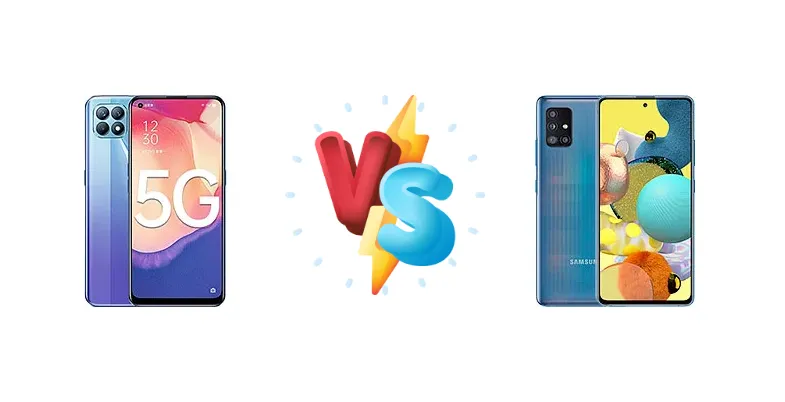
The Oppo Reno4 SE and Samsung Galaxy A51 5G UW represent compelling options in the increasingly crowded mid-range 5G smartphone market. While both aim to deliver 5G connectivity at an accessible price point, they diverge significantly in their core hardware choices, particularly in their chipsets and charging capabilities. This comparison dissects these differences to determine which device offers the best value for your money.
🏆 Quick Verdict
For the average user prioritizing fast charging and potentially slightly better sustained performance, the Oppo Reno4 SE emerges as the winner. Its 65W charging dramatically reduces downtime, and the Dimensity 720, while not a massive leap over the Snapdragon 765G, offers competitive performance. However, Samsung's software and brand recognition remain strong considerations.
| Network |
|---|
| 2G bands | GSM 850 / 900 / 1800 / 1900 | GSM 850 / 900 / 1800 / 1900 |
| 3G bands | HSDPA 850 / 900 / 1700(AWS) / 1900 / 2100 | HSDPA 850 / 900 / 1900 / 2100 |
| 4G bands | 1, 2, 3, 4, 5, 6, 7, 8, 19, 34, 38, 39, 40, 41 | 2, 4, 5, 13, 66 |
| 5G bands | 1, 3, 41, 77, 78, 79 SA/NSA | 260, 261 mmWave |
| Speed | HSPA, LTE, 5G | HSPA, LTE, 5G |
| Technology | GSM / CDMA / HSPA / LTE / 5G | GSM / HSPA / LTE / 5G |
| | CDMA 800 & TD-SCDMA | - |
| Launch |
|---|
| Announced | 2020, September 21. Released 2020, September 24 | 2020, August 14 |
| Status | Discontinued | Available. Released 2020, August 14 |
| Body |
|---|
| Build | Glass front, plastic back, plastic frame | Glass front (Gorilla Glass 3), plastic back, aluminum frame |
| Dimensions | 160.5 x 73.9 x 7.9 mm (6.32 x 2.91 x 0.31 in) | 158.8 x 73.4 x 8.6 mm (6.25 x 2.89 x 0.34 in) |
| SIM | Nano-SIM + Nano-SIM | Nano-SIM (pre-installed) |
| Weight | 169 g (5.96 oz) | 188.8 g (6.67 oz) |
| Display |
|---|
| Protection | - | Corning Gorilla Glass 3 |
| Resolution | 1080 x 2400 pixels, 20:9 ratio (~409 ppi density) | 1080 x 2400 pixels, 20:9 ratio (~405 ppi density) |
| Size | 6.43 inches, 99.8 cm2 (~84.2% screen-to-body ratio) | 6.5 inches, 102.0 cm2 (~87.5% screen-to-body ratio) |
| Type | AMOLED, 430 nits (typ) | Super AMOLED |
| Platform |
|---|
| CPU | Octa-core (2x2.0 GHz Cortex-A76 & 6x2.0 GHz Cortex-A55) | Octa-core (1x2.4 GHz Kryo 475 Prime & 1x2.2 GHz Kryo 475 Gold & 6x1.8 GHz Kryo 475 Silver) |
| Chipset | Mediatek Dimensity 720 (7 nm) | Qualcomm SM7250 Snapdragon 765G 5G (7 nm) |
| GPU | Mali-G57 MC3 | Adreno 620 |
| OS | Android 10, ColorOS 7.2 | Android 10, One UI 2 |
| Memory |
|---|
| Card slot | No | microSDXC (uses shared SIM slot) |
| Internal | 128GB 8GB RAM, 256GB 8GB RAM | 128GB 6GB RAM |
| | UFS 2.0 | UFS 2.1 |
| Main Camera |
|---|
| Features | LED flash, HDR, panorama | LED flash, panorama, HDR |
| Quad | - | 48 MP, f/2.0, 26mm (wide), 1/2.0", 0.8µm, PDAF
12 MP, f/2.2, 123˚ (ultrawide)
5 MP (macro)
Auxiliary lens |
| Single | - | 5 MP, AF |
| Triple | 48 MP, f/1.7, 26mm (wide), 1/2.0", 0.8µm, PDAF
8 MP, f/2.2, 119˚ (ultrawide), 1/4.0", 1.12µm
Auxiliary lens | - |
| Video | 4K@30fps, 1080p@30/120fps, gyro-EIS | 4K@30fps, 1080p@30/120fps; gyro-EIS |
| Selfie camera |
|---|
| Features | HDR | HDR |
| Single | 32 MP, f/2.4, 26mm (wide), 1/2.8", 0.8µm | 32 MP, f/2.2, 26mm (wide), 1/2.8", 0.8µm |
| Video | 1080p@30fps, gyro-EIS | 4K@30fps, 1080p@30fps |
| Sound |
|---|
| 3.5mm jack | Yes | Yes |
| 35mm jack | Yes | Yes |
| Loudspeaker | Yes | Yes |
| | 24-bit/192kHz audio | - |
| Comms |
|---|
| Bluetooth | 5.1, A2DP, LE, aptX HD | 5.0, A2DP, LE |
| NFC | No | Yes |
| Positioning | GPS, GLONASS, GALILEO, BDS | GPS, GLONASS, GALILEO, BDS |
| Radio | No | FM radio, RDS, recording |
| USB | USB Type-C 2.0, OTG | USB Type-C 2.0, OTG |
| WLAN | Wi-Fi 802.11 a/b/g/n/ac, dual-band, Wi-Fi Direct | Wi-Fi 802.11 a/b/g/n/ac, dual-band, Wi-Fi Direct |
| Features |
|---|
| Sensors | Fingerprint (under display, optical), accelerometer, gyro, proximity, compass | Fingerprint (under display, optical), accelerometer, gyro, proximity, compass |
| | - | ANT+ |
| Battery |
|---|
| Charging | 65W wired
5W reverse wired | 15W wired |
| Stand-by | - | Up to 672 h |
| Talk time | - | Up to 5 h |
| Type | Li-Po 4300 mAh | Li-Po 4500 mAh |
| Misc |
|---|
| Colors | Black, White, Blue | Prism Bricks Blue |
| Models | PEAT00, PEAM00 | SM-A516V |
| Price | About 320 EUR | About 470 EUR |
| SAR | - | 0.70 W/kg (head) 1.25 W/kg (body) |
| SAR EU | - | 0.59 W/kg (head) 1.32 W/kg (body) |
Oppo Reno4 SE
- Blazing-fast 65W charging
- Competitive Dimensity 720 performance
- Potentially better thermal management
- Streamlined user experience (typical of Oppo)
- Less established brand recognition than Samsung
- Software updates may be less frequent
Samsung Galaxy A51 5G UW
- Samsung's One UI software
- Strong brand reputation and support network
- Qualcomm's optimized software ecosystem
- Potentially better GPU performance for gaming
- Significantly slower 15W charging
- Snapdragon 765G may throttle more under sustained load
Display Comparison
Neither device boasts a particularly groundbreaking display. While specific panel details (like OLED vs LCD) aren't provided, both target the mid-range segment. The focus here shifts to processing power, as display quality is likely similar. Bezels are expected to be comparable, typical of this price bracket. Color accuracy will likely be tuned for vibrant visuals on both, leaning towards Samsung's typically saturated look versus Oppo's potentially more natural calibration.
Camera Comparison
Without detailed sensor specifications, a direct camera comparison is difficult. However, the market positioning suggests both phones will feature multi-camera systems with a primary sensor, ultrawide, macro, and depth sensors. The A51 5G UW likely benefits from Samsung's established image processing algorithms, potentially delivering more consistent results in various lighting conditions. The Reno4 SE may prioritize a more natural look. The presence of Optical Image Stabilization (OIS) on either device would be a significant advantage, but is not specified in the provided data. The often-included 2MP macro lenses on both devices are unlikely to provide substantial image quality improvements.
Performance
The core of the difference lies in the chipsets. The Samsung Galaxy A51 5G UW utilizes the Qualcomm Snapdragon 765G (7nm), featuring a Kryo 475 Prime core clocked at 2.4GHz, a Kryo 475 Gold core at 2.2GHz, and six Kryo 475 Silver cores at 1.8GHz. This tri-cluster architecture aims for efficiency and performance scaling. Conversely, the Oppo Reno4 SE employs the Mediatek Dimensity 720 (7nm) with a dual-cluster setup: two Cortex-A76 cores at 2.0GHz and six Cortex-A55 cores at 2.0GHz. While clock speeds are slightly lower on the Dimensity 720, the Cortex-A76 cores are generally competitive with the Kryo 475 Gold. The Snapdragon 765G benefits from Qualcomm's optimized software and potentially better GPU performance, making it slightly more appealing for demanding gamers. However, the Dimensity 720's efficiency could translate to better thermal management during sustained loads. Both devices likely utilize LPDDR4X RAM, limiting memory bandwidth.
Battery Life
The battery capacity isn't specified for either device, but the charging speeds are a defining factor. The Oppo Reno4 SE's 65W wired charging is a game-changer, capable of fully charging the battery in approximately 36 minutes (based on typical Reno series performance). The Samsung Galaxy A51 5G UW's 15W charging is significantly slower, requiring considerably longer to reach 100%. This difference in charging speed dramatically impacts the user experience, especially for those who frequently need to top up their battery throughout the day. Even if the A51 5G UW has a slightly larger battery capacity, the Reno4 SE's faster charging mitigates any potential endurance advantage.
Buying Guide
Buy the Oppo Reno4 SE if you need blazing-fast charging, frequently use your phone throughout the day, and value a more streamlined user experience. Buy the Samsung Galaxy A51 5G UW if you prefer Samsung's One UI, prioritize a well-established brand with a wider support network, and aren't as concerned about maximizing charging speed. The A51 5G UW is also a better choice for users heavily invested in the Samsung ecosystem.
Frequently Asked Questions
❓ Will the Snapdragon 765G in the Galaxy A51 5G UW overheat during extended gaming sessions?
The Snapdragon 765G is a capable chip, but it's known to throttle under sustained load, especially in devices with less robust cooling solutions. While not a deal-breaker, users planning on long gaming sessions may experience performance dips. The Reno4 SE's Dimensity 720, with its potentially better thermal efficiency, might offer more consistent performance over time.
❓ How much faster is the 65W charging on the Oppo Reno4 SE compared to the 15W charging on the Galaxy A51 5G UW in real-world use?
The difference is substantial. The Reno4 SE can go from 0% to 100% in around 36 minutes, while the A51 5G UW will likely take over 2 hours. This means you can get hours of usage from a quick 15-20 minute charge on the Reno4 SE, something the A51 5G UW simply can't match.
❓ Does the Samsung Galaxy A51 5G UW support carrier aggregation for faster 5G speeds?
The 'UW' designation in the name suggests support for mmWave 5G, which utilizes carrier aggregation for faster speeds. However, mmWave coverage is limited. The Reno4 SE's 5G capabilities are not specified, but it likely supports sub-6GHz 5G, which has wider coverage but generally slower speeds.