
Oppo Reno 5G vs Reno4 SE: A Deep Dive into Mid-Range Performance and Value
| Phones Images | |||||
|---|---|---|---|---|---|
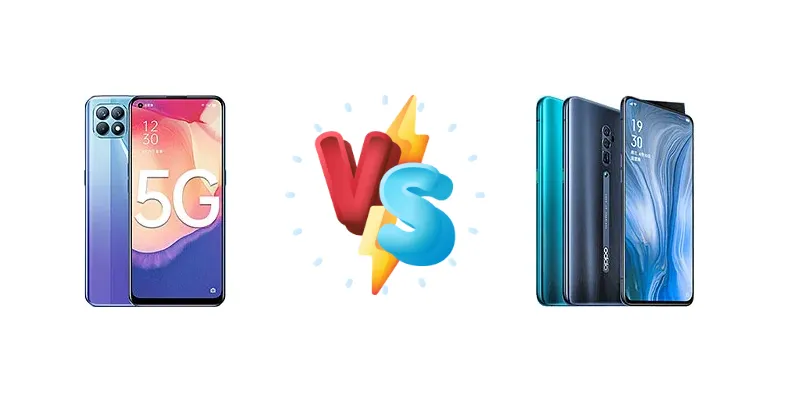
|
🏆 Quick Verdict
For most users, the Oppo Reno 5G emerges as the stronger choice. While the Reno4 SE boasts faster 65W charging, the Snapdragon 855 in the Reno 5G provides a significant performance advantage in demanding tasks and gaming, justifying the trade-off in charging speed. The Reno 5G offers a more future-proof experience.
| PHONES | ||
|---|---|---|
| Phone Names | Oppo Reno4 SE | Oppo Reno 5G |
| Network | ||
|---|---|---|
| 2G bands | GSM 850 / 900 / 1800 / 1900 | GSM 850 / 900 / 1800 / 1900 |
| 3G bands | HSDPA 850 / 900 / 1700(AWS) / 1900 / 2100 | HSDPA 800 / 850 / 900 / 1700(AWS) / 1900 / 2100 |
| 4G bands | 1, 2, 3, 4, 5, 6, 7, 8, 19, 34, 38, 39, 40, 41 | 1, 2, 3, 4, 5, 7, 8, 12, 13, 17, 18, 19, 20, 25, 26, 28, 29, 32, 34, 38, 39, 40, 41, 66 - Global |
| 5G bands | 1, 3, 41, 77, 78, 79 SA/NSA | 78 NSA/Sub6 |
| Speed | HSPA, LTE, 5G | HSPA 42.2/5.76 Mbps, LTE (5CA) Cat18 1200/150 Mbps, 5G (2+ Gbps DL) |
| Technology | GSM / CDMA / HSPA / LTE / 5G | GSM / CDMA / HSPA / EVDO / LTE / 5G |
| CDMA 800 & TD-SCDMA | CDMA2000 1xEV-DO | |
| Launch | ||
|---|---|---|
| Announced | 2020, September 21. Released 2020, September 24 | 2019, April. Released 2019, May |
| Status | Discontinued | Discontinued |
| Body | ||
|---|---|---|
| Build | Glass front, plastic back, plastic frame | Glass front (Gorilla Glass 6), glass back (Gorilla Glass 5), aluminum frame |
| Dimensions | 160.5 x 73.9 x 7.9 mm (6.32 x 2.91 x 0.31 in) | 162 x 77.2 x 9.3 mm (6.38 x 3.04 x 0.37 in) |
| SIM | Nano-SIM + Nano-SIM | · Nano-SIM· Nano-SIM + Nano-SIM |
| Weight | 169 g (5.96 oz) | 215 g (7.58 oz) |
| Display | ||
|---|---|---|
| Protection | - | Corning Gorilla Glass 6 |
| Resolution | 1080 x 2400 pixels, 20:9 ratio (~409 ppi density) | 1080 x 2340 pixels, 19.5:9 ratio (~387 ppi density) |
| Size | 6.43 inches, 99.8 cm2 (~84.2% screen-to-body ratio) | 6.6 inches, 108.6 cm2 (~86.8% screen-to-body ratio) |
| Type | AMOLED, 430 nits (typ) | AMOLED |
| Platform | ||
|---|---|---|
| CPU | Octa-core (2x2.0 GHz Cortex-A76 & 6x2.0 GHz Cortex-A55) | Octa-core (1x2.84 GHz Kryo 485 & 3x2.42 GHz Kryo 485 & 4x1.78 GHz Kryo 485) |
| Chipset | Mediatek Dimensity 720 (7 nm) | Qualcomm SM8150 Snapdragon 855 (7 nm) |
| GPU | Mali-G57 MC3 | Adreno 640 |
| OS | Android 10, ColorOS 7.2 | Android 9.0 (Pie), ColorOS 6 |
| Memory | ||
|---|---|---|
| Card slot | No | microSDXC (uses shared SIM slot) |
| Internal | 128GB 8GB RAM, 256GB 8GB RAM | 256GB 8GB RAM |
| UFS 2.0 | UFS 2.1 | |
| Main Camera | ||
|---|---|---|
| Features | LED flash, HDR, panorama | Laser AF, Dual-LED flash, HDR, panorama |
| Triple | 48 MP, f/1.7, 26mm (wide), 1/2.0", 0.8µm, PDAF 8 MP, f/2.2, 119˚ (ultrawide), 1/4.0", 1.12µm Auxiliary lens | 48 MP, f/1.7, 26mm (wide), 1/2.0", 0.8µm, PDAF, OIS 13 MP, f/3.0, 130mm (periscope telephoto), 5x optical zoom, PDAF, OIS 8 MP, f/2.2, 16mm (ultrawide) |
| Video | 4K@30fps, 1080p@30/120fps, gyro-EIS | 4K@30/60fps, 1080p@30/60/240fps, gyro-EIS; video rec. only with main camera |
| Selfie camera | ||
|---|---|---|
| Features | HDR | LED flash, HDR |
| Single | 32 MP, f/2.4, 26mm (wide), 1/2.8", 0.8µm | Motorized pop-up 16 MP, f/2.0, 26mm (wide), 1/3.06", 1.0µm |
| Video | 1080p@30fps, gyro-EIS | 1080p@30fps |
| Sound | ||
|---|---|---|
| 3.5mm jack | Yes | No |
| 35mm jack | Yes | No |
| Loudspeaker | Yes | Yes, with stereo speakers |
| 24-bit/192kHz audio | 24-bit/192kHz audio | |
| Comms | ||
|---|---|---|
| Bluetooth | 5.1, A2DP, LE, aptX HD | 5.0, A2DP, EDR, LE, aptX HD |
| NFC | No | Yes |
| Positioning | GPS, GLONASS, GALILEO, BDS | GPS (L1+L5), GLONASS, BDS, GALILEO, QZSS |
| Radio | No | No |
| USB | USB Type-C 2.0, OTG | USB Type-C, OTG |
| WLAN | Wi-Fi 802.11 a/b/g/n/ac, dual-band, Wi-Fi Direct | Wi-Fi 802.11 a/b/g/n/ac, dual-band, Wi-Fi Direct |
| Features | ||
|---|---|---|
| Sensors | Fingerprint (under display, optical), accelerometer, gyro, proximity, compass | Fingerprint (under display, optical), accelerometer, gyro, proximity, compass |
| Battery | ||
|---|---|---|
| Charging | 65W wired 5W reverse wired | 20W wired |
| Type | Li-Po 4300 mAh | Li-Po 4065 mAh, non-removable |
| Misc | ||
|---|---|---|
| Colors | Black, White, Blue | Ocean Green, Jet Black |
| Models | PEAT00, PEAM00 | CPH1921 |
| Price | About 320 EUR | About 880 EUR |
Oppo Reno4 SE
- 65W SuperVOOC Charging: Extremely fast charging speeds.
- More Power Efficient Chipset: Dimensity 720 offers good battery life.
- Potentially Lower Price: Often available at a more affordable price point.
- Lower Performance: Dimensity 720 is less powerful than Snapdragon 855.
- Less Future-Proof: May struggle with demanding games and apps in the long run.
Oppo Reno 5G
- Superior Performance: Snapdragon 855 delivers significantly faster processing.
- Better Gaming Experience: Handles demanding games with ease.
- More Robust ISP: Potentially better image quality and processing.
- Slower Charging: 20W charging is considerably slower than the Reno4 SE.
- Potentially More Throttling: Snapdragon 855 can throttle under sustained load.
Display Comparison
Neither Oppo provides detailed display specs beyond resolution in their marketing. However, both likely utilize AMOLED panels, common for the Reno series. The Reno 5G, being the older model, may have slightly lower peak brightness. The Reno4 SE's panel is likely optimized for power efficiency given the Dimensity 720's focus. Without specific nit ratings, it's difficult to declare a clear winner, but the Reno 5G's higher price point suggests a potentially more refined display calibration.
Camera Comparison
Detailed camera specs are unavailable. However, the Reno series generally emphasizes camera capabilities. Given the Reno 5G’s higher initial price, it likely features a more sophisticated image signal processor (ISP) within the Snapdragon 855, potentially leading to better dynamic range and low-light performance. The Reno4 SE’s Dimensity 720 ISP is capable, but likely less advanced. Without knowing sensor sizes and lens apertures, it’s difficult to make a definitive judgment, but the Reno 5G’s processing power gives it an edge in image quality.
Performance
The core difference lies in the chipsets. The Qualcomm Snapdragon 855 (7nm) in the Reno 5G features a 1x2.84 GHz Kryo 485 prime core, supported by 3x2.42 GHz Kryo 485 cores and 4x1.78 GHz Kryo 485 cores. This contrasts with the Mediatek Dimensity 720 (7nm) in the Reno4 SE, utilizing a 2x2.0 GHz Cortex-A76 and 6x2.0 GHz Cortex-A55 configuration. The Snapdragon 855’s architecture, with its higher clock speeds and more powerful cores, delivers significantly better CPU and GPU performance. While both are 7nm chips, the Snapdragon 855’s design is geared towards higher sustained performance, though it can be prone to thermal throttling under prolonged heavy load. The Reno4 SE’s Dimensity 720 is more efficient, but sacrifices raw power. This translates to smoother gaming and faster app loading times on the Reno 5G.
Battery Life
The Reno4 SE’s 65W wired charging is a major advantage, allowing for a full charge in under 40 minutes. The Reno 5G’s 20W charging is considerably slower, taking significantly longer to reach 100%. However, battery life is also influenced by chipset efficiency. The Dimensity 720 is more power-efficient, potentially offsetting the Reno 5G’s more demanding processor. Real-world usage will determine the actual battery endurance, but the Reno4 SE’s charging speed is a compelling feature for users who prioritize quick top-ups.
Buying Guide
Buy the Oppo Reno4 SE if you prioritize extremely fast charging and are a casual user who primarily focuses on social media, browsing, and light tasks. Its 65W charging is a standout feature. Buy the Oppo Reno 5G if you value performance for gaming, multitasking, or demanding applications, and are willing to accept a slower 20W charging speed. The Snapdragon 855 offers a more robust and responsive experience.