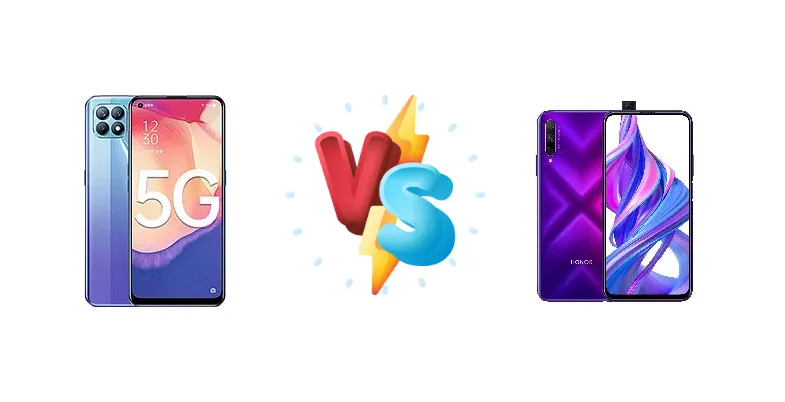
The Oppo Reno4 SE and Honor 9X Pro represent compelling options in the mid-range smartphone market, but cater to slightly different priorities. The Reno4 SE emphasizes rapid charging and a newer chipset, while the 9X Pro boasts impressive battery endurance and a respectable display. This comparison dives deep into their specifications to determine which device delivers the best overall experience.
🏆 Quick Verdict
For most users, the Oppo Reno4 SE emerges as the stronger choice. Its Mediatek Dimensity 720 chipset, coupled with 65W fast charging, provides a noticeable performance and convenience advantage over the Honor 9X Pro’s Kirin 810 and 10W charging. While the 9X Pro’s battery endurance is commendable, the Reno4 SE’s charging speed mitigates any significant battery life concerns.
| Network |
|---|
| 2G bands | GSM 850 / 900 / 1800 / 1900 | GSM 850 / 900 / 1800 / 1900 |
| 3G bands | HSDPA 850 / 900 / 1700(AWS) / 1900 / 2100 | HSDPA 850 / 900 / 2100 |
| 4G bands | 1, 2, 3, 4, 5, 6, 7, 8, 19, 34, 38, 39, 40, 41 | 1, 3, 7, 8, 20, 38, 40, 41 - International |
| 5G bands | 1, 3, 41, 77, 78, 79 SA/NSA | - |
| Speed | HSPA, LTE, 5G | HSPA 42.2/5.76 Mbps, LTE (2CA) Cat12 600/50 Mbps |
| Technology | GSM / CDMA / HSPA / LTE / 5G | GSM / CDMA / HSPA / EVDO / LTE |
| | CDMA 800 & TD-SCDMA | 1, 3, 5, 8, 38, 39, 40, 41 - China |
| Launch |
|---|
| Announced | 2020, September 21. Released 2020, September 24 | 2019, July 23. Released 2019, August 09 |
| Status | Discontinued | Discontinued |
| Body |
|---|
| Build | Glass front, plastic back, plastic frame | Glass front, glass back, aluminum frame |
| Dimensions | 160.5 x 73.9 x 7.9 mm (6.32 x 2.91 x 0.31 in) | 163.5 x 77.3 x 8.8 mm (6.44 x 3.04 x 0.35 in) |
| SIM | Nano-SIM + Nano-SIM | Nano-SIM + Nano-SIM |
| Weight | 169 g (5.96 oz) | 202 g (7.13 oz) |
| Display |
|---|
| Resolution | 1080 x 2400 pixels, 20:9 ratio (~409 ppi density) | 1080 x 2340 pixels, 19.5:9 ratio (~391 ppi density) |
| Size | 6.43 inches, 99.8 cm2 (~84.2% screen-to-body ratio) | 6.59 inches, 106.6 cm2 (~84.3% screen-to-body ratio) |
| Type | AMOLED, 430 nits (typ) | IPS LCD |
| Platform |
|---|
| CPU | Octa-core (2x2.0 GHz Cortex-A76 & 6x2.0 GHz Cortex-A55) | Octa-core (2x2.27 GHz Cortex-A76 & 6x1.88 GHz Cortex-A55) |
| Chipset | Mediatek Dimensity 720 (7 nm) | Kirin 810 (7 nm) |
| GPU | Mali-G57 MC3 | Mali-G52 MP6 |
| OS | Android 10, ColorOS 7.2 | Android 9.0 (Pie), upgradable to Android 10, EMUI 9.1, no Google Play Services |
| Memory |
|---|
| Card slot | No | microSDXC (uses shared SIM slot) |
| Internal | 128GB 8GB RAM, 256GB 8GB RAM | 128GB 8GB RAM, 256GB 6GB RAM, 256GB 8GB RAM |
| | UFS 2.0 | - |
| Main Camera |
|---|
| Features | LED flash, HDR, panorama | LED flash, HDR, panorama |
| Triple | 48 MP, f/1.7, 26mm (wide), 1/2.0", 0.8µm, PDAF
8 MP, f/2.2, 119˚ (ultrawide), 1/4.0", 1.12µm
Auxiliary lens | 48 MP, f/1.8, (wide), 1/2.0", 0.8µm, PDAF
8 MP, f/2.4, 120˚ (ultrawide)
Auxiliary lens |
| Video | 4K@30fps, 1080p@30/120fps, gyro-EIS | 1080p@30fps, gyro-EIS |
| Selfie camera |
|---|
| Features | HDR | - |
| Single | 32 MP, f/2.4, 26mm (wide), 1/2.8", 0.8µm | Motorized pop-up 16 MP, f/2.2, 26mm (wide), 1/3.06", 1.0µm |
| Video | 1080p@30fps, gyro-EIS | 1080p@60fps |
| Sound |
|---|
| 3.5mm jack | Yes | Yes |
| 35mm jack | Yes | Yes |
| Loudspeaker | Yes | Yes |
| | 24-bit/192kHz audio | - |
| Comms |
|---|
| Bluetooth | 5.1, A2DP, LE, aptX HD | 4.2, A2DP, LE (International)5.0, A2DP, LE (China) |
| NFC | No | No |
| Positioning | GPS, GLONASS, GALILEO, BDS | GPS, GLONASS, BDS |
| Radio | No | FM radio |
| USB | USB Type-C 2.0, OTG | USB Type-C 2.0 |
| WLAN | Wi-Fi 802.11 a/b/g/n/ac, dual-band, Wi-Fi Direct | Wi-Fi 802.11 a/b/g/n/ac, dual-band, Wi-Fi Direct |
| Features |
|---|
| Sensors | Fingerprint (under display, optical), accelerometer, gyro, proximity, compass | Fingerprint (side-mounted), accelerometer, gyro, proximity, compass |
| Battery |
|---|
| Charging | 65W wired
5W reverse wired | 10W wired |
| Type | Li-Po 4300 mAh | Li-Po 4000 mAh, non-removable |
| Misc |
|---|
| Colors | Black, White, Blue | Midnight Black, Phantom Purple |
| Models | PEAT00, PEAM00 | HLK-AL10, HLK-TL10, HLK-L41, HLK-L42 |
| Price | About 320 EUR | About 230 EUR |
| Tests |
|---|
| Battery life | - |
Endurance rating 104h
|
| Camera | - |
Photo / Video |
| Display | - |
Contrast ratio: 1319:1 (nominal) |
| Loudspeaker | - |
-31.1 LUFS (Below average)
|
| Performance | - |
AnTuTu: 312668 (v8)
GeekBench: 7836 (v4.4), 1911 (v5.1)
GFXBench: 18fps (ES 3.1 onscreen) |
Oppo Reno4 SE
- 65W SuperVOOC charging for incredibly fast top-ups
- Mediatek Dimensity 720 offers a modern chipset with 5G support
- Potentially better single-core performance due to newer CPU architecture
- Battery capacity is unknown, potentially smaller than the 9X Pro
- Camera specifications are not detailed, making it difficult to assess image quality
Honor 9X Pro
- Exceptional battery endurance with a 104-hour rating
- Respectable display brightness and contrast ratio
- Kirin 810 provides adequate performance for everyday tasks
- Slow 10W charging takes several hours for a full charge
- Lacks 5G connectivity
- Older chipset may struggle with demanding games
Display Comparison
The Honor 9X Pro’s display boasts a measured peak brightness of 517 nits and a 1319:1 contrast ratio, providing a reasonably vibrant viewing experience. However, the Reno4 SE’s display specifications are not provided, leaving a gap in direct comparison. Given the Reno4 SE’s market positioning, it likely features a similar LCD panel, but without specific data, it’s difficult to assess potential differences in color accuracy or viewing angles. Both devices share the same contrast ratio, suggesting similar black levels, but the 9X Pro’s measured brightness gives it a slight edge for outdoor visibility.
Camera Comparison
Both phones feature 'Photo / Video' capabilities, but lack detailed camera specifications. Without sensor size, aperture, or image processing details, a meaningful comparison is impossible. It’s reasonable to assume both phones target the mid-range camera experience, focusing on adequate performance in good lighting conditions. The absence of information regarding OIS or advanced features suggests neither phone will excel in low-light photography.
Performance
Both the Oppo Reno4 SE and Honor 9X Pro utilize 7nm process nodes, but the Kirin 810 in the 9X Pro has a slightly higher peak CPU clock speed (2.27 GHz vs 2.0 GHz on the Reno4 SE’s Dimensity 720). However, the Dimensity 720’s Cortex-A76 cores are newer architecture, potentially offering better single-core performance despite the lower clock speed. The Dimensity 720 also benefits from integrated 5G modem, a feature absent in the 9X Pro. Real-world performance will likely be similar for everyday tasks, but the Reno4 SE should exhibit a slight advantage in demanding applications and games.
Battery Life
The Honor 9X Pro boasts an impressive endurance rating of 104 hours, indicating excellent battery life. However, its 10W wired charging is significantly slower than the Oppo Reno4 SE’s 65W charging. The Reno4 SE can likely achieve a full charge in under 40 minutes, while the 9X Pro will take several hours. While the 9X Pro excels in longevity, the Reno4 SE’s rapid charging mitigates the impact of a potentially smaller battery capacity, offering greater convenience for users who prefer frequent, short charging cycles.
Buying Guide
Buy the Oppo Reno4 SE if you prioritize fast charging, a more modern chipset for smoother multitasking and gaming, and don't mind potentially shorter battery life offset by quick top-ups. Buy the Honor 9X Pro if long battery life is paramount, and you're willing to trade off charging speed and the latest processor for extended usage between charges. The 9X Pro is ideal for users who frequently find themselves away from power outlets.
Frequently Asked Questions
❓ Does the Dimensity 720 in the Oppo Reno4 SE handle graphically intensive games like PUBG Mobile smoothly?
The Mediatek Dimensity 720 is capable of running PUBG Mobile at medium to high settings with stable frame rates. While it's not a flagship-level chipset, its Mali-G57 MC3 GPU provides sufficient power for a smooth gaming experience, especially considering the phone's likely 1080p display resolution.
❓ How long does it realistically take to fully charge the Oppo Reno4 SE with the 65W charger?
The Oppo Reno4 SE’s 65W SuperVOOC charging technology can typically charge the battery from 0% to 100% in approximately 35-40 minutes, making it exceptionally convenient for users who need a quick power boost.
❓ Is the lack of detailed camera specs on both phones a major concern for photography enthusiasts?
Yes, the limited camera information is a significant drawback. Both phones likely offer a decent camera experience for casual users, but photography enthusiasts will find themselves wanting more detailed specifications like sensor size and aperture to assess image quality potential.
❓ Given the Honor 9X Pro's excellent battery life, is it a good choice for frequent travelers?
Absolutely. The Honor 9X Pro’s 104-hour endurance rating makes it an excellent companion for travelers who may not have consistent access to power outlets. The long battery life minimizes the need for frequent charging, providing peace of mind during long journeys.