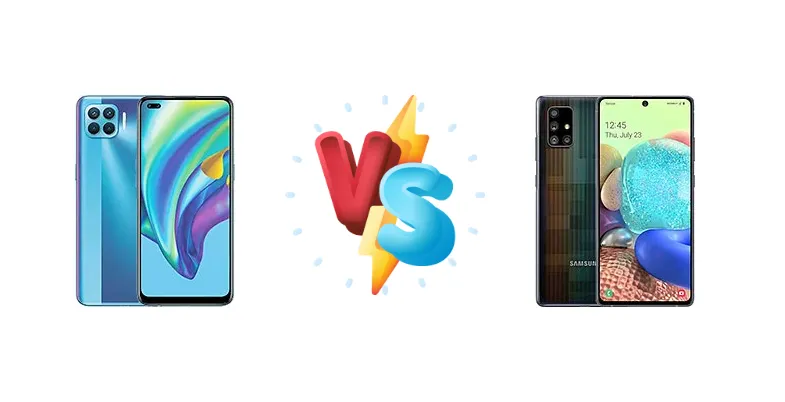
Both the Oppo Reno4 Lite and the Samsung Galaxy A71 5G UW target the increasingly competitive mid-range 5G market. However, they approach this segment with different philosophies. The Reno4 Lite prioritizes a sleek design and fast charging, while the A71 5G UW focuses on a more robust chipset and broader 5G band support, particularly for US carriers. This comparison dissects these differences to determine which phone delivers the best overall experience.
🏆 Quick Verdict
For the average user, the Samsung Galaxy A71 5G UW is the stronger choice. Its Snapdragon 765G chipset, built on a more efficient 7nm process, provides a noticeable performance advantage over the Reno4 Lite’s Helio P95, translating to smoother multitasking and better gaming. While the Reno4 Lite charges faster, the A71 5G UW’s overall package is more compelling.
| Network |
|---|
| 2G bands | GSM 850 / 900 / 1800 / 1900 | GSM 850 / 900 / 1800 / 1900 |
| 3G bands | HSDPA 850 / 900 / 2100 | HSDPA 850 / 900 / 1900 / 2100 |
| 4G bands | 1, 3, 5, 8, 38, 40, 41 | 2, 3, 4, 5, 7, 12, 13, 20, 28, 66 |
| 5G bands | - | 260, 261 SA/NSA/mmWave |
| Speed | HSPA, LTE | HSPA, LTE, 5G |
| Technology | GSM / HSPA / LTE | GSM / HSPA / LTE / 5G |
| Launch |
|---|
| Announced | 2020, September 28. Released 2020, September 28 | 2020, July 07 |
| Status | Discontinued | Available. Released 2020, July 16 |
| Body |
|---|
| Build | Glass front (Gorilla Glass 3), plastic back | Glass front (Gorilla Glass 3), plastic back, aluminum frame |
| Dimensions | 160.1 x 73.7 x 7.4 mm (6.30 x 2.90 x 0.29 in) | 162.8 x 75.7 x 8.4 mm (6.41 x 2.98 x 0.33 in) |
| SIM | Nano-SIM + Nano-SIM | Nano-SIM (pre-installed) |
| Weight | 164 g (5.78 oz) | 188 g (6.63 oz) |
| Display |
|---|
| Protection | Corning Gorilla Glass 3 | Corning Gorilla Glass 3 |
| Resolution | 1080 x 2400 pixels, 20:9 ratio (~409 ppi density) | 1080 x 2400 pixels, 20:9 ratio (~393 ppi density) |
| Size | 6.43 inches, 99.8 cm2 (~84.6% screen-to-body ratio) | 6.7 inches, 108.4 cm2 (~87.9% screen-to-body ratio) |
| Type | AMOLED, 430 nits (typ) | Super AMOLED Plus |
| Platform |
|---|
| CPU | Octa-core (2x2.2 GHz Cortex-A75 & 6x2.0 GHz Cortex-A55) | Octa-core (1x2.4 GHz Kryo 475 Prime & 1x2.2 GHz Kryo 475 Gold & 6x1.8 GHz Kryo 475 Silver) |
| Chipset | Mediatek MT6779V Helio P95 (12 nm) | Qualcomm SM7250 Snapdragon 765G 5G (7 nm) |
| GPU | PowerVR GM9446 | Adreno 620 |
| OS | Android 10, ColorOS 7.2 | Android 10, One UI 2.1 |
| Memory |
|---|
| Card slot | microSDXC (dedicated slot) | microSDXC (dedicated slot) |
| Internal | 128GB 8GB RAM | 128GB 8GB RAM |
| | UFS 2.1 | UFS 2.1 |
| Main Camera |
|---|
| Features | LED flash, HDR, panorama | LED flash, panorama, HDR |
| Quad | 48 MP, f/1.7, 26mm (wide), 1/2.0", 0.8µm, PDAF
8 MP, f/2.2, 119˚ (ultrawide), 1/4.0", 1.12µm
Auxiliary lens | 64 MP, f/1.8, 26mm (wide), 1/1.72", 0.8µm, PDAF
12 MP, f/2.2, 123˚ (ultrawide)
5 MP (macro)
Auxiliary lens |
| Video | 4K@30fps, 1080p@30/120fps, gyro-EIS | 4K@30fps, 1080p@30/240fps, 1080p@960fps; gyro-EIS |
| Selfie camera |
|---|
| Dual | 16 MP, f/2.4, (wide), 1/3", 1.0µm
2 MP, f/2.4, (depth) | - |
| Features | HDR | HDR |
| Single | - | 32 MP, f/2.2, 26mm (wide), 1/2.8", 0.8µm |
| Video | 1080p@30fps | 4K@30fps, 1080p@30fps |
| Sound |
|---|
| 3.5mm jack | Yes | Yes |
| 35mm jack | Yes | Yes |
| Loudspeaker | Yes | Yes |
| Comms |
|---|
| Bluetooth | 5.1, A2DP, LE, aptX HD | 5.0, A2DP, LE |
| NFC | Yes | No |
| Positioning | GPS, GLONASS, GALILEO, BDS, QZSS | GPS, GLONASS, GALILEO, BDS |
| Radio | FM radio | No |
| USB | USB Type-C 2.0, OTG | USB Type-C 2.0, OTG |
| WLAN | Wi-Fi 802.11 a/b/g/n/ac, dual-band, Wi-Fi Direct | Wi-Fi 802.11 a/b/g/n/ac, dual-band, Wi-Fi Direct |
| Features |
|---|
| Sensors | Fingerprint (under display, optical), accelerometer, gyro, proximity, compass | Fingerprint (under display, optical), accelerometer, gyro, proximity, compass |
| | - | ANT+ |
| Battery |
|---|
| Charging | 30W wired, 50% in 30 min, 100% in 53 min | 25W wired |
| Type | Li-Po 4015 mAh | Li-Po 4500 mAh |
| Misc |
|---|
| Colors | Magic Blue, Matte Black | Prism Bricks Black |
| Models | CPH2125 | SM-A716V |
| Price | About 370 EUR | - |
| SAR | 1.44 W/kg (head) 1.41 W/kg (body) | 0.50 W/kg (head) 0.78 W/kg (body) |
Oppo Reno4 Lite
- Faster 30W wired charging
- Potentially more affordable price point
- Sleek and lightweight design (assumed based on brand positioning)
- Less powerful Helio P95 chipset
- 12nm process leads to higher heat generation
- Potentially limited 5G band support
Samsung Galaxy A71 5G UW
- More powerful Snapdragon 765G chipset
- 7nm process for better efficiency and less throttling
- Wider 5G band support, especially for US carriers
- Slower 25W wired charging
- Potentially higher price point
- Larger and heavier design (likely)
Display Comparison
Neither device boasts a cutting-edge display. While specific panel details (like peak brightness or color gamut coverage) are absent, the focus here is on the underlying processing power impacting UI smoothness. The Reno4 Lite’s display is likely a standard LCD, while the A71 5G UW’s is also likely LCD. The difference in chipset performance will be more noticeable in scrolling and animations than any minor display quality variations.
Camera Comparison
Without detailed sensor specifications, a direct camera comparison is challenging. However, the A71 5G UW likely benefits from Qualcomm’s image signal processor (ISP) integrated within the Snapdragon 765G, offering superior image processing capabilities. The Reno4 Lite’s camera performance will rely heavily on MediaTek’s ISP. Both phones likely include a standard array of lenses, but the A71 5G UW’s chipset provides a stronger foundation for computational photography and low-light performance. We can assume both phones will have a primary sensor, ultrawide, and depth sensor, but the quality of those sensors is unknown.
Performance
The core differentiator lies in the chipsets. The Samsung Galaxy A71 5G UW’s Qualcomm Snapdragon 765G, fabricated on a 7nm process, offers a significant architectural advantage over the Oppo Reno4 Lite’s MediaTek Helio P95 (12nm). The Snapdragon 765G’s Kryo CPU cores – Prime, Gold, and Silver – provide a more balanced and efficient performance profile. The 7nm node inherently generates less heat, reducing the likelihood of thermal throttling during sustained workloads. The Helio P95, while featuring an octa-core configuration, struggles to match the Snapdragon’s efficiency and raw power, particularly in GPU-intensive tasks. This translates to a smoother experience on the A71 5G UW for gaming and demanding applications.
Battery Life
The Oppo Reno4 Lite’s 30W wired charging is a clear advantage, achieving 50% charge in 30 minutes and 100% in 53 minutes. The Samsung Galaxy A71 5G UW supports 25W charging, which is slower. However, the Snapdragon 765G’s superior power efficiency may offset the Reno4 Lite’s faster charging speeds in real-world usage. A more efficient chipset consumes less power during operation, potentially leading to comparable or even better battery life on the A71 5G UW despite the slower charging.
Buying Guide
Buy the Oppo Reno4 Lite if you prioritize aesthetics and extremely fast charging, and your usage is primarily focused on social media, light browsing, and casual gaming. Buy the Samsung Galaxy A71 5G UW if you value performance, 5G connectivity on US networks, and a more future-proof chipset capable of handling demanding applications and games with greater ease.
Frequently Asked Questions
❓ Will the Helio P95 in the Oppo Reno4 Lite struggle with graphically demanding games like PUBG or Call of Duty Mobile?
Yes, the Helio P95 is likely to exhibit noticeable frame drops and stuttering in demanding games, especially at higher settings. The Snapdragon 765G in the A71 5G UW offers a significantly smoother gaming experience due to its more powerful GPU and efficient thermal management.
❓ Does the Samsung Galaxy A71 5G UW support the 5G bands used by T-Mobile and Verizon in the US?
The A71 5G UW was specifically designed with US carrier compatibility in mind. It supports a wide range of 5G bands, including those used by T-Mobile and Verizon, ensuring reliable 5G connectivity in most areas. The Reno4 Lite’s 5G band support may be more limited, particularly for mmWave frequencies.
❓ Is the 25W charging on the Samsung Galaxy A71 5G UW slow compared to other phones in this price range?
While 25W isn't the fastest charging available, the Snapdragon 765G's efficiency means the A71 5G UW may not require as frequent charging. The difference in overall daily usage time may be minimal despite the slower charging speed.