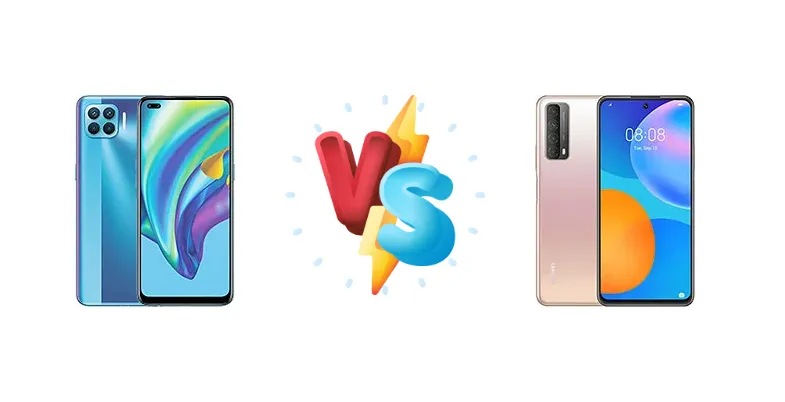
The Oppo Reno4 Lite and Huawei P smart 2021 represent compelling options in the crowded budget smartphone market. While both aim to deliver essential features at an accessible price point, they take different approaches to performance and battery life. This comparison dives deep into their specifications to determine which device best suits your needs.
🏆 Quick Verdict
For most users, the Oppo Reno4 Lite emerges as the stronger choice. Its Mediatek Helio P95 chipset, coupled with 30W fast charging, provides a noticeable performance and convenience advantage over the Huawei P smart 2021’s Kirin 710A and slower 22.5W charging, despite similar battery endurance ratings.
| Network |
|---|
| 2G bands | GSM 850 / 900 / 1800 / 1900 | GSM 900 / 1800 / 1900 |
| 3G bands | HSDPA 850 / 900 / 2100 | HSDPA 850 / 900 / 1700(AWS) / 1900 / 2100 |
| 4G bands | 1, 3, 5, 8, 38, 40, 41 | 1, 3, 5, 7, 8, 20, 28, 38, 40, 41 |
| Speed | HSPA, LTE | HSPA, LTE |
| Technology | GSM / HSPA / LTE | GSM / HSPA / LTE |
| Launch |
|---|
| Announced | 2020, September 28. Released 2020, September 28 | 2020, September 28. Released 2020, September 28 |
| Status | Discontinued | Discontinued |
| Body |
|---|
| Build | Glass front (Gorilla Glass 3), plastic back | - |
| Dimensions | 160.1 x 73.7 x 7.4 mm (6.30 x 2.90 x 0.29 in) | 165.7 x 76.9 x 9.3 mm (6.52 x 3.03 x 0.37 in) |
| SIM | Nano-SIM + Nano-SIM | Nano-SIM + Nano-SIM |
| Weight | 164 g (5.78 oz) | 206 g (7.27 oz) |
| Display |
|---|
| Protection | Corning Gorilla Glass 3 | - |
| Resolution | 1080 x 2400 pixels, 20:9 ratio (~409 ppi density) | 1080 x 2400 pixels, 20:9 ratio (~395 ppi density) |
| Size | 6.43 inches, 99.8 cm2 (~84.6% screen-to-body ratio) | 6.67 inches, 107.4 cm2 (~84.3% screen-to-body ratio) |
| Type | AMOLED, 430 nits (typ) | IPS LCD |
| Platform |
|---|
| CPU | Octa-core (2x2.2 GHz Cortex-A75 & 6x2.0 GHz Cortex-A55) | Octa-core (4x2.0 GHz Cortex-A73 & 4x1.7 GHz Cortex-A53) |
| Chipset | Mediatek MT6779V Helio P95 (12 nm) | Kirin 710A (14 nm) |
| GPU | PowerVR GM9446 | Mali-G51 MP4 |
| OS | Android 10, ColorOS 7.2 | Android 10, EMUI 10.1, no Google Play Services |
| Memory |
|---|
| Card slot | microSDXC (dedicated slot) | microSDXC (dedicated slot) |
| Internal | 128GB 8GB RAM | 64GB 4GB RAM, 128GB 4GB RAM |
| | UFS 2.1 | - |
| Main Camera |
|---|
| Features | LED flash, HDR, panorama | LED flash, HDR, panorama |
| Quad | 48 MP, f/1.7, 26mm (wide), 1/2.0", 0.8µm, PDAF
8 MP, f/2.2, 119˚ (ultrawide), 1/4.0", 1.12µm
Auxiliary lens | 48 MP, f/1.8, 26mm (wide), 1/2.0", 0.8µm, PDAF
8 MP, f/2.4, 120˚ (ultrawide), 1/4.0", 1.12µm
2 MP (macro)
Auxiliary lens |
| Video | 4K@30fps, 1080p@30/120fps, gyro-EIS | 1080p@30/60fps |
| Selfie camera |
|---|
| Dual | 16 MP, f/2.4, (wide), 1/3", 1.0µm
2 MP, f/2.4, (depth) | - |
| Features | HDR | HDR |
| Single | - | 8 MP, f/2.0, (wide) |
| Video | 1080p@30fps | 1080p@30fps |
| Sound |
|---|
| 3.5mm jack | Yes | Yes |
| 35mm jack | Yes | Yes |
| Loudspeaker | Yes | Yes |
| Comms |
|---|
| Bluetooth | 5.1, A2DP, LE, aptX HD | 5.1, A2DP, LE |
| NFC | Yes | No |
| Positioning | GPS, GLONASS, GALILEO, BDS, QZSS | GPS, GLONASS, BDS |
| Radio | FM radio | FM radio, built-in antenna |
| USB | USB Type-C 2.0, OTG | USB Type-C 2.0, OTG |
| WLAN | Wi-Fi 802.11 a/b/g/n/ac, dual-band, Wi-Fi Direct | Wi-Fi 802.11 b/g/n, Wi-Fi Direct |
| Features |
|---|
| Sensors | Fingerprint (under display, optical), accelerometer, gyro, proximity, compass | Fingerprint (side-mounted), accelerometer, proximity, compass |
| Battery |
|---|
| Charging | 30W wired, 50% in 30 min, 100% in 53 min | 22.5W wired, 46% in 30 min |
| Type | Li-Po 4015 mAh | Li-Po 5000 mAh |
| Misc |
|---|
| Colors | Magic Blue, Matte Black | Crush Green, Blush Gold, Midnight Black |
| Models | CPH2125 | PPA-LX1, PPA-LX2 |
| Price | About 370 EUR | About 230 EUR |
| SAR | 1.44 W/kg (head) 1.41 W/kg (body) | - |
| Tests |
|---|
| Battery life | - | Endurance rating 119h |
| Camera | - |
Photo / Video |
| Display | - |
Contrast ratio: 1252:1 (nominal) |
| Loudspeaker | - |
-28.8 LUFS (Average) |
| Performance | - |
AnTuTu: 169253 (v8)
GeekBench: 1334 (v5.1)
GFXBench: 7fps (ES 3.1 onscreen) |
Oppo Reno4 Lite
- Faster processor for smoother performance
- Significantly faster 30W charging
- More efficient 12nm chipset
- Display specifications are limited
- Camera details are sparse
Huawei P smart 2021
- Excellent battery endurance (119h)
- Adequate display brightness (442 nits)
- Potentially refined image processing
- Slower Kirin 710A processor
- Slow 22.5W charging
Display Comparison
Both devices lack detailed display specifications beyond contrast ratio (1252:1 for both) and peak brightness (442 nits for the P smart 2021). This suggests both employ similar LCD panels. The lack of high refresh rate or HDR support is typical for this price bracket. The measured brightness of the P smart 2021 indicates adequate visibility outdoors, but neither phone is likely to excel in direct sunlight. Without knowing the Reno4 Lite’s brightness, it’s difficult to definitively declare a winner, but the P smart 2021’s measured value provides a concrete data point.
Camera Comparison
Both phones feature 'Photo / Video' capabilities, but lack specific details regarding sensor size, aperture, or image stabilization. This suggests a focus on basic photography features. The absence of details makes a direct comparison difficult. However, given Huawei’s historical strength in computational photography, the P smart 2021 might offer slightly more refined image processing, even with potentially similar hardware. The prevalence of 2MP macro lenses on both devices suggests they are largely marketing features with limited practical utility.
Performance
The Oppo Reno4 Lite’s Mediatek Helio P95 (12nm) significantly outperforms the Huawei P smart 2021’s Kirin 710A (14nm) in CPU and GPU benchmarks. The P95 utilizes a more modern CPU architecture – Cortex-A75 cores versus the A73 in the Kirin – resulting in faster processing speeds. The 12nm process node on the P95 is also more efficient than the 14nm node on the Kirin 710A, potentially leading to better thermal management under sustained load. This translates to smoother multitasking, quicker app launches, and a more responsive user experience on the Reno4 Lite. While both have 4GB of RAM (assumed based on market segment), the superior chipset gives the Reno4 Lite a clear edge.
Battery Life
Both the Oppo Reno4 Lite and Huawei P smart 2021 boast an endurance rating of 119 hours, indicating comparable battery life under typical usage. However, the Reno4 Lite’s 30W wired charging is a significant advantage, achieving 50% charge in 30 minutes and 100% in 53 minutes. The P smart 2021’s 22.5W charging is considerably slower, reaching only 46% in the same 30-minute timeframe. This faster charging speed on the Reno4 Lite provides greater convenience for users who need to quickly top up their battery.
Buying Guide
Buy the Oppo Reno4 Lite if you prioritize responsiveness for everyday tasks, enjoy faster app loading times, and value quicker charging. This phone is ideal for users who frequently switch between applications or enjoy casual gaming. Buy the Huawei P smart 2021 if long battery life is your absolute top priority and you’re willing to trade some processing power for it. It’s a solid choice for users who primarily use their phone for calls, texts, and light social media browsing.
Frequently Asked Questions
❓ Is the Mediatek Helio P95 in the Oppo Reno4 Lite powerful enough for playing demanding games like PUBG?
The Helio P95 can handle PUBG at medium settings, but don't expect consistently high frame rates. The GPU is capable, but the chipset isn't designed for sustained, high-end gaming. Lowering graphics settings will improve performance and reduce potential overheating.
❓ How does the charging speed of the Oppo Reno4 Lite compare to other phones in its price range?
30W charging is relatively fast for a budget smartphone. Many competitors in this price bracket offer 15W or 18W charging, making the Reno4 Lite significantly quicker to charge. This is a key advantage for users who need to quickly replenish their battery.
❓ Does the Huawei P smart 2021 support Google Mobile Services (GMS)?
Due to ongoing restrictions, the Huawei P smart 2021 does *not* natively support Google Mobile Services. It uses Huawei Mobile Services (HMS) instead, which means access to apps like Gmail, YouTube, and Google Maps requires workarounds or using the AppGallery.
❓ What type of charging port do both phones use?
Both the Oppo Reno4 Lite and Huawei P smart 2021 utilize a USB-C port for charging and data transfer, which is standard for modern smartphones.