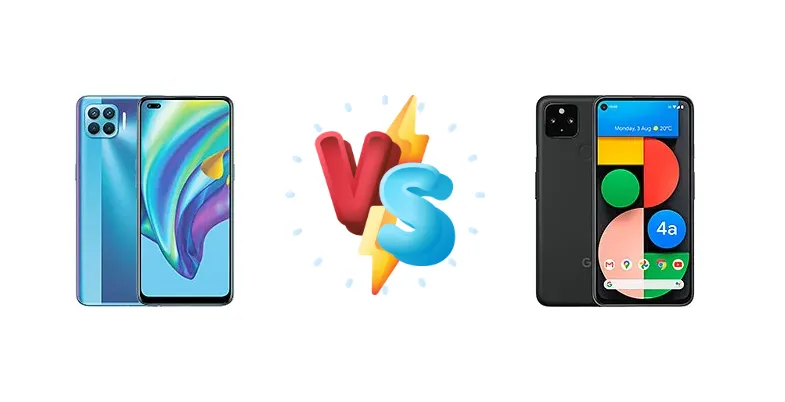
The Oppo Reno4 Lite and Google Pixel 4a 5G represent compelling options in the increasingly crowded mid-range 5G smartphone market. While both aim to deliver a smooth experience without breaking the bank, they take distinctly different approaches to achieving that goal. The Reno4 Lite focuses on fast charging and a streamlined design, while the Pixel 4a 5G leverages Google’s computational photography prowess and a more modern chipset.
🏆 Quick Verdict
For most users, the Google Pixel 4a 5G is the superior choice. Its Snapdragon 765G chipset provides a noticeable performance advantage, particularly in sustained workloads, and its camera consistently delivers better image quality. While the Reno4 Lite’s 30W charging is faster, the Pixel 4a 5G’s overall package offers a more refined and future-proof experience.
| Network |
|---|
| 2G bands | GSM 850 / 900 / 1800 / 1900 | GSM 850 / 900 / 1800 / 1900 |
| 3G bands | HSDPA 850 / 900 / 2100 | HSDPA 850 / 900 / 1700(AWS) / 1900 / 2100 |
| 4G bands | 1, 3, 5, 8, 38, 40, 41 | 1, 2, 3, 4, 5, 7, 8, 12, 13, 14, 17, 18, 19, 20, 25, 26, 28, 29, 30, 32, 38, 39, 40, 41, 42, 46, 48, 66, 71 |
| 5G bands | - | 1, 2, 3, 5, 7, 8, 12, 28, 41, 66, 71, 77, 78 Sub6, mmWave (market dependant) |
| Speed | HSPA, LTE | HSPA, LTE, 5G |
| Technology | GSM / HSPA / LTE | GSM / HSPA / LTE / 5G |
| Launch |
|---|
| Announced | 2020, September 28. Released 2020, September 28 | 2020, September 30 |
| Status | Discontinued | Available. Released 2020, November 05 |
| Body |
|---|
| Build | Glass front (Gorilla Glass 3), plastic back | Glass front (Gorilla Glass 3), plastic back, plastic frame |
| Dimensions | 160.1 x 73.7 x 7.4 mm (6.30 x 2.90 x 0.29 in) | 153.9 x 74 x 8.2 mm (Sub-6) or 8.5 mm (Sub-6 and mmWave) |
| SIM | Nano-SIM + Nano-SIM | Nano-SIM + eSIM |
| Weight | 164 g (5.78 oz) | 168 g (5G Sub-6); 171 g ( 5G Sub-6 and mmWave) (5.93 oz) |
| Display |
|---|
| Protection | Corning Gorilla Glass 3 | Corning Gorilla Glass 3 |
| Resolution | 1080 x 2400 pixels, 20:9 ratio (~409 ppi density) | 1080 x 2340 pixels, 19.5:9 ratio (~413 ppi density) |
| Size | 6.43 inches, 99.8 cm2 (~84.6% screen-to-body ratio) | 6.2 inches, 95.7 cm2 (~84.1% screen-to-body ratio) |
| Type | AMOLED, 430 nits (typ) | OLED, HDR |
| | - | Always-on display |
| Platform |
|---|
| CPU | Octa-core (2x2.2 GHz Cortex-A75 & 6x2.0 GHz Cortex-A55) | Octa-core (1x2.4 GHz Kryo 475 Prime & 1x2.2 GHz Kryo 475 Gold & 6x1.8 GHz Kryo 475 Silver) |
| Chipset | Mediatek MT6779V Helio P95 (12 nm) | Qualcomm SM7250 Snapdragon 765G 5G (7 nm) |
| GPU | PowerVR GM9446 | Adreno 620 |
| OS | Android 10, ColorOS 7.2 | Android 11, upgradable to Android 14 |
| Memory |
|---|
| Card slot | microSDXC (dedicated slot) | No |
| Internal | 128GB 8GB RAM | 128GB 6GB RAM |
| | UFS 2.1 | UFS 2.1 |
| Main Camera |
|---|
| Dual | - | 12.2 MP, f/1.7, 27mm (wide), 1/2.55", 1.4µm, dual pixel PDAF, OIS
16 MP, f/2.2, 107˚ (ultrawide), 1.0µm |
| Features | LED flash, HDR, panorama | LED flash, Pixel Shift, Auto-HDR, panorama |
| Quad | 48 MP, f/1.7, 26mm (wide), 1/2.0", 0.8µm, PDAF
8 MP, f/2.2, 119˚ (ultrawide), 1/4.0", 1.12µm
Auxiliary lens | - |
| Video | 4K@30fps, 1080p@30/120fps, gyro-EIS | 4K@30/60fps, 1080p@30/60/120/240fps; gyro-EIS |
| Selfie camera |
|---|
| Dual | 16 MP, f/2.4, (wide), 1/3", 1.0µm
2 MP, f/2.4, (depth) | - |
| Features | HDR | HDR |
| Single | - | 8 MP, f/2.0, 24mm (wide), 1/4.0", 1.12µm |
| Video | 1080p@30fps | 1080p@30fps |
| Sound |
|---|
| 3.5mm jack | Yes | Yes |
| 35mm jack | Yes | Yes |
| Loudspeaker | Yes | Yes, with stereo speakers |
| Comms |
|---|
| Bluetooth | 5.1, A2DP, LE, aptX HD | 5.0, A2DP, LE, aptX HD |
| NFC | Yes | Yes |
| Positioning | GPS, GLONASS, GALILEO, BDS, QZSS | GPS, GLONASS, GALILEO, QZSS, BDS |
| Radio | FM radio | No |
| USB | USB Type-C 2.0, OTG | USB Type-C 3.1 |
| WLAN | Wi-Fi 802.11 a/b/g/n/ac, dual-band, Wi-Fi Direct | Wi-Fi 802.11 a/b/g/n/ac, dual-band, Wi-Fi Direct |
| Features |
|---|
| Sensors | Fingerprint (under display, optical), accelerometer, gyro, proximity, compass | Fingerprint (rear-mounted), accelerometer, gyro, proximity, compass, barometer |
| Battery |
|---|
| Charging | 30W wired, 50% in 30 min, 100% in 53 min | 18W wired, PD2.0 |
| Type | Li-Po 4015 mAh | Li-Po 3885 mAh |
| Misc |
|---|
| Colors | Magic Blue, Matte Black | Just Black, Clearly White |
| Models | CPH2125 | GD1YQ, G025I, G025E, G025H, G6QU3 |
| Price | About 370 EUR | About 140 EUR |
| SAR | 1.44 W/kg (head) 1.41 W/kg (body) | - |
Oppo Reno4 Lite
- Significantly faster 30W charging
- Potentially lighter and more compact design
- Competitive price point
- Less powerful Helio P95 chipset
- Inferior camera performance compared to Pixel
- Likely slower software updates
Google Pixel 4a 5G
- More powerful Snapdragon 765G chipset
- Superior camera quality and image processing
- Guaranteed software updates from Google
- Slower 18W charging
- Potentially larger and heavier build
- Slightly higher price
Display Comparison
Neither device boasts a cutting-edge display. Both likely utilize LCD panels, though specific panel technology isn't provided. The Reno4 Lite’s display specs are unavailable, but given its price point, it likely targets a standard 60Hz refresh rate. The Pixel 4a 5G, similarly, doesn’t push display boundaries. The key difference lies in processing power impacting UI smoothness, rather than display hardware itself. Color accuracy is likely comparable, leaning towards Google’s typically well-calibrated output.
Camera Comparison
While megapixel counts aren’t the whole story, the Pixel 4a 5G benefits from Google’s renowned computational photography algorithms. Although sensor sizes aren’t specified, the Pixel’s image processing excels in dynamic range and low-light performance. The Reno4 Lite likely relies more heavily on hardware, and while it may produce acceptable results in good lighting, it will fall short of the Pixel’s consistency. The Pixel 4a 5G’s image processing pipeline is optimized for detail retention and noise reduction, providing a superior overall photographic experience. We can assume the Reno4 Lite includes standard features like portrait mode, but the Pixel’s implementation will be more refined.
Performance
The core difference between these phones lies in their chipsets. The Google Pixel 4a 5G’s Qualcomm Snapdragon 765G, fabricated on a 7nm process, offers a significant advantage over the Oppo Reno4 Lite’s MediaTek Helio P95 (12nm). The Snapdragon 765G’s Kryo CPU architecture – with its Prime, Gold, and Silver cores – is designed for efficient task allocation, resulting in smoother multitasking and better sustained performance. The Helio P95, while capable, will struggle with demanding games and applications compared to the Snapdragon. The 7nm process also translates to better thermal efficiency, reducing the likelihood of throttling during extended use. This benefits gamers and power users.
Battery Life
The Reno4 Lite’s 30W wired charging is its standout battery feature, achieving 50% charge in 30 minutes and 100% in 53 minutes. The Pixel 4a 5G’s 18W charging with PD2.0 is considerably slower. However, the Snapdragon 765G’s superior power efficiency may offset the Reno4 Lite’s faster charging. Real-world battery life will depend on usage patterns, but the Pixel 4a 5G is likely to offer comparable, if not slightly better, endurance due to its more efficient chipset. The Reno4 Lite’s faster charging is ideal for quick top-ups, while the Pixel prioritizes overall efficiency.
Buying Guide
Buy the Oppo Reno4 Lite if you prioritize extremely fast charging and a lightweight design, and are willing to compromise on raw processing power and camera capabilities. It’s ideal for users who frequently top up their phones throughout the day. Buy the Google Pixel 4a 5G if you value a smoother, more responsive user experience, exceptional camera performance, and guaranteed software updates. This phone is best suited for users who rely on their smartphone for photography and demand consistent performance.
Frequently Asked Questions
❓ Will the Helio P95 in the Reno4 Lite struggle with graphically demanding games like Genshin Impact?
Yes, the MediaTek Helio P95 is likely to struggle with graphically intensive games like Genshin Impact. You’ll likely need to lower graphics settings significantly to achieve playable frame rates, and even then, expect some stuttering. The Snapdragon 765G in the Pixel 4a 5G offers a much smoother gaming experience.
❓ How important is the software update commitment from Google on the Pixel 4a 5G?
Google guarantees at least 3 years of Android OS updates and 5 years of security patches for the Pixel 4a 5G. This is crucial for long-term security and access to new features. Oppo’s update commitment for the Reno4 Lite is less certain, meaning it will likely become outdated faster.
❓ Does the Pixel 4a 5G support carrier aggregation for faster 5G speeds?
Yes, the Snapdragon 765G in the Pixel 4a 5G supports carrier aggregation, allowing it to combine multiple 5G channels for significantly faster download and upload speeds where available. This is a key advantage for users in areas with robust 5G infrastructure.
❓ Is the difference in charging speed between the two phones really that noticeable in everyday use?
While 30W charging sounds impressive, the difference in real-world convenience isn't always massive. The Pixel 4a 5G's 18W charging is still adequate for overnight charging, and the Snapdragon 765G's efficiency means you may not need to top up as frequently.