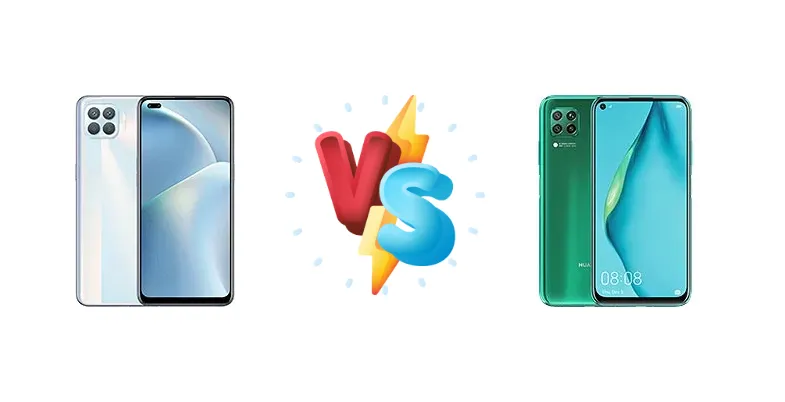
The Oppo Reno4 F and Huawei nova 7i represent compelling options in the increasingly competitive mid-range smartphone market. While both aim to deliver a balanced experience, they take different approaches to achieving it. The Reno4 F focuses on a streamlined design and efficient processor, while the nova 7i prioritizes fast charging and a more powerful chipset. This comparison dives deep into the specifics to determine which device offers the best value.
🏆 Quick Verdict
For the average user prioritizing fast charging and slightly better overall performance, the Huawei nova 7i is the stronger choice. Its Kirin 810 chipset and 40W charging significantly outperform the Reno4 F’s Helio P95 and 18W charging, making it ideal for power users and gamers. However, the Reno4 F remains a viable option for those seeking a more power-efficient device.
| Network |
|---|
| 2G bands | GSM 850 / 900 / 1800 / 1900 | GSM 850 / 900 / 1800 / 1900 |
| 3G bands | HSDPA 850 / 900 / 2100 | HSDPA 800 / 850 / 900 / 1700(AWS) / 2100 |
| 4G bands | 1, 3, 5, 7, 8, 38, 40, 41 | 1, 2, 3, 4, 5, 7, 8, 18, 19, 20, 28, 34, 38, 39, 40, 41 - JNY-L21A, JNY-L01A, JNY-L21B |
| Speed | HSPA, LTE | HSPA 42.2/5.76 Mbps, LTE (2CA) Cat13 400/75 Mbps |
| Technology | GSM / HSPA / LTE | GSM / CDMA / HSPA / LTE |
| | - | 1, 2, 3, 4, 5, 7, 8, 18, 19, 28, 34, 38, 39, 40, 41 - JNY-L22A, JNY-L02A, JNY-L22B |
| Launch |
|---|
| Announced | 2020, October 10. Released 2020, October 16 | 2020, January 30. Released 2020, February 14 |
| Status | Discontinued | Discontinued |
| Body |
|---|
| Build | Glass front, plastic back | Glass front, plastic back, plastic frame |
| Dimensions | 160.1 x 73.8 x 7.5 mm (6.30 x 2.91 x 0.30 in) | 159.2 x 76.3 x 8.7 mm (6.27 x 3.00 x 0.34 in) |
| SIM | Nano-SIM + Nano-SIM | · Nano-SIM· Nano-SIM + Nano-SIM |
| Weight | 164 g (5.78 oz) | 183 g (6.46 oz) |
| Display |
|---|
| Resolution | 1080 x 2400 pixels, 20:9 ratio (~409 ppi density) | 1080 x 2310 pixels (~398 ppi density) |
| Size | 6.43 inches, 99.8 cm2 (~84.5% screen-to-body ratio) | 6.4 inches, 101.4 cm2 (~83.5% screen-to-body ratio) |
| Type | Super AMOLED, 430 nits (typ), 800 nits (peak) | IPS LCD |
| Platform |
|---|
| CPU | Octa-core (2x2.2 GHz Cortex-A75 & 6x2.0 GHz Cortex-A55) | Octa-core (2x2.27 GHz Cortex-A76 & 6x1.88 GHz Cortex-A55) |
| Chipset | Mediatek MT6779V Helio P95 (12 nm) | Kirin 810 (7 nm) |
| GPU | PowerVR GM9446 | Mali-G52 MP6 |
| OS | Android 10, ColorOS 7.2 | Android 10, EMUI 10, no Google Play Services |
| Memory |
|---|
| Card slot | microSDXC (dedicated slot) | Nano Memory (uses shared SIM slot) |
| Internal | 128GB 8GB RAM | 128GB 8GB RAM |
| | UFS 2.1 | UFS 2.1 |
| Main Camera |
|---|
| Features | LED flash, HDR, panorama | LED flash, HDR, panorama |
| Quad | 48 MP, f/1.7, 26mm (wide), 1/2.0", 0.8µm, PDAF
8 MP, f/2.2, 119˚, 16mm (ultrawide), 1/4.0", 1.12µm
Auxiliary lens | 48 MP, f/1.8, 26mm (wide), 1/2.0", 0.8µm, PDAF
8 MP, f/2.4, (ultrawide)
2 MP (macro)
Auxiliary lens |
| Video | 4K@30fps, 1080p@30/120fps, gyro-EIS | 1080p@30fps |
| Selfie camera |
|---|
| Dual | 16 MP, f/2.4, (wide), 1/3.09", 1.0µm
2 MP, f/2.4, (depth) | - |
| Features | HDR | HDR |
| Single | - | 16 MP, f/2.0, (wide), 1/3.06", 1.0µm |
| Video | 1080p@30fps | 1080p@30fps |
| Sound |
|---|
| 3.5mm jack | Yes | Yes |
| 35mm jack | Yes | Yes |
| Loudspeaker | Yes | Yes |
| Comms |
|---|
| Bluetooth | 5.1, A2DP, LE, aptX HD | 5.1, A2DP, LE |
| NFC | No | No |
| Positioning | GPS, GLONASS, GALILEO, BDS, QZSS | GPS, GLONASS, GALILEO, BDS, QZSS |
| Radio | FM radio | FM radio (market/region dependent) |
| USB | USB Type-C 2.0, OTG | USB Type-C 2.0, OTG |
| WLAN | Wi-Fi 802.11 a/b/g/n/ac, dual-band, Wi-Fi Direct | Wi-Fi 802.11 a/b/g/n/ac, dual-band, Wi-Fi Direct |
| Features |
|---|
| Sensors | Fingerprint (under display, optical), accelerometer, gyro, proximity, compass | Fingerprint (side-mounted), accelerometer, proximity, compass |
| Battery |
|---|
| Charging | 18W wired | 40W wired, 70% in 30 min |
| Type | Li-Po 4000 mAh | Li-Po 4200 mAh |
| Misc |
|---|
| Colors | Matte Black, Metallic White | Midnight Black, Crush Green, Sakura Pink |
| Models | SPH2209 | JNY-L22B, JNY-L21A, JNY-L01A, JNY-L21B, JNY-L22A, JNY-L02A, JNY-LX2 |
| Price | About 250 EUR | About 240 EUR |
Oppo Reno4 F
- Potentially better power efficiency due to the Helio P95 chipset.
- Sleek and lightweight design (assumed based on Reno series history).
- Oppo’s ColorOS offers a clean and user-friendly interface.
- Significantly slower 18W charging.
- Less powerful Helio P95 chipset compared to the Kirin 810.
- Likely less capable GPU for gaming.
Huawei nova 7i
- 40W fast charging – a significant advantage.
- More powerful Kirin 810 chipset for better performance.
- Improved GPU performance for smoother gaming.
- Kirin 810 may run slightly warmer under sustained load.
- Huawei’s software ecosystem may be limited due to geopolitical factors.
- Potentially less battery life compared to the Reno4 F under light usage.
Display Comparison
Neither device boasts a standout display. Both likely utilize LCD panels, a common choice in this price bracket. The key difference lies under the hood: processing power. Display specs beyond panel type are not provided, so we can only assume similar brightness levels and color accuracy. Bezels are likely comparable, focusing on maximizing screen real estate within the mid-range budget.
Camera Comparison
Without detailed sensor information, a direct camera comparison is difficult. However, the market positioning suggests the nova 7i likely features a more capable main sensor. The focus should be on the primary lens aperture and image processing capabilities. Huawei’s image processing algorithms are generally more aggressive, often resulting in vibrant, albeit sometimes over-processed, photos. Oppo tends towards a more natural look. The presence of a 2MP macro lens on both devices is largely a marketing tactic, offering limited practical benefit due to the small sensor size and lack of optical image stabilization (OIS).
Performance
The Huawei nova 7i’s Kirin 810 (7nm) represents a significant architectural advantage over the Oppo Reno4 F’s MediaTek Helio P95 (12nm). The 7nm process allows for greater transistor density and improved power efficiency, translating to better sustained performance and reduced thermal throttling. While both CPUs feature a 2x2.2 GHz core configuration, the Kirin 810 utilizes Cortex-A76 cores, which offer a substantial performance uplift over the Reno4 F’s Cortex-A75 cores. This difference will be most noticeable in demanding tasks like gaming and video editing. The Kirin 810’s GPU will also provide a smoother gaming experience.
Battery Life
The Huawei nova 7i’s 40W wired charging is a game-changer. The claim of 70% charge in 30 minutes drastically reduces downtime compared to the Oppo Reno4 F’s 18W charging. While battery capacity isn’t specified, the faster charging speed effectively mitigates any potential capacity disadvantage. The Kirin 810’s 7nm process also contributes to better power efficiency, potentially offsetting the Reno4 F’s advantage in processor efficiency. Users who frequently find themselves needing a quick top-up will greatly benefit from the nova 7i’s charging capabilities.
Buying Guide
Buy the Oppo Reno4 F if you need a phone that prioritizes all-day battery life and a lighter, more efficient processor for everyday tasks. It’s a good fit for users who don’t heavily game or require extremely fast charging. Buy the Huawei nova 7i if you prefer a phone with faster processing speeds for gaming and demanding applications, coupled with incredibly rapid 40W charging that minimizes downtime. This is the better choice for users who frequently use their phone for multimedia and gaming.
Frequently Asked Questions
❓ Will the Kirin 810 in the nova 7i overheat during prolonged gaming sessions?
While the Kirin 810 is a capable chipset, it can experience some thermal throttling during extended gaming. However, the 7nm process helps mitigate this compared to older, larger node chipsets. Expect some performance dips after 30-60 minutes of intensive gaming, but it shouldn't be a dealbreaker for casual gamers.
❓ Is the 18W charging on the Oppo Reno4 F slow enough to be a major inconvenience?
Yes, 18W charging is noticeably slower than the 40W charging on the nova 7i. A full charge will take significantly longer, potentially requiring overnight charging. This is a major drawback for users who need a quick power boost throughout the day.
❓ Does the Huawei nova 7i support Google Mobile Services (GMS)?
Due to ongoing geopolitical restrictions, the Huawei nova 7i does *not* natively support Google Mobile Services (GMS). It utilizes Huawei Mobile Services (HMS) and the AppGallery. While many popular apps are available through HMS and third-party sources, some Google apps may require workarounds.
❓ How does the Helio P95 in the Reno4 F handle multitasking compared to the Kirin 810?
The Kirin 810’s more powerful CPU and GPU, coupled with potentially faster RAM, will provide a smoother multitasking experience. The Reno4 F’s Helio P95 can handle basic multitasking, but may exhibit lag or slowdowns when running multiple demanding applications simultaneously.