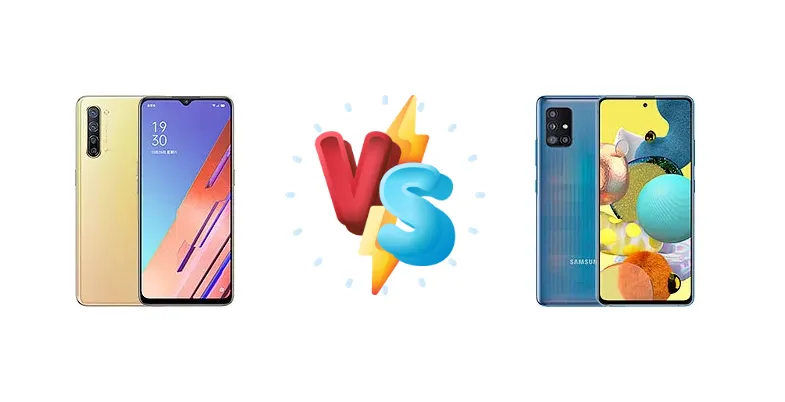
The Oppo Reno3 Youth and Samsung Galaxy A51 5G UW represent a fascinating intersection in the mid-range 5G market. Both devices leverage the Qualcomm Snapdragon 765G, promising similar performance, but diverge significantly in charging capabilities and potentially, software experience. This comparison dissects these differences to help you choose the right phone for your needs.
🏆 Quick Verdict
For the average user prioritizing quick top-ups, the Oppo Reno3 Youth is the clear winner thanks to its 30W charging. However, Samsung’s A51 5G UW may appeal to those deeply embedded in the Samsung ecosystem and prefer its One UI software experience, despite the slower 15W charging.
| Network |
|---|
| 2G bands | GSM 850 / 900 / 1800 / 1900 | GSM 850 / 900 / 1800 / 1900 |
| 3G bands | HSDPA 800 / 850 / 900 / 1700(AWS) / 1900 / 2100 | HSDPA 850 / 900 / 1900 / 2100 |
| 4G bands | 1, 2, 3, 4, 5, 7, 8, 12, 17, 18, 19, 20, 26, 34, 38, 39, 40, 41 | 2, 4, 5, 13, 66 |
| 5G bands | 1, 41, 78, 79 SA/NSA | 260, 261 mmWave |
| Speed | HSPA, LTE, 5G (1.9 Gbps DL) | HSPA, LTE, 5G |
| Technology | GSM / CDMA / HSPA / EVDO / LTE / 5G | GSM / HSPA / LTE / 5G |
| | CDMA2000 1xEV-DO | - |
| Launch |
|---|
| Announced | 2020, February 08. Released 2020, February 14 | 2020, August 14 |
| Status | Discontinued | Available. Released 2020, August 14 |
| Body |
|---|
| Build | Glass front (Gorilla Glass 5), glass back (Gorilla Glass 5), aluminum frame | Glass front (Gorilla Glass 3), plastic back, aluminum frame |
| Dimensions | 160.3 x 74.3 x 8 mm (6.31 x 2.93 x 0.31 in) | 158.8 x 73.4 x 8.6 mm (6.25 x 2.89 x 0.34 in) |
| SIM | Nano-SIM + Nano-SIM | Nano-SIM (pre-installed) |
| Weight | 180 g (6.35 oz) | 188.8 g (6.67 oz) |
| Display |
|---|
| Protection | Corning Gorilla Glass 5 | Corning Gorilla Glass 3 |
| Resolution | 1080 x 2400 pixels, 20:9 ratio (~411 ppi density) | 1080 x 2400 pixels, 20:9 ratio (~405 ppi density) |
| Size | 6.4 inches, 98.9 cm2 (~83.0% screen-to-body ratio) | 6.5 inches, 102.0 cm2 (~87.5% screen-to-body ratio) |
| Type | AMOLED, 430 nits (typ) | Super AMOLED |
| Platform |
|---|
| CPU | Octa-core (1x2.4 GHz Kryo 475 Prime & 1x2.2 GHz Kryo 475 Gold & 6x1.8 GHz Kryo 475 Silver) | Octa-core (1x2.4 GHz Kryo 475 Prime & 1x2.2 GHz Kryo 475 Gold & 6x1.8 GHz Kryo 475 Silver) |
| Chipset | Qualcomm SM7250 Snapdragon 765G 5G (7 nm) | Qualcomm SM7250 Snapdragon 765G 5G (7 nm) |
| GPU | Adreno 620 | Adreno 620 |
| OS | Android 10, ColorOS 7 | Android 10, One UI 2 |
| Memory |
|---|
| Card slot | No | microSDXC (uses shared SIM slot) |
| Internal | 128GB 8GB RAM | 128GB 6GB RAM |
| | UFS 2.1 | UFS 2.1 |
| Main Camera |
|---|
| Features | LED flash, HDR, panorama | LED flash, panorama, HDR |
| Quad | 48 MP, f/1.7, 26mm (wide), 1/2.0", 0.8µm, PDAF, OIS
8 MP, f/2.2, 13mm (ultrawide), 1/3.2", 1.4µm
2 MP B/W, f/2.4, 1/5.0", 1.75µm
Auxiliary lens | 48 MP, f/2.0, 26mm (wide), 1/2.0", 0.8µm, PDAF
12 MP, f/2.2, 123˚ (ultrawide)
5 MP (macro)
Auxiliary lens |
| Single | - | 5 MP, AF |
| Video | 4K@30fps, 1080p@30/60/120fps; gyro-EIS, OIS | 4K@30fps, 1080p@30/120fps; gyro-EIS |
| Selfie camera |
|---|
| Features | HDR | HDR |
| Single | 32 MP, f/2.0, 26mm (wide), 1/2.8", 0.8µm | 32 MP, f/2.2, 26mm (wide), 1/2.8", 0.8µm |
| Video | 1080p@30fps | 4K@30fps, 1080p@30fps |
| Sound |
|---|
| 3.5mm jack | Yes | Yes |
| 35mm jack | Yes | Yes |
| Loudspeaker | Yes | Yes |
| Comms |
|---|
| Bluetooth | 5.1, A2DP, LE, aptX HD | 5.0, A2DP, LE |
| NFC | Yes | Yes |
| Positioning | GPS (L1+L5), GLONASS, BDS (B1I+B2a), GALILEO, QZSS | GPS, GLONASS, GALILEO, BDS |
| Radio | Unspecified | FM radio, RDS, recording |
| USB | USB Type-C 3.1, OTG | USB Type-C 2.0, OTG |
| WLAN | Wi-Fi 802.11 a/b/g/n/ac, dual-band, Wi-Fi Direct | Wi-Fi 802.11 a/b/g/n/ac, dual-band, Wi-Fi Direct |
| Features |
|---|
| Sensors | Fingerprint (under display, optical), accelerometer, gyro, proximity, compass | Fingerprint (under display, optical), accelerometer, gyro, proximity, compass |
| | - | ANT+ |
| Battery |
|---|
| Charging | 30W wired, 50% in 20 min | 15W wired |
| Stand-by | - | Up to 672 h |
| Talk time | - | Up to 5 h |
| Type | Li-Po 4025 mAh | Li-Po 4500 mAh |
| Misc |
|---|
| Colors | White, Black, Gold | Prism Bricks Blue |
| Models | PCLM50 | SM-A516V |
| Price | About 400 EUR | About 470 EUR |
| SAR | - | 0.70 W/kg (head) 1.25 W/kg (body) |
| SAR EU | - | 0.59 W/kg (head) 1.32 W/kg (body) |
Oppo Reno3 Youth
- Significantly faster 30W charging
- Potentially more streamlined software experience
- Identical Snapdragon 765G performance
- Brand recognition may be lower than Samsung
- Specific display details are unknown
Samsung Galaxy A51 5G UW
- Strong brand recognition and ecosystem integration
- Samsung’s One UI software experience
- Identical Snapdragon 765G performance
- Slower 15W charging
- Potentially more bloatware
Display Comparison
While specific display specs (resolution, panel type) aren't provided, both phones likely utilize LCD panels common in this price bracket. The key difference isn't display *quality* but potentially size and software calibration. Samsung historically excels at display tuning, potentially offering more vibrant colors, but without detailed data, this remains speculative. Bezels are likely comparable, aiming for maximizing screen real estate within the mid-range segment.
Camera Comparison
Without detailed camera sensor information, a direct comparison is limited. However, the market positioning suggests both phones will feature multi-camera setups. The absence of information regarding OIS (Optical Image Stabilization) is notable; its presence on one device but not the other would be a significant differentiator. Image processing will likely differ, with Samsung typically favoring more saturated and contrast-rich images, while Oppo often aims for a more natural look. The inclusion of low-resolution auxiliary cameras (e.g., 2MP macro) is common in this segment, but their utility is limited.
Performance
Both the Oppo Reno3 Youth and Samsung Galaxy A51 5G UW are powered by the Qualcomm SM7250 Snapdragon 765G 5G (7 nm) chipset, featuring an identical CPU configuration: Octa-core (1x2.4 GHz Kryo 475 Prime & 1x2.2 GHz Kryo 475 Gold & 6x1.8 GHz Kryo 475 Silver). This means raw processing power will be virtually indistinguishable between the two. Performance will be similar in everyday tasks and even moderate gaming. Thermal management will likely depend on chassis design and software optimization; however, the identical chipset suggests comparable throttling behavior under sustained load. RAM configurations, not specified, will also play a role, with more RAM generally improving multitasking.
Battery Life
The battery capacity isn't specified for either device. However, the critical difference lies in charging speed. The Oppo Reno3 Youth boasts 30W wired charging, capable of reaching 50% charge in just 20 minutes. The Samsung Galaxy A51 5G UW is limited to 15W wired charging, significantly slower. This disparity means the Reno3 Youth offers a much more convenient charging experience, especially for users who frequently need to top up their battery. Even with a slightly smaller battery, the Reno3 Youth’s faster charging could result in less perceived downtime.
Buying Guide
Buy the Oppo Reno3 Youth if you need faster charging speeds and a more streamlined Android experience. This phone is ideal for users who frequently find themselves needing a quick power boost throughout the day. Buy the Samsung Galaxy A51 5G UW if you prefer Samsung’s One UI, value brand recognition, and aren’t overly concerned with charging speed. It’s a solid choice for users already invested in the Samsung ecosystem.
Frequently Asked Questions
❓ Will the Snapdragon 765G in the Oppo Reno3 Youth handle demanding games like PUBG Mobile?
Yes, the Snapdragon 765G is capable of running PUBG Mobile at medium to high settings with stable frame rates. However, sustained gaming will likely lead to some thermal throttling, reducing performance over extended sessions. Both phones will experience similar gaming performance due to the identical chipset.
❓ How much faster is the 30W charging on the Oppo Reno3 Youth compared to the 15W charging on the Samsung Galaxy A51 5G UW in real-world use?
The 30W charging on the Reno3 Youth can add approximately 50% battery in 20 minutes, while the A51 5G UW’s 15W charging will take significantly longer – likely over 40-60 minutes to achieve the same level. This difference is substantial for users who need a quick power boost.
❓ Does either phone support expandable storage via microSD card?
This information is not provided in the context data. However, Samsung phones in this price range often include microSD card support, while Oppo sometimes omits it. Checking the official specifications is crucial if expandable storage is a priority.