
Oppo Reno3 Youth vs Huawei P40 lite 5G: Which 5G Mid-Ranger Reigns Supreme?
| Phones Images | |||||
|---|---|---|---|---|---|
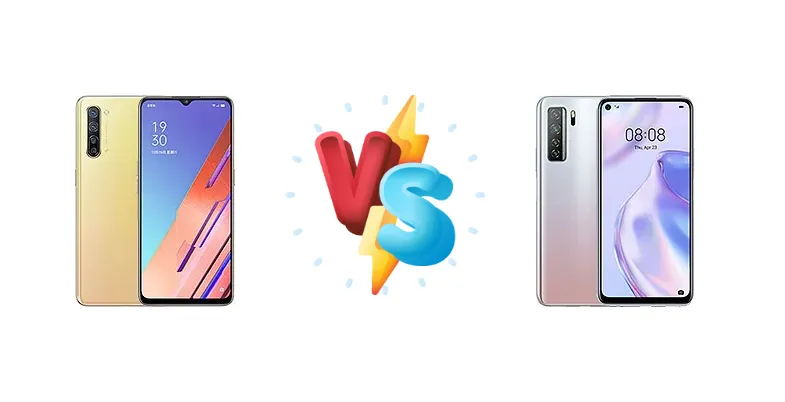
|
🏆 Quick Verdict
For the average user prioritizing sustained performance and faster charging, the Huawei P40 lite 5G emerges as the stronger contender. Its Kirin 820 chipset, despite architectural differences, offers a slight edge in processing power, and its 40W charging significantly reduces downtime. However, the Reno3 Youth remains a viable option for those heavily invested in the Qualcomm ecosystem.
| PHONES | ||
|---|---|---|
| Phone Names | Oppo Reno3 Youth | Huawei P40 lite 5G |
| Network | ||
|---|---|---|
| 2G bands | GSM 850 / 900 / 1800 / 1900 | GSM 850 / 900 / 1800 / 1900 |
| 3G bands | HSDPA 800 / 850 / 900 / 1700(AWS) / 1900 / 2100 | HSDPA 800 / 850 / 900 / 1700(AWS) / 1900 / 2100 |
| 4G bands | 1, 2, 3, 4, 5, 7, 8, 12, 17, 18, 19, 20, 26, 34, 38, 39, 40, 41 | 1, 2, 3, 4, 5, 6, 7, 8, 12, 17, 18, 19, 20, 26, 28, 34, 38, 39, 40, 41, 66 |
| 5G bands | 1, 41, 78, 79 SA/NSA | 1, 3, 28, 38, 41, 77, 78, 79 SA/NSA |
| Speed | HSPA, LTE, 5G (1.9 Gbps DL) | HSPA, LTE, 5G |
| Technology | GSM / CDMA / HSPA / EVDO / LTE / 5G | GSM / HSPA / LTE / 5G |
| CDMA2000 1xEV-DO | - | |
| Launch | ||
|---|---|---|
| Announced | 2020, February 08. Released 2020, February 14 | 2020, May 15. Released 2020, May 28 |
| Status | Discontinued | Discontinued |
| Body | ||
|---|---|---|
| Build | Glass front (Gorilla Glass 5), glass back (Gorilla Glass 5), aluminum frame | - |
| Dimensions | 160.3 x 74.3 x 8 mm (6.31 x 2.93 x 0.31 in) | 162.3 x 75 x 8.6 mm (6.39 x 2.95 x 0.34 in) |
| SIM | Nano-SIM + Nano-SIM | Nano-SIM + Nano-SIM |
| Weight | 180 g (6.35 oz) | 189 g (6.67 oz) |
| Display | ||
|---|---|---|
| Protection | Corning Gorilla Glass 5 | - |
| Resolution | 1080 x 2400 pixels, 20:9 ratio (~411 ppi density) | 1080 x 2400 pixels, 20:9 ratio (~405 ppi density) |
| Size | 6.4 inches, 98.9 cm2 (~83.0% screen-to-body ratio) | 6.5 inches, 102.0 cm2 (~83.8% screen-to-body ratio) |
| Type | AMOLED, 430 nits (typ) | IPS LCD, HDR10 |
| Platform | ||
|---|---|---|
| CPU | Octa-core (1x2.4 GHz Kryo 475 Prime & 1x2.2 GHz Kryo 475 Gold & 6x1.8 GHz Kryo 475 Silver) | Octa-core (1x2.36 GHz Cortex-A76 & 3x2.22 GHz Cortex-A76 & 4x1.84 GHz Cortex-A55) |
| Chipset | Qualcomm SM7250 Snapdragon 765G 5G (7 nm) | Kirin 820 5G (7 nm) |
| GPU | Adreno 620 | Mali-G57 (6-core) |
| OS | Android 10, ColorOS 7 | Android 10, EMUI 10.1, no Google Play Services |
| Memory | ||
|---|---|---|
| Card slot | No | Nano Memory (uses shared SIM slot) |
| Internal | 128GB 8GB RAM | 128GB 6GB RAM, 128GB 8GB RAM |
| UFS 2.1 | - | |
| Main Camera | ||
|---|---|---|
| Features | LED flash, HDR, panorama | LED flash, Panorama, HDR |
| Quad | 48 MP, f/1.7, 26mm (wide), 1/2.0", 0.8µm, PDAF, OIS 8 MP, f/2.2, 13mm (ultrawide), 1/3.2", 1.4µm 2 MP B/W, f/2.4, 1/5.0", 1.75µm Auxiliary lens | 64 MP, f/1.8, 26mm (wide), PDAF 8 MP, f/2.4, 17mm (ultrawide) 2 MP (macro) Auxiliary lens |
| Video | 4K@30fps, 1080p@30/60/120fps; gyro-EIS, OIS | 4K@30fps, 1080p@30fps |
| Selfie camera | ||
|---|---|---|
| Features | HDR | HDR |
| Single | 32 MP, f/2.0, 26mm (wide), 1/2.8", 0.8µm | 16 MP, f/2.0, (wide) |
| Video | 1080p@30fps | 1080p@30fps |
| Sound | ||
|---|---|---|
| 3.5mm jack | Yes | Yes |
| 35mm jack | Yes | Yes |
| Loudspeaker | Yes | Yes |
| Comms | ||
|---|---|---|
| Bluetooth | 5.1, A2DP, LE, aptX HD | 5.1, A2DP, LE |
| NFC | Yes | Yes |
| Positioning | GPS (L1+L5), GLONASS, BDS (B1I+B2a), GALILEO, QZSS | GPS, GLONASS, GALILEO, BDS |
| Radio | Unspecified | No |
| USB | USB Type-C 3.1, OTG | USB Type-C 2.0, OTG |
| WLAN | Wi-Fi 802.11 a/b/g/n/ac, dual-band, Wi-Fi Direct | Wi-Fi 802.11 a/b/g/n/ac, dual-band, Wi-Fi Direct |
| Features | ||
|---|---|---|
| Sensors | Fingerprint (under display, optical), accelerometer, gyro, proximity, compass | Fingerprint (side-mounted), accelerometer, gyro, proximity, compass |
| Battery | ||
|---|---|---|
| Charging | 30W wired, 50% in 20 min | 40W wired, 70% in 30 min 5W reverse wired |
| Type | Li-Po 4025 mAh | Li-Po 4000 mAh |
| Misc | ||
|---|---|---|
| Colors | White, Black, Gold | Crush Green, Space Silver, Midnight Black |
| Models | PCLM50 | CDY-NX9A |
| Price | About 400 EUR | About 190 EUR |
Oppo Reno3 Youth
- Qualcomm Snapdragon 765G chipset offers good app compatibility.
- Oppo’s ColorOS provides a feature-rich software experience.
- 30W fast charging is still reasonably quick.
- Slower charging compared to the P40 lite 5G.
- Potentially more susceptible to thermal throttling under sustained load.
Huawei P40 lite 5G
- Kirin 820 chipset offers slightly better performance.
- 40W fast charging significantly reduces charging time.
- 5W reverse wired charging adds convenience.
- Huawei’s software ecosystem may be less familiar to some users.
- Potential concerns regarding long-term software support.
Display Comparison
Neither device boasts a standout display. While specific panel details (like OLED vs LCD) are missing, the focus here is on performance. The absence of high refresh rates on both suggests a cost-saving measure. The real difference lies in charging, not display quality, making this a non-decisive factor.
Camera Comparison
Without detailed camera specs beyond the presence of sensors, a direct comparison is difficult. However, the market positioning suggests both phones prioritize versatility over outright image quality. The absence of information regarding sensor size or OIS implies neither device will excel in low-light photography. Image processing will likely be the differentiating factor, with Huawei historically favoring more saturated and contrast-rich images, while Oppo tends towards a more natural look. The usefulness of any 2MP macro sensors on either device is questionable.
Performance
The core battleground is the chipset. The Oppo Reno3 Youth features the Qualcomm Snapdragon 765G, built on a 7nm process, utilizing Kryo 475 cores in a tri-cluster configuration (1x2.4 GHz Prime, 1x2.2 GHz Gold, 6x1.8 GHz Silver). The Huawei P40 lite 5G counters with the Kirin 820 5G, also 7nm, but employing a different core arrangement: 1x2.36 GHz Cortex-A76, 3x2.22 GHz Cortex-A76, and 4x1.84 GHz Cortex-A55. The Kirin 820’s use of more A76 cores suggests a potential advantage in multi-threaded workloads. While both are 7nm, the Kirin 820’s architecture leans towards more sustained performance, potentially mitigating thermal throttling during extended gaming sessions. The Reno3 Youth benefits from Qualcomm’s optimized software ecosystem, but the Kirin 820’s raw processing power gives it a slight edge.
Battery Life
The Huawei P40 lite 5G takes a clear lead in charging speed with its 40W wired charging, capable of reaching 70% charge in 30 minutes. The Oppo Reno3 Youth’s 30W charging, while respectable, is slower, achieving only 50% in 20 minutes. The P40 lite 5G also offers 5W reverse wired charging, a feature absent on the Reno3 Youth. While battery capacity isn’t specified, the faster charging of the P40 lite 5G effectively mitigates any potential disadvantage from a slightly smaller battery.
Buying Guide
Buy the Oppo Reno3 Youth if you prioritize a Qualcomm Snapdragon chipset for compatibility with specific apps or games, or if you prefer the Oppo ColorOS software experience. Buy the Huawei P40 lite 5G if you value faster charging speeds, potentially better sustained performance under load, and a more powerful processor for demanding tasks like video editing or graphically intensive games.