
Oppo Reno3 5G vs Google Pixel 4a 5G: A Deep Dive into Mid-Range 5G Performance
| Phones Images | |||||
|---|---|---|---|---|---|
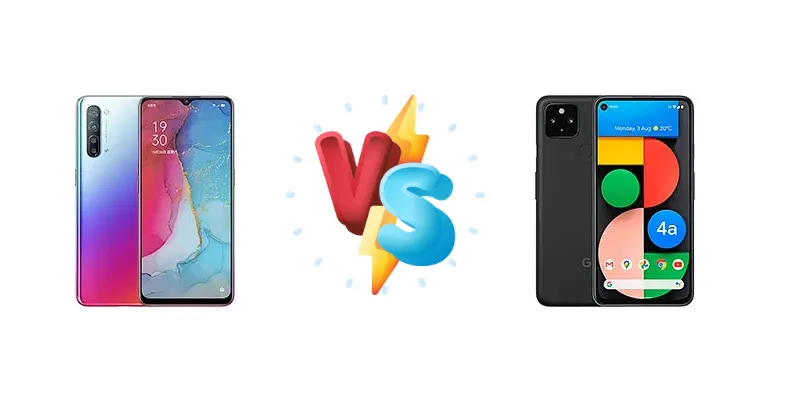
|
🏆 Quick Verdict
For users prioritizing raw processing power and faster charging, the Oppo Reno3 5G emerges as the winner. Its Mediatek Dimensity 1000L chipset provides a noticeable performance edge. However, the Pixel 4a 5G’s superior camera software and guaranteed software updates make it a strong contender for photography enthusiasts and those valuing long-term support.
| PHONES | ||
|---|---|---|
| Phone Names | Oppo Reno3 5G | Google Pixel 4a 5G |
| Network | ||
|---|---|---|
| 2G bands | GSM 850 / 900 / 1800 / 1900 | GSM 850 / 900 / 1800 / 1900 |
| 3G bands | HSDPA 800 / 850 / 900 / 1700(AWS) / 1900 / 2100 | HSDPA 850 / 900 / 1700(AWS) / 1900 / 2100 |
| 4G bands | 1, 2, 3, 4, 5, 7, 8, 12, 17, 18, 19, 20, 26, 34, 38, 39, 40, 41 | 1, 2, 3, 4, 5, 7, 8, 12, 13, 14, 17, 18, 19, 20, 25, 26, 28, 29, 30, 32, 38, 39, 40, 41, 42, 46, 48, 66, 71 |
| 5G bands | 1, 41, 78, 79 SA/NSA | 1, 2, 3, 5, 7, 8, 12, 28, 41, 66, 71, 77, 78 Sub6, mmWave (market dependant) |
| Speed | HSPA, LTE, 5G 4.7/2.5 Gbps | HSPA, LTE, 5G |
| Technology | GSM / CDMA / HSPA / EVDO / LTE / 5G | GSM / HSPA / LTE / 5G |
| CDMA2000 1xEV-DO | - | |
| Launch | ||
|---|---|---|
| Announced | 2019, December. Released 2019, December | 2020, September 30 |
| Status | Discontinued | Available. Released 2020, November 05 |
| Body | ||
|---|---|---|
| Build | Glass front (Gorilla Glass 5), glass back (Gorilla Glass 5), aluminum frame | Glass front (Gorilla Glass 3), plastic back, plastic frame |
| Dimensions | 160.3 x 74.3 x 8 mm (6.31 x 2.93 x 0.31 in) | 153.9 x 74 x 8.2 mm (Sub-6) or 8.5 mm (Sub-6 and mmWave) |
| SIM | Nano-SIM + Nano-SIM | Nano-SIM + eSIM |
| Weight | 181 g (6.38 oz) | 168 g (5G Sub-6); 171 g ( 5G Sub-6 and mmWave) (5.93 oz) |
| Display | ||
|---|---|---|
| Protection | Corning Gorilla Glass 5 | Corning Gorilla Glass 3 |
| Resolution | 1080 x 2400 pixels, 20:9 ratio (~408 ppi density) | 1080 x 2340 pixels, 19.5:9 ratio (~413 ppi density) |
| Size | 6.4 inches, 100.4 cm2 (~84.3% screen-to-body ratio) | 6.2 inches, 95.7 cm2 (~84.1% screen-to-body ratio) |
| Type | AMOLED, 430 nits (typ) | OLED, HDR |
| - | Always-on display | |
| Platform | ||
|---|---|---|
| CPU | Octa-core (2x2.2 GHz Cortex-A77 & 6x2.0 GHz Cortex A55) | Octa-core (1x2.4 GHz Kryo 475 Prime & 1x2.2 GHz Kryo 475 Gold & 6x1.8 GHz Kryo 475 Silver) |
| Chipset | Mediatek Dimensity 1000L (7 nm) | Qualcomm SM7250 Snapdragon 765G 5G (7 nm) |
| GPU | Mali-G77 MP9 | Adreno 620 |
| OS | Android 10, ColorOS 7 | Android 11, upgradable to Android 14 |
| Memory | ||
|---|---|---|
| Card slot | No | No |
| Internal | 128GB 8GB RAM, 128GB 12GB RAM | 128GB 6GB RAM |
| UFS 2.1 | UFS 2.1 | |
| Main Camera | ||
|---|---|---|
| Dual | - | 12.2 MP, f/1.7, 27mm (wide), 1/2.55", 1.4µm, dual pixel PDAF, OIS 16 MP, f/2.2, 107˚ (ultrawide), 1.0µm |
| Features | LED flash, HDR, panorama | LED flash, Pixel Shift, Auto-HDR, panorama |
| Quad | 64 MP, f/1.8, 26mm (wide), 1/1.72", 0.8µm, PDAF, OIS 8 MP, f/2.2, 13mm (ultrawide), 1/3.2", 1.4µm 2 MP B/W, f/2.4, 1/5.0", 1.75µm Auxiliary lens | - |
| Single | 13 MP, AF | - |
| Video | 4K@30fps, 1080p@30/60/120fps; gyro-EIS, OIS | 4K@30/60fps, 1080p@30/60/120/240fps; gyro-EIS |
| Selfie camera | ||
|---|---|---|
| Features | HDR | HDR |
| Single | 32 MP, f/2.0, 26mm (wide), 1/2.8", 0.8µm | 8 MP, f/2.0, 24mm (wide), 1/4.0", 1.12µm |
| Video | 1080p@30fps | 1080p@30fps |
| Sound | ||
|---|---|---|
| 3.5mm jack | Yes | Yes |
| 35mm jack | Yes | Yes |
| Loudspeaker | Yes | Yes, with stereo speakers |
| Comms | ||
|---|---|---|
| Bluetooth | 5.0, A2DP, LE, aptX HD | 5.0, A2DP, LE, aptX HD |
| NFC | Yes | Yes |
| Positioning | GPS (L1+L5), GLONASS, BDS, GALILEO, QZSS | GPS, GLONASS, GALILEO, QZSS, BDS |
| Radio | Unspecified | No |
| USB | USB Type-C 3.1, OTG | USB Type-C 3.1 |
| WLAN | Wi-Fi 802.11 a/b/g/n/ac/6, dual-band, Wi-Fi Direct | Wi-Fi 802.11 a/b/g/n/ac, dual-band, Wi-Fi Direct |
| Features | ||
|---|---|---|
| Sensors | Fingerprint (under display, optical), accelerometer, gyro, proximity, compass | Fingerprint (rear-mounted), accelerometer, gyro, proximity, compass, barometer |
| Battery | ||
|---|---|---|
| Charging | 30W wired, 50% in 20 min | 18W wired, PD2.0 |
| Stand-by | Up to 410 h (2G) / Up to 450 h (3G) | - |
| Talk time | Up to 11 h 30 min (2G) / Up to 22 h 30 min (3G) | - |
| Type | Li-Po 4025 mAh, non-removable | Li-Po 3885 mAh |
| Misc | ||
|---|---|---|
| Colors | White, Black, Starry Night Blue, Sunrise | Just Black, Clearly White |
| Models | PCHM30, PDCM00, A001OP | GD1YQ, G025I, G025E, G025H, G6QU3 |
| Price | About 440 EUR | About 140 EUR |
Oppo Reno3 5G
- Faster 30W charging significantly reduces downtime.
- Mediatek Dimensity 1000L offers superior processing power.
- Potentially more versatile camera system with multiple lenses.
- Software updates may be less frequent than on the Pixel.
- Color Science may be less accurate than the Pixel.
Google Pixel 4a 5G
- Exceptional camera quality thanks to Google’s software.
- Clean Android experience with guaranteed software updates.
- Strong value proposition for photography enthusiasts.
- Slower 18W charging.
- Snapdragon 765G offers less raw processing power than the Dimensity 1000L.
Display Comparison
Neither device boasts a cutting-edge display. While specific panel details (like OLED vs LCD) aren't provided, the focus here is on performance. The Reno3 5G’s display is likely tuned for vibrant colors, typical of Oppo’s approach. The Pixel 4a 5G, given Google’s history, will prioritize color accuracy. The real difference lies in the underlying processing power needed to drive higher refresh rates, which neither phone explicitly supports. Bezels are likely comparable, given the similar price points.
Camera Comparison
The Pixel 4a 5G leverages Google’s renowned computational photography prowess. While sensor sizes aren’t specified, Google consistently extracts exceptional image quality from relatively modest hardware. The Reno3 5G likely features a higher megapixel count, but megapixels aren’t everything. The Pixel’s strength lies in its image processing algorithms – HDR+, Night Sight, and Portrait Mode – which consistently deliver excellent results in various lighting conditions. The Reno3 5G will likely offer more versatility with potentially more lenses, but the Pixel’s software advantage is significant. Ignoring the likely inclusion of 2MP macro/depth sensors on the Reno3 5G, the Pixel’s focus on core image quality is a key differentiator.
Performance
The core of the difference lies in the chipsets. The Oppo Reno3 5G’s Mediatek Dimensity 1000L (7nm) utilizes a Cortex-A77 based CPU, offering strong single-core performance. Its octa-core configuration (2x2.2 GHz Cortex-A77 & 6x2.0 GHz Cortex A55) is geared towards multitasking and demanding applications. Conversely, the Google Pixel 4a 5G’s Snapdragon 765G (7nm) employs Qualcomm’s Kryo architecture (1x2.4 GHz Kryo 475 Prime & 1x2.2 GHz Kryo 475 Gold & 6x1.8 GHz Kryo 475 Silver). While the Snapdragon 765G’s prime core clocks slightly higher, the Dimensity 1000L’s A77 cores generally outperform the Kryo 475 in sustained workloads. This translates to a smoother experience in graphically intensive games and faster video rendering on the Reno3 5G. The lack of LPDDR5x specification for either phone suggests they both utilize LPDDR4X, limiting memory bandwidth.
Battery Life
Battery capacity isn’t specified for either device, but the charging speeds are. The Oppo Reno3 5G’s 30W wired charging is significantly faster than the Pixel 4a 5G’s 18W charging with PD2.0. The Reno3 5G can reach 50% charge in just 20 minutes, while the Pixel 4a 5G will take considerably longer. This difference is crucial for users who frequently need to top up their battery quickly. While a larger battery capacity on the Pixel 4a 5G could offset the slower charging, the Reno3 5G’s faster charging provides a more convenient experience.
Buying Guide
Buy the Oppo Reno3 5G if you need a phone for demanding tasks like mobile gaming or video editing, and value faster 30W charging. Buy the Google Pixel 4a 5G if you prioritize camera quality, clean Android software with timely updates, and a more streamlined user experience, even if it means sacrificing some raw processing speed.