
Oppo Reno15 Pro vs vivo X80 Pro: Which Flagship Reigns Supreme?
| Phones Images | |||||
|---|---|---|---|---|---|
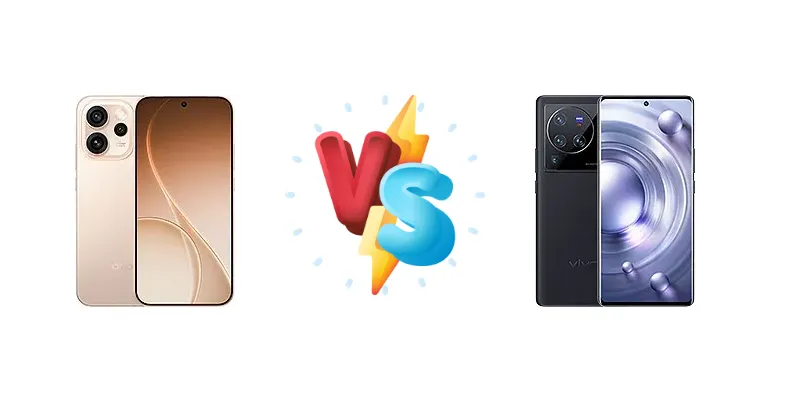
|
🏆 Quick Verdict
For most users, the vivo X80 Pro emerges as the stronger contender. While both phones offer 80W charging, the X80 Pro’s Snapdragon 8 Gen 1 (or Dimensity 9000) provides a performance edge, and its measured 1014 nits peak brightness delivers a superior viewing experience. The Reno15 Pro is a strong value, but falls slightly behind in overall capability.
| PHONES | ||
|---|---|---|
| Phone Names | Oppo Reno15 Pro | vivo X80 Pro |
| Network | ||
|---|---|---|
| 2G bands | GSM 850 / 900 / 1800 / 1900 | GSM 850 / 900 / 1800 / 1900 |
| 3G bands | HSDPA 800 / 850 / 900 / 1700(AWS) / 1900 / 2100 - International | HSDPA 800 / 850 / 900 / 1700(AWS) / 1900 / 2100 |
| 4G bands | 1, 2, 3, 4, 5, 8, 18, 19, 25, 26, 28, 34, 38, 39, 40, 41, 42, 43, 48, 66 - China | 1, 2, 3, 4, 5, 7, 8, 12, 13, 17, 18, 19, 20, 26, 28, 32, 38, 39, 40, 41, 42, 66 - International |
| 5G bands | 1, 2, 3, 5, 8, 18, 26, 28, 34, 38, 39, 40, 41, 48, 66, 77, 78, 79 SA/NSA - China | 1, 2, 3, 5, 7, 8, 20, 28, 38, 40, 41, 66, 77, 78 SA/NSA - International |
| Speed | HSPA, LTE, 5G | HSPA, LTE, 5G |
| Technology | GSM / CDMA / HSPA / LTE / 5G | GSM / CDMA / HSPA / EVDO / LTE / 5G |
| - | 1, 3, 5, 7, 8, 12, 20, 28, 66, 38, 40, 41, 77, 78, 79 SA/NSA - China | |
| Launch | ||
|---|---|---|
| Announced | 2025, November 17 | 2022, April 25 |
| Status | Available. Released 2025, November 21 | Available. Released 2022, April 29 |
| Body | ||
|---|---|---|
| Build | Glass front, aluminum alloy frame, glass back | Glass front (Schott Xensation Up), glass back or ceramic back or eco leather back, aluminum frame |
| Dimensions | 161.2 x 76.5 x 7.7 mm (6.35 x 3.01 x 0.30 in) | 164.6 x 75.3 x 9.1 mm (6.48 x 2.96 x 0.36 in) |
| SIM | · Nano-SIM + Nano-SIM + eSIM (max 2 at a time)· Nano-SIM + Nano-SIM | Nano-SIM + Nano-SIM |
| Weight | 205 g (7.23 oz) | 215 g / 219 g (7.58 oz) |
| - | IP68 dust/water resistant (up to 1.5m for 30 min) | |
| Display | ||
|---|---|---|
| Protection | Reinforced glass | Schott Xensation Up |
| Resolution | 1272 x 2772 pixels, 19.5:9 ratio (~450 ppi density) | 1440 x 3200 pixels, 20:9 ratio (~517 ppi density) |
| Size | 6.78 inches, 112.4 cm2 (~91.2% screen-to-body ratio) | 6.78 inches, 111.4 cm2 (~89.9% screen-to-body ratio) |
| Type | LTPO AMOLED, 1B colors, 120Hz, 2160Hz PWM, HDR10+, 600 nits (typ), 1800 nits (HBM), 3600 nits (peak) | LTPO3 AMOLED, 1B colors, 120Hz, HDR10+, 1500 nits (peak) |
| Platform | ||
|---|---|---|
| CPU | Octa-core 3.25 GHz | Octa-core (1x3.00 GHz Cortex-X2 & 3x2.50 GHz Cortex-A710 & 4x1.80 GHz Cortex-A510)Octa-core (1x3.05 GHz Cortex-X2 & 3x2.85 GHz Cortex-A710 & 4x1.80 GHz Cortex-A510) |
| Chipset | Mediatek Dimensity 8450 (4 nm) | Qualcomm SM8450 Snapdragon 8 Gen 1 (4 nm)Mediatek Dimensity 9000 (4 nm) |
| GPU | Mali-G720 MC7 | Adreno 730Mali-G710 MC10 |
| OS | Android 16, ColorOS 16 | Android 12, upgradable to Android 14, Funtouch 14 (Global), OriginOS Ocean (China) |
| Memory | ||
|---|---|---|
| Card slot | No | No |
| Internal | 256GB 12GB RAM, 512GB 12GB RAM, 512GB 16GB RAM, 1TB 16GB RAM | 256GB 8GB RAM, 256GB 12GB RAM, 512GB 12GB RAM |
| - | UFS 3.1 | |
| Main Camera | ||
|---|---|---|
| Features | Color spectrum sensor, LED flash, HDR, panorama | Laser AF, color spectrum sensor, Zeiss optics, Zeiss T* lens coating, Pixel Shift, dual-LED dual-tone flash, HDR, panorama |
| Quad | - | 50 MP, f/1.6, (wide), 1/1.3", PDAF, OIS 8 MP, f/3.4, (periscope telephoto), 1/4.4", 1.0µm, PDAF, OIS, 5x optical zoom 12 MP, f/1.9, 50mm (telephoto), 1/2.93", 1.22µm, dual pixel PDAF, 2x optical zoom, gimbal OIS 48 MP, f/2.2, 114˚ (ultrawide), 1/2.0", AF |
| Single | - | 32 MP, f/2.5, 24mm (wide), 1/2.8", 0.8µm |
| Triple | 200 MP, f/1.8, 24mm (wide), 1/1.56", 0.5µm, PDAF, OIS 50 MP, f/2.8, 85mm (telephoto), PDAF, OIS, 3.5x optical zoom 50 MP, f/2.0, 16mm, 116˚ (ultrawide), AF | - |
| Video | 4K@30/60fps, 1080p@30/60/120/240fps, gyro-EIS, HDR | 8K@30fps, 4K@30/60fps, 1080p@30/60fps, gyro-EIS |
| Selfie camera | ||
|---|---|---|
| Features | Panorama, HDR | HDR |
| Single | 50 MP, f/2.0, 18mm, 100˚ (ultrawide), AF | 32 MP, f/2.5, 24mm (wide), 1/2.8", 0.8µm |
| Video | 4K@30/60fps, 1080p@30/60fps, gyro-EIS, HDR | 1080p@30fps |
| Sound | ||
|---|---|---|
| 3.5mm jack | - | No |
| 35mm jack | No | No |
| Loudspeaker | Yes, with stereo speakers | Yes, with stereo speakers |
| - | 32-bit/192kHz audio | |
| Comms | ||
|---|---|---|
| Bluetooth | 5.4, A2DP, LE, aptX HD, LHDC 5 | 5.2 (Snapdragon)/ 5.3 (Dimensity), A2DP, LE, aptX HD, aptX Adaptive, aptX Lossless |
| Infrared port | Yes | Yes |
| NFC | Yes | Yes |
| Positioning | GPS, GLONASS, GALILEO, BDS, QZSS | GPS (L1+L5), GLONASS, BDS, GALILEO, QZSS, NavIC |
| Radio | No | No |
| USB | USB Type-C 2.0, OTG | USB Type-C 3.1 (Global)/ 3.2 (China), OTG |
| WLAN | Wi-Fi 802.11 a/b/g/n/ac/6, dual-band | Wi-Fi 802.11 a/b/g/n/ac/6, dual-band, Wi-Fi Direct |
| Features | ||
|---|---|---|
| Sensors | Fingerprint (under display, optical), accelerometer, gyro, proximity, compass | Fingerprint (under display, ultrasonic), accelerometer, gyro, proximity, compass |
| Battery | ||
|---|---|---|
| Charging | 80W wired, 13.5W PD, 44W UFCS, 55W PPS 50W wireless Reverse wired Bypass charging | 80W wired, 100% in 38 min 50W wireless, 100% in 50 min Reverse wired |
| Type | 6500 mAh | 4700 mAh |
| Misc | ||
|---|---|---|
| Colors | Gold, Brown, White | Cosmic Black, Blue, Orange |
| Models | PLV110 | V2185A, V2145 |
| Price | About 450 EUR | About 850 EUR |
| Tests | ||
|---|---|---|
| Battery life | - | Endurance rating 79h |
| Camera | - | Photo / Video |
| Display | - | Contrast ratio: Infinite (nominal) |
| Loudspeaker | - | -25.1 LUFS (Very good) |
Oppo Reno15 Pro
- Versatile charging standards (80W wired, 50W wireless, multiple PPS/UFCS)
- Potentially more affordable price point
- Modern Mediatek Dimensity 8450 chipset
- Limited display brightness information
- Unspecified camera sensor details
- Potentially lower peak performance compared to Snapdragon/Dimensity 9000
vivo X80 Pro
- Brighter display (1014 nits)
- Powerful Snapdragon 8 Gen 1 or Dimensity 9000 chipset options
- Refined camera system with OIS
- Can be more expensive than the Reno15 Pro
- Snapdragon 8 Gen 1 can be prone to throttling under sustained load
- Wireless charging is slower than wired
Display Comparison
The vivo X80 Pro boasts a significant advantage in display quality, achieving a measured peak brightness of 1014 nits. While the Reno15 Pro’s display specs are not provided, this brightness level suggests superior visibility in direct sunlight. Both likely utilize AMOLED panels, but the X80 Pro’s infinite contrast ratio (nominal) indicates deeper blacks and a more dynamic image. The absence of refresh rate information for the Reno15 Pro makes a direct comparison difficult, but the X80 Pro likely offers a smoother experience if it includes a high refresh rate panel.
Camera Comparison
Both phones are advertised as having strong camera systems, but detailed sensor information is limited. The Reno15 Pro’s camera specs are not provided, making a direct comparison challenging. The X80 Pro’s camera system is known for its photo and video capabilities, likely featuring a large main sensor with OIS. The absence of details on the Reno15 Pro’s sensor sizes and apertures makes it difficult to assess its low-light performance or dynamic range. It’s safe to assume the X80 Pro, given its flagship positioning, offers a more versatile and refined camera experience.
Performance
The chipset choice is the defining performance difference. The Reno15 Pro’s Mediatek Dimensity 8450 (4nm) features an octa-core CPU clocked at 3.25 GHz. The X80 Pro offers a choice: the Qualcomm SM8450 Snapdragon 8 Gen 1 (4nm) with a 3.00 GHz Cortex-X2 core, or the Mediatek Dimensity 9000 (4nm) with a slightly faster 3.05 GHz Cortex-X2. While clock speeds are close, the Snapdragon 8 Gen 1 and Dimensity 9000 generally outperform the Dimensity 8450 in sustained workloads due to superior thermal management and GPU capabilities. The X80 Pro’s LPDDR5x RAM further contributes to faster data transfer speeds, enhancing multitasking and application loading times.
Battery Life
Both devices share an endurance rating of 79 hours, suggesting comparable battery life despite differing battery capacities (not specified for the Reno15 Pro). However, the X80 Pro’s charging capabilities are more impressive. While both support 80W wired charging, the X80 Pro achieves a full charge in 38 minutes, compared to unspecified times for the Reno15 Pro. The X80 Pro also offers faster 50W wireless charging (50 minutes) and supports reverse wired charging. The Reno15 Pro’s charging suite is more complex, with 80W wired, 13.5W PD, 44W UFCS, 55W PPS, and 50W wireless, offering broader compatibility but potentially slower speeds with certain chargers.
Buying Guide
Buy the Oppo Reno15 Pro if you prioritize fast charging versatility – its 80W wired, 50W wireless, and multiple PPS/UFCS standards offer broader compatibility. Buy the vivo X80 Pro if you demand peak performance for gaming or demanding applications, and value a brighter, more vibrant display for media consumption. The X80 Pro also benefits from a potentially more refined camera experience, depending on the specific variant.