
Xiaomi 13 Pro vs Oppo Reno14: Which Flagship Reigns Supreme?
| Phones Images | |||||
|---|---|---|---|---|---|
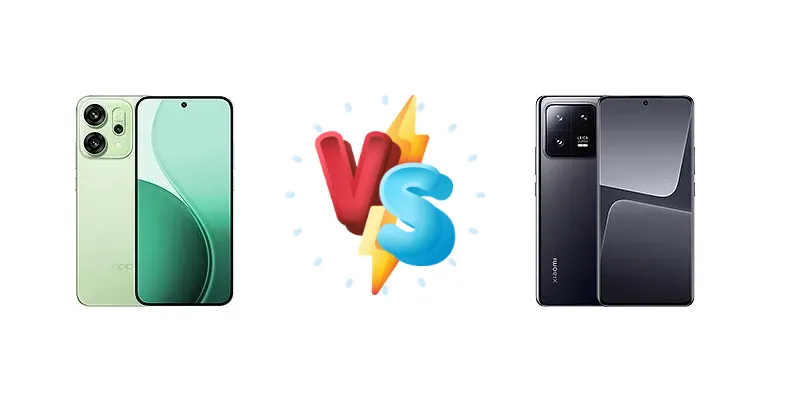
|
🏆 Quick Verdict
For users prioritizing raw power and a premium experience, the Xiaomi 13 Pro is the clear winner. Its Snapdragon 8 Gen 2 chipset and faster charging significantly outperform the Reno14. However, the Reno14 offers a compelling alternative for those seeking a strong performer at a potentially lower cost.
| PHONES | ||
|---|---|---|
| Phone Names | Oppo Reno14 | Xiaomi 13 Pro |
| Network | ||
|---|---|---|
| 2G bands | GSM 850 / 900 / 1800 / 1900 | GSM 850 / 900 / 1800 / 1900 |
| 3G bands | HSDPA 800 / 850 / 900 / 1700(AWS) / 1900 / 2100 - International | HSDPA 800 / 850 / 900 / 1700(AWS) / 1900 / 2100 |
| 4G bands | 1, 2, 3, 4, 5, 7, 8, 12, 13, 17, 18, 19, 20, 26, 28, 32, 38, 39, 40, 41, 66 - International | 1, 2, 3, 4, 5, 7, 8, 12, 13, 17, 18, 19, 20, 25, 26, 28, 32, 38, 39, 40, 41, 42, 48, 66 - International |
| 5G bands | 1, 2, 3, 5, 7, 8, 12, 20, 26, 28, 38, 40, 41, 66, 77, 78 SA/NSA - International | 1, 3, 5, 7, 8, 20, 28, 38, 40, 41, 66, 71, 75, 77, 78 SA/NSA - International |
| Speed | HSPA, LTE, 5G | HSPA, LTE, 5G |
| Technology | GSM / CDMA / HSPA / LTE / 5G | GSM / CDMA / HSPA / CDMA2000 / LTE / 5G |
| - | 1, 3, 5, 8, 28, 38, 40, 41, 77, 78, 79 SA/NSA - China | |
| Launch | ||
|---|---|---|
| Announced | 2025, May 15 | 2022, December 11 |
| Status | Available. Released 2025, May 23 | Available. Released 2022, December 14 |
| Body | ||
|---|---|---|
| Build | Glass front (Gorilla Glass 7i), aluminum alloy frame, glass back | Glass front (Gorilla Glass Victus), ceramic back or silicone polymer back, aluminum frame |
| Dimensions | 157.9 x 74.7 x 7.3 mm (6.22 x 2.94 x 0.29 in) | 162.9 x 74.6 x 8.4 mm or 8.7 mm |
| SIM | · Nano-SIM + Nano-SIM + eSIM (max 2 at a time)· Nano-SIM + Nano-SIM | · Nano-SIM + eSIM· Nano-SIM + Nano-SIM |
| Weight | 187 g (6.60 oz) | 210 g or 229 g (7.41 oz) |
| - | IP68 dust/water resistant (up to 1.5m for 30 min) | |
| Display | ||
|---|---|---|
| Protection | Corning Gorilla Glass 7i or Crystal Shield Glass | Corning Gorilla Glass Victus |
| Resolution | 1256 x 2760 pixels (~460 ppi density) | 1440 x 3200 pixels, 20:9 ratio (~522 ppi density) |
| Size | 6.59 inches, 105.6 cm2 (~89.6% screen-to-body ratio) | 6.73 inches, 108.9 cm2 (~89.6% screen-to-body ratio) |
| Type | AMOLED, 1B colors, 120Hz, 3840Hz PWM, HDR10+, 600 nits (typ), 1200 nits (HBM) | LTPO AMOLED, 1B colors, 120Hz, Dolby Vision, HDR10+, 1200 nits (HBM), 1900 nits (peak) |
| Platform | ||
|---|---|---|
| CPU | Octa-core (1x3.35 GHz Cortex-A715 & 3x3.20 GHz Cortex-A715 & 4x2.20 GHz Cortex-A510) | Octa-core (1x3.2 GHz Cortex-X3 & 2x2.8 GHz Cortex-A715 & 2x2.8 GHz Cortex-A710 & 3x2.0 GHz Cortex-A510) |
| Chipset | Mediatek Dimensity 8350 (4 nm) | Qualcomm SM8550-AB Snapdragon 8 Gen 2 (4 nm) |
| GPU | Mali G615-MC6 | Adreno 740 |
| OS | Android 15, ColorOS 15 | Android 13, upgradable to Android 14, HyperOS |
| Memory | ||
|---|---|---|
| Card slot | No | No |
| Internal | 256GB 8GB RAM, 256GB 12GB RAM, 256GB 16GB RAM, 512GB 12GB RAM, 512GB 16GB RAM, 1TB 16GB RAM | 128GB 8GB RAM, 256GB 8GB RAM, 256GB 12GB RAM, 512GB 12GB RAM |
| - | UFS 3.1 - 128GB UFS 4.0 - 256/512GB | |
| Main Camera | ||
|---|---|---|
| Features | Color spectrum sensor, LED flash, HDR, panorama | Laser AF, color spectrum sensor, Leica lens, Dual-LED dual-tone flash, HDR, panorama |
| Triple | 50 MP, f/1.8, 26mm (wide), PDAF, OIS 50 MP, f/2.8, 80mm (telephoto), PDAF, OIS, 3.5x optical zoom 8 MP, f/2.2, 15mm, 116˚ (ultrawide), 1/4.0", 1.12µm, AF | 50.3 MP, f/1.9, 23mm (wide), 1.0"-type, 1.6µm, dual pixel PDAF, OIS 50 MP, f/2.0, 75mm (telephoto), PDAF (10cm - ∞), 3.2x optical zoom 50 MP, f/2.2, 14mm, 115˚ (ultrawide), AF |
| Video | 4K@30/60fps, 1080p@30/60/120fps, gyro-EIS, HDR | 8K@24fps (HDR), 4K@24/30/60fps (HDR10+, 10-bit Dolby Vision HDR, 10-bit LOG), 1080p@30/120/240/960fps, 1080p@1920fps, gyro-EIS |
| Selfie camera | ||
|---|---|---|
| Features | Panorama, HDR | HDR, panorama |
| Single | 50 MP, f/2.0, 21mm (wide), AF | 32 MP, f/2.0, 22mm (wide), 1/3.14", 0.7µm |
| Video | 4K@30/60fps, 1080p@30/60fps, gyro-EIS, HDR | 1080p@30fps |
| Sound | ||
|---|---|---|
| 3.5mm jack | - | No |
| 35mm jack | No | No |
| Loudspeaker | Yes, with stereo speakers | Yes, with stereo speakers |
| - | 24-bit/192kHz audio | |
| Comms | ||
|---|---|---|
| Bluetooth | 5.4, A2DP, LE, aptX HD, LHDC 5 | 5.3, A2DP, aptX HD, aptX Adaptive |
| Infrared port | Yes | Yes |
| NFC | Yes (market/region dependent) | Yes |
| Positioning | GPS, GLONASS, GALILEO, BDS, QZSS | GPS (L1+L5), GLONASS (G1), BDS (B1I+B1c+B2a), GALILEO (E1+E5a), QZSS (L1+L5), NavIC (L5) |
| Radio | No | No |
| USB | USB Type-C 2.0, OTG | USB Type-C 2.0, OTG |
| WLAN | Wi-Fi 802.11 a/b/g/n/ac/6e, dual-band | Wi-Fi 802.11 a/b/g/n/ac/6e, dual-band, Wi-Fi Direct |
| Features | ||
|---|---|---|
| Sensors | Fingerprint (under display, optical), accelerometer, gyro, proximity, compass | Fingerprint (under display, optical), accelerometer, proximity, gyro, compass, barometer |
| Battery | ||
|---|---|---|
| Charging | 80W wired, 13.5W PD, 33W PPS Reverse wired | 120W wired, PD3.0, QC4, 100% in 19 min 50W wireless, 100% in 36 min 10W reverse wireless |
| Type | 6000 mAh | Li-Po 4820 mAh |
| Misc | ||
|---|---|---|
| Colors | Tranquil Green (Forest Green), Brilliant White (Pearl White), Black, Green | Ceramic White, Ceramic Black, Ceramic Flora Green, Mountain Blue |
| Models | PLA110, CPH2737 | 2210132G, 2210132C |
| Price | $ 749.00 / £ 599.00 / ₹ 36,799 | About 750 EUR |
| SAR | 1.12 W/kg (head) 0.85 W/kg (body) | - |
| Tests | ||
|---|---|---|
| Battery life | - | Endurance rating 115h |
| Camera | - | Photo / Video |
| Display | - | Contrast ratio: Infinite (nominal) |
| Loudspeaker | - | -25.6 LUFS (Very good) |
| Performance | - | AnTuTu: 1281666 (v9) GeekBench: 5087 (v5.1), 5323 (v6) GFXBench: 64fps (ES 3.1 onscreen) |
Oppo Reno14
- Superior performance with Snapdragon 8 Gen 2
- Significantly faster 120W wired charging
- Brighter and potentially more accurate display
- Likely more advanced camera system
- Potentially higher price
- May run hotter under sustained load
Xiaomi 13 Pro
- Potentially more affordable price point
- Fast 80W wired charging
- Efficient Dimensity 8350 processor
- Reverse wired charging
- Less powerful processor than Snapdragon 8 Gen 2
- Slower charging speeds compared to Xiaomi 13 Pro
Display Comparison
The Xiaomi 13 Pro boasts a significantly brighter display, reaching a measured 1253 nits, compared to an unspecified peak brightness for the Reno14. While both utilize 4nm chipsets, the brighter display of the Xiaomi 13 Pro will be more visible outdoors. The Xiaomi 13 Pro’s ‘Infinite’ contrast ratio (nominal) suggests a high-quality panel, likely OLED, offering deep blacks. The Reno14’s display specifications are less detailed, making a direct comparison of color accuracy and panel technology difficult, but it’s likely to be a high-quality AMOLED panel as well.
Camera Comparison
Both devices are advertised as having strong photo and video capabilities, but detailed sensor information is lacking for the Reno14. The Xiaomi 13 Pro likely features a larger main sensor, benefiting from better light gathering and dynamic range. The Xiaomi 13 Pro’s image processing, powered by the Snapdragon 8 Gen 2’s ISP, will likely offer more sophisticated features and better overall image quality. Without specific details on the Reno14’s camera system, it’s difficult to make a precise comparison, but the Xiaomi 13 Pro’s flagship status suggests a more advanced and versatile camera setup.
Performance
The Xiaomi 13 Pro’s Snapdragon 8 Gen 2 is the performance leader. Its octa-core configuration, featuring a Cortex-X3 prime core clocked at 3.2 GHz, provides a substantial advantage over the Reno14’s Dimensity 8350. While both chips are built on a 4nm process, the Snapdragon 8 Gen 2’s architecture is more advanced, offering superior CPU and GPU performance. The Reno14’s Dimensity 8350, with its mix of Cortex-A715 and A510 cores, is still a capable performer, but will likely show its limitations in graphically intensive games or demanding multitasking scenarios. The Xiaomi 13 Pro’s LPDDR5x RAM (assumed, based on flagship status) will further enhance its performance.
Battery Life
The Xiaomi 13 Pro’s battery life is rated at an endurance rating of 115 hours with active use scoring 10:55h, indicating excellent longevity. Crucially, it supports 120W wired charging, achieving a full charge in just 19 minutes. It also offers 50W wireless charging (36 minutes to full) and 10W reverse wireless charging. The Oppo Reno14 offers 80W wired charging, 13.5W PD, 33W PPS, and reverse wired charging. While 80W is fast, it’s significantly slower than the Xiaomi 13 Pro’s 120W. The Reno14’s battery capacity is unspecified, but the Xiaomi 13 Pro’s combination of capacity and charging speed provides a clear advantage.
Buying Guide
Buy the Oppo Reno14 if you need a well-rounded smartphone with fast 80W charging and a focus on everyday usability, and are comfortable with a slightly less powerful processor. Buy the Xiaomi 13 Pro if you demand top-tier performance for gaming and demanding tasks, require the fastest possible charging (120W wired, 50W wireless), and value a brighter, potentially more color-accurate display.