
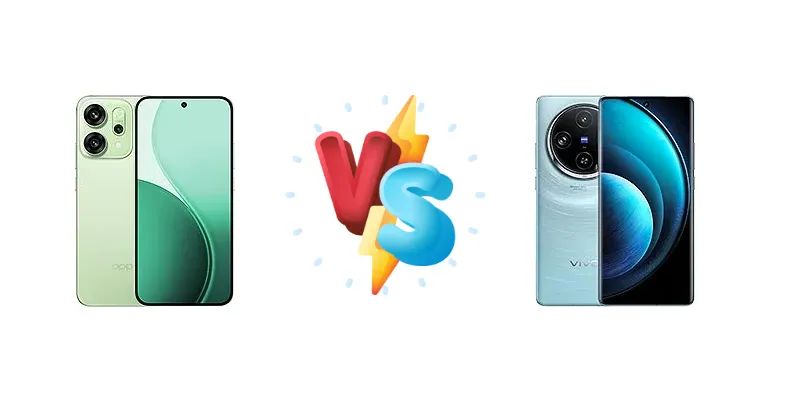
vivo X100 Pro vs Oppo Reno14: Which Dimensity-Powered Phone Reigns Supreme?
| Phones Images | |||||
|---|---|---|---|---|---|
|
🏆 Quick Verdict
For most users, the vivo X100 Pro is the superior choice. Its Dimensity 9300 chipset delivers significantly faster performance, complemented by a brighter display and longer battery life. While the Reno14 offers a compelling value proposition, the X100 Pro’s advancements justify the price difference for power users and photography enthusiasts.
| PHONES | ||
|---|---|---|
| Phone Names | Oppo Reno14 | vivo X100 Pro |
| Network | ||
|---|---|---|
| 2G bands | GSM 850 / 900 / 1800 / 1900 | GSM 850 / 900 / 1800 / 1900 |
| 3G bands | HSDPA 800 / 850 / 900 / 1700(AWS) / 1900 / 2100 - International | HSDPA 800 / 850 / 900 / 1700(AWS) / 1900 / 2100 |
| 4G bands | 1, 2, 3, 4, 5, 7, 8, 12, 13, 17, 18, 19, 20, 26, 28, 32, 38, 39, 40, 41, 66 - International | 1, 2, 3, 4, 5, 7, 8, 12, 17, 18, 19, 20, 26, 28, 32, 38, 39, 40, 41, 42, 66 - International |
| 5G bands | 1, 2, 3, 5, 7, 8, 12, 20, 26, 28, 38, 40, 41, 66, 77, 78 SA/NSA - International | 1, 3, 5, 7, 8, 20, 28, 38, 40, 41, 66, 75, 77, 78, 79 SA/NSA - International |
| Speed | HSPA, LTE, 5G | HSPA, LTE, 5G |
| Technology | GSM / CDMA / HSPA / LTE / 5G | GSM / CDMA / HSPA / LTE / 5G |
| Launch | ||
|---|---|---|
| Announced | 2025, May 15 | 2023, November 13 |
| Status | Available. Released 2025, May 23 | Available. Released 2023, November 21 |
| Body | ||
|---|---|---|
| Build | Glass front (Gorilla Glass 7i), aluminum alloy frame, glass back | Glass front, aluminum frame, glass back |
| Dimensions | 157.9 x 74.7 x 7.3 mm (6.22 x 2.94 x 0.29 in) | 164.1 x 75.3 x 8.9 mm or 9.1 mm |
| SIM | · Nano-SIM + Nano-SIM + eSIM (max 2 at a time)· Nano-SIM + Nano-SIM | · Nano-SIM + eSIM· Nano-SIM + Nano-SIM |
| Weight | 187 g (6.60 oz) | 221 g or 225 g (7.80 oz) |
| Display | ||
|---|---|---|
| Protection | Corning Gorilla Glass 7i or Crystal Shield Glass | - |
| Resolution | 1256 x 2760 pixels (~460 ppi density) | 1260 x 2800 pixels, 20:9 ratio (~452 ppi density) |
| Size | 6.59 inches, 105.6 cm2 (~89.6% screen-to-body ratio) | 6.78 inches, 111.5 cm2 (~90.2% screen-to-body ratio) |
| Type | AMOLED, 1B colors, 120Hz, 3840Hz PWM, HDR10+, 600 nits (typ), 1200 nits (HBM) | LTPO AMOLED, 1B colors, 120Hz, HDR10+, 3000 nits (peak) |
| Platform | ||
|---|---|---|
| CPU | Octa-core (1x3.35 GHz Cortex-A715 & 3x3.20 GHz Cortex-A715 & 4x2.20 GHz Cortex-A510) | Octa-core (1x3.25 GHz Cortex-X4 & 3x2.85 GHz Cortex-X4 & 4x2.0 GHz Cortex-A720) |
| Chipset | Mediatek Dimensity 8350 (4 nm) | Mediatek Dimensity 9300 (4 nm) |
| GPU | Mali G615-MC6 | Immortalis-G720 MC12 |
| OS | Android 15, ColorOS 15 | Android 14, upgradable to Android 15, Funtouch 15 (International), OriginOS 4 (China) |
| Memory | ||
|---|---|---|
| Card slot | No | No |
| Internal | 256GB 8GB RAM, 256GB 12GB RAM, 256GB 16GB RAM, 512GB 12GB RAM, 512GB 16GB RAM, 1TB 16GB RAM | 256GB 12GB RAM, 256GB 16GB RAM, 512GB 16GB RAM, 1TB 16GB RAM |
| Main Camera | ||
|---|---|---|
| Features | Color spectrum sensor, LED flash, HDR, panorama | Laser AF, color spectrum sensor, Zeiss optics, Zeiss T* lens coating, LED flash, panorama, HDR, 3D LUT import |
| Triple | 50 MP, f/1.8, 26mm (wide), PDAF, OIS 50 MP, f/2.8, 80mm (telephoto), PDAF, OIS, 3.5x optical zoom 8 MP, f/2.2, 15mm, 116˚ (ultrawide), 1/4.0", 1.12µm, AF | 50 MP, f/1.8, 23mm (wide), 1/0.98", 1.6µm, dual pixel PDAF, OIS 50 MP, f/2.5, 100mm (periscope telephoto), 1/2.51", 0.7µm, PDAF (18cm - ∞), OIS, 4.3x optical zoom 50 MP, f/2.0, 15mm, 119˚ (ultrawide), 1/2.76", 0.64µm, AF |
| Video | 4K@30/60fps, 1080p@30/60/120fps, gyro-EIS, HDR | 8K@30fps, 4K@30/60fps, 1080p, gyro-EIS |
| Selfie camera | ||
|---|---|---|
| Features | Panorama, HDR | HDR |
| Single | 50 MP, f/2.0, 21mm (wide), AF | 32 MP, f/2.0, 20mm (ultrawide) |
| Video | 4K@30/60fps, 1080p@30/60fps, gyro-EIS, HDR | 4K@30/60fps, 1080p@30/60fps |
| Sound | ||
|---|---|---|
| 35mm jack | No | No |
| Loudspeaker | Yes, with stereo speakers | Yes, with stereo speakers |
| Comms | ||
|---|---|---|
| Bluetooth | 5.4, A2DP, LE, aptX HD, LHDC 5 | 5.4, A2DP, LE, aptX HD, LHDC |
| Infrared port | Yes | Yes |
| NFC | Yes (market/region dependent) | Yes |
| Positioning | GPS, GLONASS, GALILEO, BDS, QZSS | GPS (L1+L5), GLONASS (L1), BDS (B1I+B1c+B2a+B2b), GALILEO (E1+E5a+E5b), QZSS (L1+L5), NavIC (L5) |
| Radio | No | No |
| USB | USB Type-C 2.0, OTG | USB Type-C 3.2, OTG |
| WLAN | Wi-Fi 802.11 a/b/g/n/ac/6e, dual-band | Wi-Fi 802.11 a/b/g/n/ac/6/7, tri-band, Wi-Fi Direct |
| Features | ||
|---|---|---|
| Sensors | Fingerprint (under display, optical), accelerometer, gyro, proximity, compass | Fingerprint (under display, optical), accelerometer, gyro, proximity, compass |
| Battery | ||
|---|---|---|
| Charging | 80W wired, 13.5W PD, 33W PPS Reverse wired | 100W wired, 50% in 14 min 50W wireless Reverse wired |
| Type | 6000 mAh | Li-Ion 5400 mAh |
| Misc | ||
|---|---|---|
| Colors | Tranquil Green (Forest Green), Brilliant White (Pearl White), Black, Green | Startrail Blue, Asteroid Black, Sunset Orange, White |
| Models | PLA110, CPH2737 | V2324A, V2309 |
| Price | $ 749.00 / £ 599.00 / ₹ 36,799 | ₹ 59,999 |
| SAR | 1.12 W/kg (head) 0.85 W/kg (body) | - |
| SAR EU | - | 0.99 W/kg (head) 1.19 W/kg (body) |
Oppo Reno14
- More affordable price point
- Sleek and stylish design (assumed)
- Fast 80W wired charging
- Less powerful Dimensity 8350 chipset
- Likely lower peak display brightness
- Potentially shorter battery life
vivo X100 Pro
- Flagship Dimensity 9300 performance
- Brighter display with potential LTPO
- Longer battery life (13:53h)
- Faster 100W wired and 50W wireless charging
- Higher price tag
- Potentially larger and heavier build (assumed)
- May lack headphone jack (market trend)
Display Comparison
The vivo X100 Pro boasts a significantly brighter display, reaching a measured peak of 1472 nits, ensuring excellent visibility even in direct sunlight. While the Reno14’s display specifications aren’t provided, it’s likely to fall short of this peak brightness. The X100 Pro’s panel likely incorporates LTPO technology, enabling variable refresh rates for improved power efficiency, a feature not confirmed for the Reno14. This difference in brightness and potential refresh rate technology directly impacts the outdoor usability and overall viewing experience.
Camera Comparison
While both phones are expected to deliver strong camera performance, the X100 Pro is positioned as a photography powerhouse. Details on the X100 Pro’s camera system are limited to 'Photo / Video', but vivo’s flagship series historically features large sensors and advanced image processing. The Reno14’s camera specs are not provided, making a direct comparison difficult. However, the X100 Pro’s likely larger sensor and more sophisticated image signal processor (ISP) will result in superior low-light performance, dynamic range, and overall image quality. We can assume the X100 Pro will offer more advanced video recording capabilities as well.
Performance
The core difference lies in the chipsets: the Dimensity 9300 in the X100 Pro versus the Dimensity 8350 in the Reno14. The 9300’s CPU configuration – 1x3.25 GHz Cortex-X4 & 3x2.85 GHz Cortex-X4 & 4x2.0 GHz Cortex-A720 – utilizes newer and more powerful Cortex-X4 cores compared to the Reno14’s 1x3.35 GHz Cortex-A715 & 3x3.20 GHz Cortex-A715 & 4x2.20 GHz Cortex-A510. This translates to a substantial performance advantage for the X100 Pro in CPU-intensive tasks and gaming. Both chips are built on a 4nm process, but the architectural improvements in the 9300 provide a clear edge. The X100 Pro will likely exhibit less throttling under sustained load.
Battery Life
The vivo X100 Pro demonstrates impressive battery endurance, achieving an active use score of 13:53h. The Reno14’s battery capacity isn’t specified, but the X100 Pro’s longer runtime suggests a larger battery or more efficient power management. Charging speeds also differ significantly: the X100 Pro supports 100W wired charging (50% in 14 minutes) and 50W wireless charging, while the Reno14 offers 80W wired, 13.5W PD, 33W PPS, and reverse wired charging. The X100 Pro’s faster wired and wireless charging provide a more convenient and rapid replenishment of battery life.
Buying Guide
Buy the Oppo Reno14 if you prioritize a sleek design and a smooth, responsive experience for everyday tasks and light gaming, all while staying within a tighter budget. Buy the vivo X100 Pro if you demand top-tier performance for demanding applications, mobile gaming, and professional-quality photography, and are willing to invest in a more premium device with faster charging and a superior display.