
Oppo Reno14 vs. Samsung Galaxy S23 Ultra: A Deep Dive into Performance and Value
| Phones Images | |||||
|---|---|---|---|---|---|
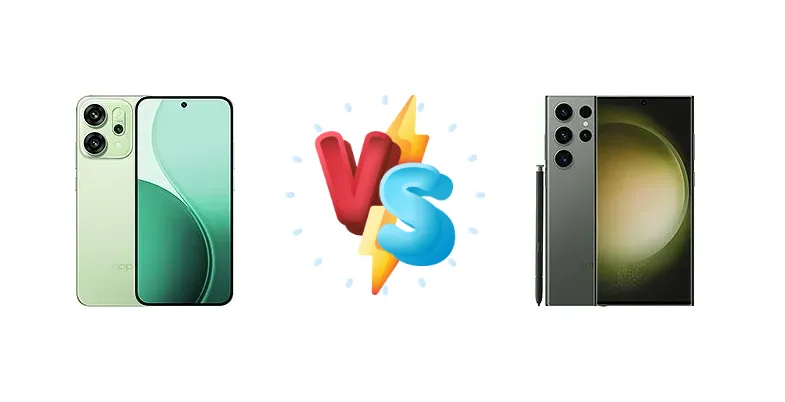
|
🏆 Quick Verdict
For the average user prioritizing a complete, premium experience, the Samsung Galaxy S23 Ultra is the clear winner. Its superior battery life, brighter display, and more refined camera system justify the higher price. However, the Oppo Reno14 offers exceptional value for those seeking flagship-level performance without the flagship price tag.
| PHONES | ||
|---|---|---|
| Phone Names | Oppo Reno14 | Samsung Galaxy S23 Ultra |
| Network | ||
|---|---|---|
| 2G bands | GSM 850 / 900 / 1800 / 1900 | GSM 850 / 900 / 1800 / 1900 |
| 3G bands | HSDPA 800 / 850 / 900 / 1700(AWS) / 1900 / 2100 - International | HSDPA 850 / 900 / 1700(AWS) / 1900 / 2100 |
| 4G bands | 1, 2, 3, 4, 5, 7, 8, 12, 13, 17, 18, 19, 20, 26, 28, 32, 38, 39, 40, 41, 66 - International | 1, 2, 3, 4, 5, 7, 8, 12, 13, 17, 18, 19, 20, 25, 26, 28, 32, 38, 39, 40, 41, 66 - International |
| 5G bands | 1, 2, 3, 5, 7, 8, 12, 20, 26, 28, 38, 40, 41, 66, 77, 78 SA/NSA - International | 1, 2, 3, 5, 7, 8, 12, 20, 25, 28, 38, 40, 41, 66, 75, 77, 78 SA/NSA/Sub6 - International |
| Speed | HSPA, LTE, 5G | HSPA, LTE (up to 7CA), 5G |
| Technology | GSM / CDMA / HSPA / LTE / 5G | GSM / CDMA / HSPA / EVDO / LTE / 5G |
| - | 1, 7, 28, 41, 66, 71, 78, 258, 260, 261 SA/NSA/Sub6/mmWave - USA | |
| Launch | ||
|---|---|---|
| Announced | 2025, May 15 | 2023, February 01 |
| Status | Available. Released 2025, May 23 | Available. Released 2023, February 17 |
| Body | ||
|---|---|---|
| Build | Glass front (Gorilla Glass 7i), aluminum alloy frame, glass back | Glass front (Gorilla Glass Victus 2), glass back (Gorilla Glass Victus 2), aluminum frame |
| Dimensions | 157.9 x 74.7 x 7.3 mm (6.22 x 2.94 x 0.29 in) | 163.4 x 78.1 x 8.9 mm (6.43 x 3.07 x 0.35 in) |
| SIM | · Nano-SIM + Nano-SIM + eSIM (max 2 at a time)· Nano-SIM + Nano-SIM | · Nano-SIM + eSIM· Nano-SIM + Nano-SIM + eSIM (max 2 at a time) |
| Weight | 187 g (6.60 oz) | 234 g (8.25 oz) |
| - | IP68 dust/water resistant (up to 1.5m for 30 min) Armor aluminum frame with tougher drop and scratch resistance (advertised) Stylus (Bluetooth integration, accelerometer, gyro) | |
| Display | ||
|---|---|---|
| Protection | Corning Gorilla Glass 7i or Crystal Shield Glass | Corning Gorilla Glass Victus 2 |
| Resolution | 1256 x 2760 pixels (~460 ppi density) | 1440 x 3088 pixels, 19.3:9 ratio (~500 ppi density) |
| Size | 6.59 inches, 105.6 cm2 (~89.6% screen-to-body ratio) | 6.8 inches, 114.7 cm2 (~89.9% screen-to-body ratio) |
| Type | AMOLED, 1B colors, 120Hz, 3840Hz PWM, HDR10+, 600 nits (typ), 1200 nits (HBM) | Dynamic AMOLED 2X, 120Hz, HDR10+, 1200 nits (HBM), 1750 nits (peak) |
| - | Always-on display | |
| Platform | ||
|---|---|---|
| CPU | Octa-core (1x3.35 GHz Cortex-A715 & 3x3.20 GHz Cortex-A715 & 4x2.20 GHz Cortex-A510) | Octa-core (1x3.36 GHz Cortex-X3 & 2x2.8 GHz Cortex-A715 & 2x2.8 GHz Cortex-A710 & 3x2.0 GHz Cortex-A510) |
| Chipset | Mediatek Dimensity 8350 (4 nm) | Qualcomm SM8550-AC Snapdragon 8 Gen 2 (4 nm) |
| GPU | Mali G615-MC6 | Adreno 740 |
| OS | Android 15, ColorOS 15 | Android 13, up to 4 major Android upgrades, One UI 8 |
| Memory | ||
|---|---|---|
| Card slot | No | No |
| Internal | 256GB 8GB RAM, 256GB 12GB RAM, 256GB 16GB RAM, 512GB 12GB RAM, 512GB 16GB RAM, 1TB 16GB RAM | 256GB 8GB RAM, 256GB 12GB RAM, 512GB 12GB RAM, 1TB 12GB RAM |
| - | UFS 4.0 | |
| Main Camera | ||
|---|---|---|
| Features | Color spectrum sensor, LED flash, HDR, panorama | Laser AF, LED flash, auto-HDR, panorama |
| Quad | - | 200 MP, f/1.7, 24mm (wide), 1/1.3", 0.6µm, multi-directional PDAF, OIS 10 MP, f/2.4, 70mm (telephoto), 1/3.52", 1.12µm, PDAF, OIS, 3x optical zoom 10 MP, f/4.9, 230mm (periscope telephoto), 1/3.52", 1.12µm, PDAF, OIS, 10x optical zoom 12 MP, f/2.2, 13mm, 120˚ (ultrawide), 1/2.55", 1.4µm, dual pixel PDAF, Super Steady video |
| Single | - | 12 MP, f/2.2, 26mm (wide), Dual Pixel PDAF |
| Triple | 50 MP, f/1.8, 26mm (wide), PDAF, OIS 50 MP, f/2.8, 80mm (telephoto), PDAF, OIS, 3.5x optical zoom 8 MP, f/2.2, 15mm, 116˚ (ultrawide), 1/4.0", 1.12µm, AF | - |
| Video | 4K@30/60fps, 1080p@30/60/120fps, gyro-EIS, HDR | 8K@24/30fps, 4K@30/60fps, 1080p@30/60/120/240fps, HDR10+, stereo sound rec., gyro-EIS |
| Selfie camera | ||
|---|---|---|
| Features | Panorama, HDR | HDR, HDR10+ |
| Single | 50 MP, f/2.0, 21mm (wide), AF | 12 MP, f/2.2, 26mm (wide), 1/3.2", 1.12µm, dual pixel PDAF |
| Video | 4K@30/60fps, 1080p@30/60fps, gyro-EIS, HDR | 4K@30/60fps, 1080p@30fps |
| Sound | ||
|---|---|---|
| 3.5mm jack | - | No |
| 35mm jack | No | No |
| Loudspeaker | Yes, with stereo speakers | Yes, with stereo speakers |
| - | 32-bit/384kHz audio Tuned by AKG | |
| Comms | ||
|---|---|---|
| Bluetooth | 5.4, A2DP, LE, aptX HD, LHDC 5 | 5.3, A2DP, LE |
| Infrared port | Yes | - |
| NFC | Yes (market/region dependent) | Yes |
| Positioning | GPS, GLONASS, GALILEO, BDS, QZSS | GPS, GALILEO, GLONASS, BDS, QZSS |
| Radio | No | No |
| USB | USB Type-C 2.0, OTG | USB Type-C 3.2, OTG |
| WLAN | Wi-Fi 802.11 a/b/g/n/ac/6e, dual-band | Wi-Fi 802.11 a/b/g/n/ac/6e, tri-band, Wi-Fi Direct |
| Features | ||
|---|---|---|
| Sensors | Fingerprint (under display, optical), accelerometer, gyro, proximity, compass | Fingerprint (under display, ultrasonic), accelerometer, gyro, proximity, compass, barometer |
| - | Samsung DeX, Samsung Wireless DeX (desktop experience support) Bixby natural language commands and dictation Samsung Pay (Visa, MasterCard certified) Ultra Wideband (UWB) support | |
| Battery | ||
|---|---|---|
| Charging | 80W wired, 13.5W PD, 33W PPS Reverse wired | 45W wired, PD3.0, 65% in 30 min 15W wireless (Qi) 4.5W reverse wireless |
| Type | 6000 mAh | Li-Ion 5000 mAh |
| Misc | ||
|---|---|---|
| Colors | Tranquil Green (Forest Green), Brilliant White (Pearl White), Black, Green | Phantom Black, Green, Cream, Lavender, Graphite, Sky Blue, Lime, Red, BMW M Edition |
| Models | PLA110, CPH2737 | SM-S918B, SM-S918B/DS, SM-S918U, SM-S918U1, SM-S918W, SM-S918N, SM-S9180, SM-S918E, SM-S918E/DS |
| Price | $ 749.00 / £ 599.00 / ₹ 36,799 | € 549.90 / $ 454.99 / £ 433.00 |
| SAR | 1.12 W/kg (head) 0.85 W/kg (body) | 1.12 W/kg (head) 0.92 W/kg (body) |
| SAR EU | - | 0.96 W/kg (head) 1.40 W/kg (body) |
| Tests | ||
|---|---|---|
| Battery life | - | Endurance rating 126h |
| Camera | - | Photo / Video |
| Display | - | Contrast ratio: Infinite (nominal) |
| Loudspeaker | - | -25.6 LUFS (Very good) |
| Performance | - | AnTuTu: 1241531 (v9) GeekBench: 4927 (v5.1) GFXBench: 67fps (ES 3.1 onscreen) |
Oppo Reno14
- Incredibly fast 80W wired charging
- More affordable price point
- Powerful Dimensity 8350 chipset
- Likely inferior camera system compared to S23 Ultra
- Battery life likely shorter than S23 Ultra
Samsung Galaxy S23 Ultra
- Exceptional battery life (13:24h active use)
- Superior camera system with advanced features
- Brighter and more refined display
- Significantly higher price
- Slower 45W wired charging
Display Comparison
The Samsung Galaxy S23 Ultra boasts a significantly brighter display, reaching a measured 1274 nits, compared to an unstated peak brightness for the Reno14. While the Reno14’s display quality is likely very good, the S23 Ultra’s panel offers superior visibility in direct sunlight. Both displays feature an 'infinite' (nominal) contrast ratio, suggesting excellent black levels. The S23 Ultra likely utilizes LTPO technology for adaptive refresh rates, contributing to better power efficiency, a feature not confirmed for the Reno14.
Camera Comparison
Both devices are listed as having 'Photo / Video' capabilities, but the specifics differ greatly. The S23 Ultra is renowned for its versatile camera system, likely featuring a larger main sensor and more advanced image processing algorithms. The Reno14’s camera system, while capable, is expected to be less sophisticated. Without detailed sensor information for the Reno14, it’s difficult to make a precise comparison, but the S23 Ultra’s reputation for image quality and zoom capabilities gives it a significant advantage. The Reno14 may rely more heavily on software processing to compensate for hardware limitations.
Performance
At the heart of the Reno14 lies the Mediatek Dimensity 8350 (4nm), featuring an octa-core configuration with a Cortex-A715 prime core clocked at 3.35 GHz. The S23 Ultra, however, is powered by the Qualcomm Snapdragon 8 Gen 2 (4nm), utilizing a more advanced CPU architecture with a Cortex-X3 prime core at 3.36 GHz. This architectural difference, coupled with the Snapdragon’s optimized GPU, translates to superior sustained performance and gaming capabilities for the S23 Ultra. While both chips are built on a 4nm process, the Snapdragon 8 Gen 2 generally exhibits better thermal management, reducing the likelihood of throttling during extended demanding tasks.
Battery Life
The Samsung Galaxy S23 Ultra delivers an impressive endurance rating of 126 hours and achieves 13:24 hours of active use, demonstrating exceptional battery life. The Reno14’s battery capacity is not specified, but its 80W wired charging capability is a major advantage, allowing for significantly faster charging times compared to the S23 Ultra’s 45W charging. The Reno14 also supports 33W PPS and 13.5W PD, offering flexibility in charging options. While the S23 Ultra’s battery lasts longer on a single charge, the Reno14’s faster charging mitigates the impact of a potentially smaller battery.
Buying Guide
Buy the Oppo Reno14 if you need a powerful daily driver with incredibly fast 80W charging and are willing to compromise on some camera features and the absolute highest level of display refinement. Buy the Samsung Galaxy S23 Ultra if you demand the best possible camera system, a stunningly bright and color-accurate display, and all-day battery life, and are prepared to pay a premium for it.