
OnePlus 12R vs Oppo Reno14: A Deep Dive into Performance and Value
| Phones Images | |||||
|---|---|---|---|---|---|
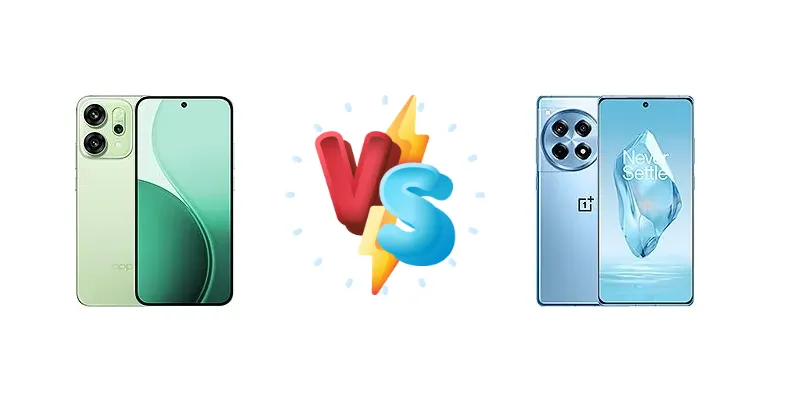
|
🏆 Quick Verdict
For most users, the OnePlus 12R emerges as the stronger choice. Its Snapdragon 8 Gen 2 chipset provides a significant performance advantage, particularly in sustained workloads and gaming, and its 100W charging is faster. While the Reno14 offers a respectable experience, the 12R’s raw power and charging speed justify the price difference.
| PHONES | ||
|---|---|---|
| Phone Names | Oppo Reno14 | OnePlus 12R |
| Network | ||
|---|---|---|
| 2G bands | GSM 850 / 900 / 1800 / 1900 | GSM 850 / 900 / 1800 / 1900 |
| 3G bands | HSDPA 800 / 850 / 900 / 1700(AWS) / 1900 / 2100 - International | HSDPA 850 / 900 / 1700(AWS) / 1900 / 2100 |
| 4G bands | 1, 2, 3, 4, 5, 7, 8, 12, 13, 17, 18, 19, 20, 26, 28, 32, 38, 39, 40, 41, 66 - International | 1, 2, 3, 4, 5, 7, 8, 12, 17, 18, 19, 20, 26, 28, 32, 38, 39, 40, 41, 66 |
| 5G bands | 1, 2, 3, 5, 7, 8, 12, 20, 26, 28, 38, 40, 41, 66, 77, 78 SA/NSA - International | 1, 2, 3, 5, 7, 8, 12, 20, 28, 38, 40, 41, 66, 77, 78 SA/NSA |
| Speed | HSPA, LTE, 5G | HSPA, LTE, 5G |
| Technology | GSM / CDMA / HSPA / LTE / 5G | GSM / CDMA / HSPA / LTE / 5G |
| Launch | ||
|---|---|---|
| Announced | 2025, May 15 | 2024, January 23 |
| Status | Available. Released 2025, May 23 | Available. Released 2024, February 06 |
| Body | ||
|---|---|---|
| Build | Glass front (Gorilla Glass 7i), aluminum alloy frame, glass back | Glass front (Gorilla Glass Victus 2), aluminum frame, glass back |
| Dimensions | 157.9 x 74.7 x 7.3 mm (6.22 x 2.94 x 0.29 in) | 163.3 x 75.3 x 8.8 mm (6.43 x 2.96 x 0.35 in) |
| SIM | · Nano-SIM + Nano-SIM + eSIM (max 2 at a time)· Nano-SIM + Nano-SIM | · Nano-SIM + Nano-SIM + eSIM (max 2 at a time)· Nano-SIM + Nano-SIM |
| Weight | 187 g (6.60 oz) | 207 g (7.30 oz) |
| Display | ||
|---|---|---|
| Protection | Corning Gorilla Glass 7i or Crystal Shield Glass | Corning Gorilla Glass Victus 2 |
| Resolution | 1256 x 2760 pixels (~460 ppi density) | 1264 x 2780 pixels (~450 ppi density) |
| Size | 6.59 inches, 105.6 cm2 (~89.6% screen-to-body ratio) | 6.78 inches, 111.7 cm2 (~90.9% screen-to-body ratio) |
| Type | AMOLED, 1B colors, 120Hz, 3840Hz PWM, HDR10+, 600 nits (typ), 1200 nits (HBM) | LTPO4 AMOLED, 1B colors, 120Hz, HDR10+, Dolby Vision, 1600 nits (HBM), 4500 nits (peak) |
| Platform | ||
|---|---|---|
| CPU | Octa-core (1x3.35 GHz Cortex-A715 & 3x3.20 GHz Cortex-A715 & 4x2.20 GHz Cortex-A510) | Octa-core (1x3.2 GHz Cortex-X3 & 2x2.8 GHz Cortex-A715 & 2x2.8 GHz Cortex-A710 & 3x2.0 GHz Cortex-A510) |
| Chipset | Mediatek Dimensity 8350 (4 nm) | Qualcomm SM8550-AB Snapdragon 8 Gen 2 (4 nm) |
| GPU | Mali G615-MC6 | Adreno 740 |
| OS | Android 15, ColorOS 15 | Android 14, up to 3 major Android upgrades, OxygenOS 15 |
| Memory | ||
|---|---|---|
| Card slot | No | No |
| Internal | 256GB 8GB RAM, 256GB 12GB RAM, 256GB 16GB RAM, 512GB 12GB RAM, 512GB 16GB RAM, 1TB 16GB RAM | 128GB 8GB RAM, 256GB 8GB RAM, 256GB 12GB RAM, 256GB 16GB RAM |
| Main Camera | ||
|---|---|---|
| Features | Color spectrum sensor, LED flash, HDR, panorama | Laser AF, color spectrum sensor, LED flash, HDR, panorama |
| Triple | 50 MP, f/1.8, 26mm (wide), PDAF, OIS 50 MP, f/2.8, 80mm (telephoto), PDAF, OIS, 3.5x optical zoom 8 MP, f/2.2, 15mm, 116˚ (ultrawide), 1/4.0", 1.12µm, AF | 50 MP, f/1.8, 24mm (wide), 1/1.56", 1.0µm, multi-directional PDAF, OIS 8 MP, f/2.2, 16mm, 112˚ (ultrawide), 1/4.0", 1.12µm 2 MP (macro) |
| Video | 4K@30/60fps, 1080p@30/60/120fps, gyro-EIS, HDR | 4K@30/60fps, 1080p@30/60/120/240fps, gyro-EIS, OIS |
| Selfie camera | ||
|---|---|---|
| Features | Panorama, HDR | HDR, panorama |
| Single | 50 MP, f/2.0, 21mm (wide), AF | 16 MP, f/2.4, 26mm (wide), 1/3", 1.0µm |
| Video | 4K@30/60fps, 1080p@30/60fps, gyro-EIS, HDR | 1080p@30fps, gyro-EIS |
| Sound | ||
|---|---|---|
| 35mm jack | No | No |
| Loudspeaker | Yes, with stereo speakers | Yes, with stereo speakers |
| Comms | ||
|---|---|---|
| Bluetooth | 5.4, A2DP, LE, aptX HD, LHDC 5 | 5.3, A2DP, LE, aptX HD |
| Infrared port | Yes | Yes |
| NFC | Yes (market/region dependent) | Yes |
| Positioning | GPS, GLONASS, GALILEO, BDS, QZSS | GPS, GALILEO, GLONASS, BDS, QZSS |
| Radio | No | No |
| USB | USB Type-C 2.0, OTG | USB Type-C 2.0 |
| WLAN | Wi-Fi 802.11 a/b/g/n/ac/6e, dual-band | Wi-Fi 802.11 a/b/g/n/ac/6/7, dual-band |
| Features | ||
|---|---|---|
| Sensors | Fingerprint (under display, optical), accelerometer, gyro, proximity, compass | Fingerprint (under display, optical), accelerometer, gyro, proximity, compass |
| Battery | ||
|---|---|---|
| Charging | 80W wired, 13.5W PD, 33W PPS Reverse wired | 100W wired, 100% in 26 min |
| Type | 6000 mAh | Li-Ion 5500 mAh |
| Misc | ||
|---|---|---|
| Colors | Tranquil Green (Forest Green), Brilliant White (Pearl White), Black, Green | Iron Gray, Cool Blue, Electric Violet, Sunset Dune |
| Models | PLA110, CPH2737 | CPH2609, CPH2585, CPH2611 |
| Price | $ 749.00 / £ 599.00 / ₹ 36,799 | € 410.84 / $ 399.95 / £ 649.00 |
| SAR | 1.12 W/kg (head) 0.85 W/kg (body) | 1.19 W/kg (head) 0.82 W/kg (body) |
Oppo Reno14
- Faster Snapdragon 8 Gen 2 processor
- 100W SuperVOOC charging for rapid refills
- Excellent battery life (14:32h active use)
- May be slightly more expensive than the Reno14
- Software experience can be divisive (OxygenOS)
OnePlus 12R
- Sleek and stylish design
- 80W SuperVOOC charging is still very fast
- Supports multiple charging protocols (PD, PPS)
- Dimensity 8350 chipset is less powerful than Snapdragon 8 Gen 2
- Performance may throttle under sustained load
Display Comparison
The OnePlus 12R boasts a brighter display, reaching a measured peak of 1181 nits, which translates to better visibility outdoors compared to the Reno14 (brightness data unavailable). While both likely utilize AMOLED panels, the 12R’s higher peak brightness is a tangible advantage. Details regarding panel technology (LTPO vs standard AMOLED) and color accuracy are missing for the Reno14, but the 12R’s display is known for its vibrant colors and smooth scrolling. Bezels appear comparable based on available imagery.
Camera Comparison
Camera details for the Reno14 are limited. The OnePlus 12R is expected to have a more robust camera system, though specific sensor sizes and apertures are not provided in the context data. The focus should be on the primary sensor capabilities; a larger sensor generally captures more light and detail. Without detailed camera specs for the Reno14, it’s difficult to make a direct comparison, but the OnePlus 12R’s brand reputation suggests a more refined image processing pipeline and potentially better low-light performance. We can safely assume the Reno14 includes standard features like portrait mode and night mode, but the 12R likely offers more advanced computational photography features.
Performance
The core difference lies in the chipsets. The OnePlus 12R’s Snapdragon 8 Gen 2 (4nm) is a significant step up from the Oppo Reno14’s Dimensity 8350 (4nm). The Snapdragon 8 Gen 2 features a Cortex-X3 prime core clocked at 3.2 GHz, alongside two Cortex-A715 cores at 2.8 GHz and two Cortex-A710 cores at 2.8 GHz, offering superior single-core and multi-core performance. The Reno14’s Dimensity 8350 uses a Cortex-A715 prime core at 3.35 GHz, but its overall architecture is less efficient for sustained performance. The 12R’s Adreno 740 GPU also eclipses the Mali-G615 MC4 in the Reno14, making it the clear winner for gaming. Both phones utilize 4nm fabrication, but the Snapdragon’s architecture provides better thermal efficiency, reducing throttling during extended gaming sessions.
Battery Life
The OnePlus 12R shines in battery and charging. Its 14:32h active use score demonstrates excellent endurance. Crucially, it supports 100W wired charging, achieving a full charge in just 26 minutes. The Oppo Reno14 offers 80W wired charging, which is still fast, but noticeably slower. The Reno14 also supports 13.5W PD and 33W PPS, offering more charging protocol options, but the 12R’s sheer speed is a significant advantage. While the Reno14’s battery capacity is unknown, the 12R’s combination of battery life and charging speed makes it the more convenient option for power users.
Buying Guide
Buy the Oppo Reno14 if you prioritize a sleek design and fast 80W charging, and your primary use case doesn't involve demanding gaming or consistently heavy multitasking. Buy the OnePlus 12R if you demand top-tier performance for gaming, video editing, or running resource-intensive applications, and value the fastest possible charging speeds alongside excellent battery life.