
Asus ROG Phone 8 Pro vs. Oppo Reno14 Pro: A Deep Dive into Performance and Features
| Phones Images | |||||
|---|---|---|---|---|---|
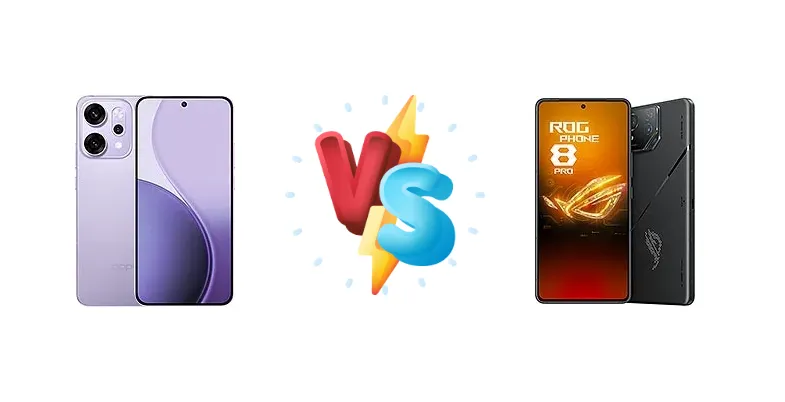
|
🏆 Quick Verdict
For the average user prioritizing a blend of style, camera quality, and fast charging, the Oppo Reno14 Pro offers a compelling package. However, the Asus ROG Phone 8 Pro is the clear winner for dedicated mobile gamers, boasting a significantly more powerful Snapdragon 8 Gen 3 chipset and superior battery endurance during intensive use.
| PHONES | ||
|---|---|---|
| Phone Names | Oppo Reno14 Pro | Asus ROG Phone 8 Pro |
| Network | ||
|---|---|---|
| 2G bands | GSM 850 / 900 / 1800 / 1900 | GSM 850 / 900 / 1800 / 1900 |
| 3G bands | HSDPA 800 / 850 / 900 / 1700(AWS) / 1900 / 2100 - International | HSDPA 850 / 900 / 1700(AWS) / 1800 / 1900 / 2100 - International |
| 4G bands | 1, 2, 3, 4, 5, 7, 8, 12, 13, 17, 18, 19, 20, 26, 28, 34, 38, 39, 40, 41, 42, 48, 66 - International | 1, 2, 3, 4, 5, 7, 8, 12, 17, 18, 19, 20, 25, 26, 28, 32, 34, 38, 39, 40, 41, 42, 43, 48, 66 - International |
| 5G bands | 1, 2, 3, 5, 7, 8, 12, 20, 26, 28, 38, 40, 41, 48, 66, 77, 78 SA/NSA - International | 1, 2, 3, 5, 7, 8, 12, 18, 20, 25, 26, 28, 38, 40, 41, 48, 66, 77, 78, 79 SA/NSA/Sub6 - International |
| Speed | HSPA, LTE, 5G | HSPA, LTE (Up to 7CA), 5G |
| Technology | GSM / CDMA / HSPA / LTE / 5G | GSM / CDMA / HSPA / LTE / 5G |
| Launch | ||
|---|---|---|
| Announced | 2025, May 15 | 2024, January 08 |
| Status | Available. Released 2025, May 23 | Available. Released 2024, January 18 |
| Body | ||
|---|---|---|
| Build | Glass front (Gorilla Glass 7i), aluminum alloy frame, glass back | Glass front (Gorilla Glass Victus 2), glass back (Gorilla Glass), aluminum frame |
| Dimensions | 163.4 x 77 x 7.5 mm (6.43 x 3.03 x 0.30 in) | 163.8 x 76.8 x 8.9 mm (6.45 x 3.02 x 0.35 in) |
| SIM | · Nano-SIM + Nano-SIM + eSIM (max 2 at a time)· Nano-SIM + Nano-SIM | Nano-SIM + Nano-SIM |
| Weight | 201 g (7.09 oz) | 225 g (7.94 oz) |
| Display | ||
|---|---|---|
| Protection | Corning Gorilla Glass 7i or Crystal Shield Glass | Corning Gorilla Glass Victus 2 |
| Resolution | 1272 x 2800 pixels (~450 ppi density) | 1080 x 2400 pixels, 20:9 ratio (~388 ppi density) |
| Size | 6.83 inches, 113.3 cm2 (~90.1% screen-to-body ratio) | 6.78 inches, 111.0 cm2 (~88.2% screen-to-body ratio) |
| Type | AMOLED, 1B colors, 120Hz, 3840Hz PWM, HDR10+, 600 nits (typ), 1200 nits (HBM) | LTPO AMOLED, 1B colors, 165Hz, HDR10, 1600 nits (HBM), 2500 nits (peak) |
| Platform | ||
|---|---|---|
| CPU | Octa-core 3.25 GHz | Octa-core (1x3.3 GHz Cortex-X4 & 3x3.2 GHz Cortex-A720 & 2x3.0 GHz Cortex-A720 & 2x2.3 GHz Cortex-A520) |
| Chipset | Mediatek Dimensity 8450 (4 nm) | Qualcomm SM8650-AB Snapdragon 8 Gen 3 (4 nm) |
| GPU | Mali-G720 MC7 | Adreno 750 |
| OS | Android 15, ColorOS 15 | Android 14, up to 2 major Android upgrades |
| Memory | ||
|---|---|---|
| Card slot | No | No |
| Internal | 256GB 12GB RAM, 512GB 12GB RAM, 512GB 16GB RAM, 1TB 16GB RAM | 512GB 16GB RAM, 1TB 24GB RAM |
| Main Camera | ||
|---|---|---|
| Features | Color spectrum sensor, LED flash, HDR, panorama | LED flash, HDR, panorama |
| Triple | 50 MP, f/1.8, 24mm (wide), 1/1.55", PDAF, OIS 50 MP, f/2.8, 80mm (periscope telephoto), PDAF, OIS, 3.5x optical zoom 50 MP, f/2.0, 16mm, 116˚ (ultrawide), AF | 50 MP, f/1.9, 24mm (wide), 1/1.56", 1.0µm, PDAF, gimbal OIS 32 MP, f/2.4, (telephoto), 1/3.2", 0.7µm, PDAF, OIS, 3x optical zoom 13 MP, f/2.2, 13mm, 120˚ (ultrawide) |
| Video | 4K@30/60fps, 1080p@30/60/120/240fps, gyro-EIS, HDR | 8K@24fps, 4K@30/60fps, 1080p@30/60/120/240fps, 720p@480fps; gyro-EIS, HDR10+ |
| Selfie camera | ||
|---|---|---|
| Features | Panorama, HDR | Panorama, HDR |
| Single | 50 MP, f/2.0, 21mm (wide), AF | 32 MP, f/2.5, 22mm (wide), 1/3.2", 0.7µm |
| Video | 4K@30/60fps, 1080p@30/60fps, gyro-EIS, HDR | 1080p@30fps |
| Sound | ||
|---|---|---|
| 35mm jack | No | Yes |
| Loudspeaker | Yes, with stereo speakers | Yes, with stereo speakers |
| Comms | ||
|---|---|---|
| Bluetooth | 5.4, A2DP, LE, aptX HD, LHDC 5 | 5.4, A2DP, LE, aptX HD, aptX Adaptive, aptX Lossless |
| Infrared port | Yes | - |
| NFC | Yes | Yes |
| Positioning | GPS, GLONASS, GALILEO, BDS, QZSS | GPS (L1+L5), BDS (B1I+B1c+B2a), GALILEO (E1+E5a), QZSS (L1+L5), NavIC (L5), GLONASS |
| Radio | No | No |
| USB | USB Type-C 2.0, OTG | USB Type-C (side), DisplayPort 1.4; USB Type-C (bottom), OTG |
| WLAN | Wi-Fi 802.11 a/b/g/n/ac/6e, dual-band | Wi-Fi 802.11 a/b/g/n/ac/6e/7, tri-band, Wi-Fi Direct |
| Features | ||
|---|---|---|
| Sensors | Fingerprint (under display, optical), accelerometer, gyro, proximity, compass | Fingerprint (under display, optical), accelerometer, gyro, proximity, compass |
| Battery | ||
|---|---|---|
| Charging | 80W wired, 13.5W PD, 33W UFCS, 33W PPS 50W wireless Reverse wired | 65W wired, PD3.0, PPS, QC5, 100% in 39 min - International 30W wired, PD3.0, PPS - India 15W wireless (Qi) 10W reverse wired |
| Type | 6200 mAh | 5500 mAh |
| Misc | ||
|---|---|---|
| Colors | Titanium Gray, Brilliant White (Opal White), Purple | Phantom Black |
| Models | PKZ110, CPH2739 | AI2401, AI2401_A, AI2401_D |
| Price | About 710 EUR | $ 1,157.98 / £ 1,693.75 / € 632.66 |
| SAR | 1.16 W/kg (head) 1.14 W/kg (body) | - |
Oppo Reno14 Pro
- Incredibly fast 80W wired charging
- Versatile charging standards (PD, UFCS, PPS)
- Sleek and stylish design
- Potentially superior camera image processing
- Less powerful chipset compared to Snapdragon 8 Gen 3
- Battery life likely shorter than ROG Phone 8 Pro
Asus ROG Phone 8 Pro
- Unmatched gaming performance with Snapdragon 8 Gen 3
- Exceptional battery life during gaming
- High brightness display for outdoor visibility
- Likely features optimized for gaming (triggers, cooling)
- More aggressive, gamer-focused design
- Slower wired charging speed (65W/30W)
Display Comparison
The Asus ROG Phone 8 Pro boasts a significantly brighter display, reaching a measured 1765 nits, ensuring excellent visibility even in direct sunlight. While the Reno14 Pro’s display specs aren’t provided, it’s unlikely to match this peak brightness. The ROG Phone 8 Pro likely utilizes an AMOLED panel with a high refresh rate, crucial for smooth gaming, while the Reno14 Pro’s panel technology remains unspecified. The ROG Phone 8 Pro’s larger size also suggests a more immersive viewing experience, though the Reno14 Pro may offer a more manageable form factor.
Camera Comparison
The context data is limited regarding camera specifics for both devices. However, the ROG Phone 8 Pro’s focus on overall performance suggests a capable camera system, likely prioritizing video recording alongside still photography. The Reno14 Pro, positioned as a flagship, likely features a more refined camera experience, potentially with a larger main sensor and advanced image processing algorithms. Without sensor size or aperture information, it’s difficult to make a definitive judgment, but the Reno14 Pro’s marketing often emphasizes camera capabilities, suggesting a stronger focus in this area. We can assume both phones will offer a variety of shooting modes, but the Reno14 Pro may excel in computational photography.
Performance
The core difference lies in the chipsets: the Asus ROG Phone 8 Pro’s Snapdragon 8 Gen 3 (4nm) is a generational leap ahead of the Oppo Reno14 Pro’s Mediatek Dimensity 8450 (4nm). The Snapdragon 8 Gen 3’s octa-core configuration, featuring a Cortex-X4 prime core clocked at 3.3 GHz, delivers substantially higher CPU and GPU performance. This translates to smoother frame rates in demanding games and faster processing for tasks like video editing. While both chips are built on a 4nm process, the Snapdragon 8 Gen 3’s architecture provides a clear advantage. The ROG Phone 8 Pro’s likely inclusion of faster LPDDR5x RAM further enhances performance, minimizing bottlenecks. The Reno14 Pro’s 3.25 GHz octa-core CPU is capable, but won’t match the ROG Phone 8 Pro’s sustained performance under heavy load.
Battery Life
The Asus ROG Phone 8 Pro demonstrates superior battery endurance with an active use score of 14:43h, indicating a larger battery capacity and efficient power management. While the Reno14 Pro’s battery capacity is unknown, its charging capabilities are more diverse: 80W wired, 13.5W PD, 33W UFCS, 33W PPS, and 50W wireless. The ROG Phone 8 Pro offers 65W wired (International) or 30W (India), 15W wireless (Qi), and 10W reverse wired. The Reno14 Pro’s 80W wired charging is faster than the ROG Phone 8 Pro’s international variant, achieving a full charge in less time. However, the ROG Phone 8 Pro’s longer battery life offsets the slightly slower charging speed for most users.
Buying Guide
Buy the Oppo Reno14 Pro if you need a stylish, well-rounded flagship with a focus on photography and incredibly fast charging speeds. It’s ideal for content creators and everyday users who value aesthetics and convenience. Buy the Asus ROG Phone 8 Pro if you prioritize uncompromising gaming performance, extended battery life during gaming sessions, and are willing to accept a more aggressive design aesthetic. It’s the choice for competitive mobile gamers and power users.