
Oppo Reno14 F vs Nothing Phone (2a) Plus: Which Mid-Range Phone Reigns Supreme?
| Phones Images | |||||
|---|---|---|---|---|---|
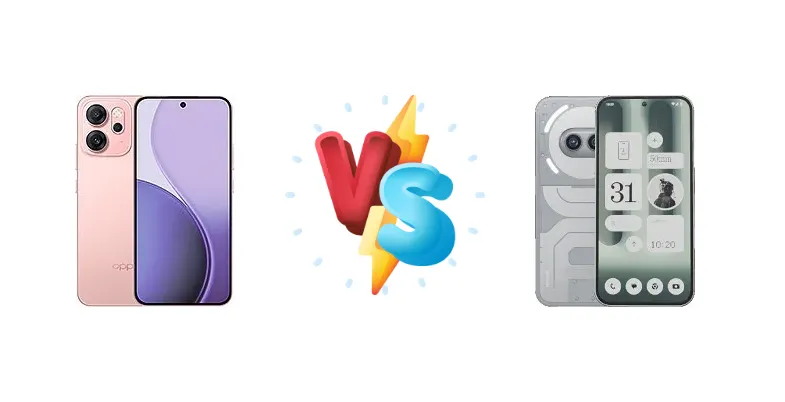
|
🏆 Quick Verdict
For the average user prioritizing sustained performance and battery longevity, the Oppo Reno14 F emerges as the stronger choice. Its 63-hour endurance and efficient Snapdragon 6 Gen 1 chipset offer peace of mind, while the Nothing Phone (2a) Plus excels in display brightness but falls short on overall stamina.
| PHONES | ||
|---|---|---|
| Phone Names | Oppo Reno14 F | Nothing Phone (2a) Plus |
| Network | ||
|---|---|---|
| 2G bands | GSM 850 / 900 / 1800 / 1900 | GSM 850 / 900 / 1800 / 1900 |
| 3G bands | HSDPA 800 / 850 / 900 / 1700(AWS) / 1900 / 2100 - version 1 | HSDPA 800 / 850 / 900 / 1700(AWS) / 1900 / 2100 |
| 4G bands | 1, 2, 3, 4, 5, 7, 8, 12, 17, 18, 19, 20, 26, 28, 38, 39, 40, 41, 42, 48, 66 - version 1 | 1, 3, 4, 5, 7, 8, 18, 19, 20, 26, 28, 38, 39, 40, 41, 42, 66 |
| 5G bands | 1, 2, 3, 5, 7, 8, 12, 20, 26, 28, 38, 40, 41, 66, 71, 77, 78 SA/NSA - version 1 | 1, 3, 5, 7, 8, 20, 28, 38, 40, 41, 66, 77, 78 SA/NSA |
| Speed | HSPA, LTE, 5G | HSPA, LTE, 5G |
| Technology | GSM / HSPA / LTE / 5G | GSM / HSPA / LTE / 5G |
| Launch | ||
|---|---|---|
| Announced | 2025, June 25 | 2024, July 31 |
| Status | Available. Released 2025, July 16 | Available. Released 2024, August 03 |
| Body | ||
|---|---|---|
| Build | - | Glass front (Gorilla Glass 5), plastic frame, plastic back |
| Dimensions | 158.1 x 75 x 7.7 mm (6.22 x 2.95 x 0.30 in) | 161.7 x 76.3 x 8.5 mm (6.37 x 3.00 x 0.33 in) |
| SIM | · Nano-SIM + Nano-SIM· Nano-SIM + eSIM | Nano-SIM + Nano-SIM |
| Weight | 180 g (6.35 oz) | 190 g (6.70 oz) |
| Display | ||
|---|---|---|
| Protection | AGC Dragontrail DT-Star D+, Mohs level 5 | Corning Gorilla Glass 5 |
| Resolution | 1080 x 2372 pixels (~397 ppi density) | 1080 x 2412 pixels, 20:9 ratio (~395 ppi density) |
| Size | 6.57 inches, 105.0 cm2 (~88.6% screen-to-body ratio) | 6.7 inches, 107.5 cm2 (~87.1% screen-to-body ratio) |
| Type | AMOLED, 1B colors, 120Hz, 600 nits (typ), 1400 nits (HBM) | AMOLED, 1B colors, 120Hz, 2160Hz PWM, HDR10+, 700 nits (typ), 1100 nits (HBM), 1300 nits (peak) |
| Platform | ||
|---|---|---|
| CPU | Octa-core (4x2.2 GHz Cortex-A78 & 4x1.8 GHz Cortex-A55) | Octa-core (2x3.0 GHz Cortex-A715 & 6x 2.0 GHz Cortex-A510) |
| Chipset | Qualcomm SM6450 Snapdragon 6 Gen 1 (4 nm) | Mediatek Dimensity 7350 Pro (4 nm) |
| GPU | Adreno 710 | Mali-G610 MC4 |
| OS | Android 15, ColorOS 15 | Android 14, up to 3 major Android upgrades, Nothing OS 3.0 |
| Memory | ||
|---|---|---|
| Card slot | microSDXC | No |
| Internal | 256GB 8GB RAM, 256GB 12GB RAM, 512GB 12GB RAM | 256GB 8GB RAM, 256GB 12GB RAM |
| Main Camera | ||
|---|---|---|
| Dual | - | 50 MP, f/1.9, 24mm (wide), 1/1.57", 1.0µm, PDAF, OIS 50 MP, f/2.2, 114˚ (ultrawide), 1/2.76", 0.64µm |
| Features | Color spectrum sensor, LED flash, HDR, panorama | LED flash, panorama, HDR |
| Triple | 50 MP, f/1.8, 26mm (wide), 1/1.95", 0.8µm, PDAF, OIS 8 MP, f/2.2, 16mm, 112˚ (ultrawide), 1/4.0", 1.12µm, AF 2 MP (macro) | - |
| Video | 4K@30fps, 1080p@30/60/120fps, gyro-EIS, OIS | 4K@30fps, 1080p@60/120fps, gyro-EIS |
| Selfie camera | ||
|---|---|---|
| Features | Panorama | HDR |
| Single | 32 MP, f/2.0, 22mm (wide), 1/2.74", 0.8µm, AF | 50 MP, f/2.2, (wide), 1/2.76" |
| Video | 1080p@30fps | 4K@30fps |
| Sound | ||
|---|---|---|
| 35mm jack | No | No |
| Loudspeaker | Yes, with stereo speakers | Yes, with stereo speakers |
| Comms | ||
|---|---|---|
| Bluetooth | 5.1, A2DP, LE, aptX HD, LHDC 5 | 5.3, A2DP, LE |
| NFC | Yes (market/region dependent) | Yes, 360˚ |
| Positioning | GPS, GLONASS, GALILEO, BDS, QZSS | GPS, GALILEO, GLONASS, BDS, QZSS |
| Radio | Unspecified | No |
| USB | USB Type-C 2.0, OTG | USB Type-C 2.0, OTG |
| WLAN | Wi-Fi 802.11 a/b/g/n/ac, dual-band | Wi-Fi 802.11 a/b/g/n/ac/6, dual-band, Wi-Fi Direct |
| Features | ||
|---|---|---|
| Sensors | Fingerprint (under display, optical), accelerometer, gyro, proximity, compass | Fingerprint (under display, optical), accelerometer, gyro, proximity, compass |
| Battery | ||
|---|---|---|
| Charging | 45W wired, PD2, QC2.0, 44W PPS Reverse wired | 50W wired, 50% in 21 min, 100% in 56 min |
| Type | 6000 mAh | 5000 mAh |
| Misc | ||
|---|---|---|
| Colors | Glossy Pink, Luminous Green, Opal Blue | Black, Grey |
| Models | CPH2743 | A142P |
| Price | $ 413.81 / £ 281.19 | € 269.90 / ₹ 22,599 |
| EU LABEL | ||
|---|---|---|
| Battery | 63:00h endurance, 1600 cycles | - |
| Energy | Class A | - |
| Free fall | Class A (300 falls) | - |
| Repairability | Class B | - |
Oppo Reno14 F
- Exceptional 63-hour battery endurance
- Versatile 45W charging with multiple protocols
- Efficient Snapdragon 6 Gen 1 chipset for sustained performance
- Likely less bright display compared to the competition
- Potentially less advanced camera system
Nothing Phone (2a) Plus
- Bright 1097 nit display for excellent outdoor visibility
- Powerful Dimensity 7350 Pro chipset for faster performance
- Faster initial charging speed (50% in 21 minutes)
- Significantly shorter battery life (16:34h active use)
- May experience more thermal throttling under sustained load
Display Comparison
The Nothing Phone (2a) Plus boasts a significantly brighter display, reaching a measured peak of 1097 nits. This is a substantial advantage over what we'd expect from the Reno14 F, making it far more usable under direct sunlight. While the Reno14 F's display specs aren't provided, the Phone (2a) Plus's brightness is a clear win for outdoor users. The absence of LTPO technology on either device suggests neither offers adaptive refresh rates for optimal power saving, but the higher peak brightness of the Nothing Phone (2a) Plus is a key differentiator.
Camera Comparison
Without detailed camera specifications for either device, a direct comparison is challenging. However, the market positioning suggests the Nothing Phone (2a) Plus likely prioritizes camera capabilities more heavily. The Reno14 F, traditionally, focuses on value, potentially resulting in a more basic camera setup. The absence of information regarding sensor sizes and OIS makes a definitive statement impossible, but the Nothing Phone (2a) Plus's brand identity leans towards a more photography-focused experience.
Performance
The Nothing Phone (2a) Plus's Dimensity 7350 Pro, with its Cortex-A715 prime cores clocked at 3.0 GHz, represents a significant leap in CPU performance compared to the Reno14 F's Snapdragon 6 Gen 1. The Snapdragon 6 Gen 1 utilizes Cortex-A78 cores at 2.2 GHz, which, while capable, are architecturally older and less efficient. The Dimensity 7350 Pro's 4nm process node, shared with the Snapdragon 6 Gen 1, contributes to efficiency, but the core architecture gives it a clear edge in demanding tasks. This translates to faster app loading times and smoother multitasking on the Nothing Phone (2a) Plus. However, the Reno14 F's optimization could mitigate some of this difference in real-world use.
Battery Life
The Oppo Reno14 F’s 63-hour endurance rating is a standout feature, indicating exceptional battery life. While the Nothing Phone (2a) Plus achieves a respectable 16:34h active use score, it falls considerably short of the Reno14 F. The Reno14 F also supports 45W wired charging with PD2, QC2.0, and 44W PPS, offering versatile charging options. The Nothing Phone (2a) Plus charges at 50W, reaching 50% in 21 minutes and 100% in 56 minutes – a faster initial charge, but the Reno14 F’s overall endurance means fewer charging cycles are needed.
Buying Guide
Buy the Oppo Reno14 F if you need exceptional battery life and a proven chipset for consistent daily use, especially if you frequently engage in extended media consumption or travel. Buy the Nothing Phone (2a) Plus if you prioritize a vibrant, bright display for outdoor visibility and appreciate a unique, minimalist design language, and are willing to compromise slightly on battery endurance.