
Oppo Reno14 F vs Motorola Edge 50 Pro: A Detailed Comparison of Mid-Range Powerhouses
| Phones Images | |||||
|---|---|---|---|---|---|
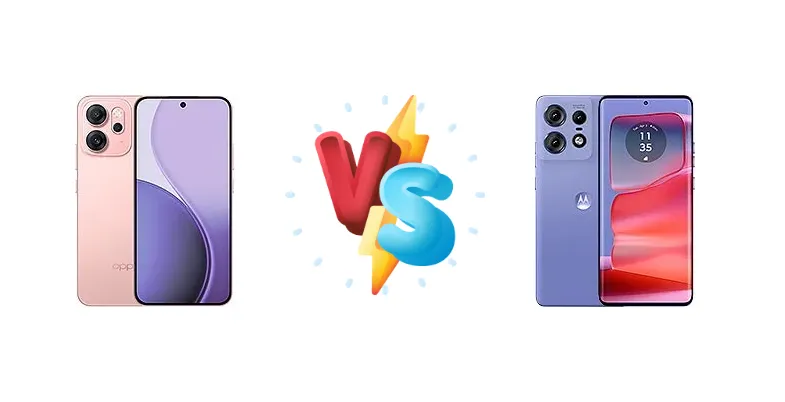
|
🏆 Quick Verdict
For the average user prioritizing all-day battery life and a reliable experience, the Oppo Reno14 F is the better choice. However, if rapid charging and a vibrant display are paramount, the Motorola Edge 50 Pro delivers a more compelling package, albeit with a trade-off in battery endurance.
| PHONES | ||
|---|---|---|
| Phone Names | Oppo Reno14 F | Motorola Edge 50 Pro |
| Network | ||
|---|---|---|
| 2G bands | GSM 850 / 900 / 1800 / 1900 | GSM 850 / 900 / 1800 / 1900 |
| 3G bands | HSDPA 800 / 850 / 900 / 1700(AWS) / 1900 / 2100 - version 1 | HSDPA 850 / 900 / 1700(AWS) / 1900 / 2100 |
| 4G bands | 1, 2, 3, 4, 5, 7, 8, 12, 17, 18, 19, 20, 26, 28, 38, 39, 40, 41, 42, 48, 66 - version 1 | 1, 2, 3, 4, 5, 7, 8, 12, 13, 17, 18, 19, 20, 26, 28, 32, 38, 39, 40, 41, 43, 48, 66 |
| 5G bands | 1, 2, 3, 5, 7, 8, 12, 20, 26, 28, 38, 40, 41, 66, 71, 77, 78 SA/NSA - version 1 | 1, 2, 3, 5, 7, 8, 20, 26, 28, 38, 40, 41, 66, 77, 78 SA/NSA/Sub6 |
| Speed | HSPA, LTE, 5G | HSPA, LTE, 5G |
| Technology | GSM / HSPA / LTE / 5G | GSM / HSPA / LTE / 5G |
| Launch | ||
|---|---|---|
| Announced | 2025, June 25 | 2024, April 03 |
| Status | Available. Released 2025, July 16 | Available. Released 2024, April 08 |
| Body | ||
|---|---|---|
| Build | - | Glass front, plastic back or silicone polymer back (eco leather), aluminum frame |
| Dimensions | 158.1 x 75 x 7.7 mm (6.22 x 2.95 x 0.30 in) | 161.2 x 72.4 x 8.2 mm (6.35 x 2.85 x 0.32 in) |
| SIM | · Nano-SIM + Nano-SIM· Nano-SIM + eSIM | · Nano-SIM + eSIM· Nano-SIM + Nano-SIM |
| Weight | 180 g (6.35 oz) | 186 g (6.56 oz) |
| Display | ||
|---|---|---|
| Protection | AGC Dragontrail DT-Star D+, Mohs level 5 | Corning Gorilla Glass (unspecified version) |
| Resolution | 1080 x 2372 pixels (~397 ppi density) | 1220 x 2712 pixels, 20:9 ratio (~446 ppi density) |
| Size | 6.57 inches, 105.0 cm2 (~88.6% screen-to-body ratio) | 6.7 inches, 107.4 cm2 (~92.0% screen-to-body ratio) |
| Type | AMOLED, 1B colors, 120Hz, 600 nits (typ), 1400 nits (HBM) | P-OLED, 1B colors, 144Hz, HDR10+, 2000 nits (peak) |
| Platform | ||
|---|---|---|
| CPU | Octa-core (4x2.2 GHz Cortex-A78 & 4x1.8 GHz Cortex-A55) | Octa-core (1x2.63 GHz Cortex-A715 & 4x2.4 GHz Cortex-A715 & 3x1.8 GHz Cortex-A510) |
| Chipset | Qualcomm SM6450 Snapdragon 6 Gen 1 (4 nm) | Qualcomm SM7550-AB Snapdragon 7 Gen 3 (4 nm) |
| GPU | Adreno 710 | Adreno 720 |
| OS | Android 15, ColorOS 15 | Android 14, up to 3 major Android upgrades |
| Memory | ||
|---|---|---|
| Card slot | microSDXC | No |
| Internal | 256GB 8GB RAM, 256GB 12GB RAM, 512GB 12GB RAM | 128GB 8GB RAM, 256GB 8GB RAM, 256GB 12GB RAM, 512GB 12GB RAM |
| Main Camera | ||
|---|---|---|
| Features | Color spectrum sensor, LED flash, HDR, panorama | Laser AF, LED flash, panorama, HDR |
| Triple | 50 MP, f/1.8, 26mm (wide), 1/1.95", 0.8µm, PDAF, OIS 8 MP, f/2.2, 16mm, 112˚ (ultrawide), 1/4.0", 1.12µm, AF 2 MP (macro) | 50 MP, f/1.4, 25mm (wide), 1/1.55", 1.0µm, multi-directional PDAF, OIS 10 MP, f/2.0, 67mm (telephoto), 1/3.94", 1.0µm, PDAF, OIS, 3x optical zoom 13 MP, f/2.2, 16mm, 120˚ (ultrawide), 1/3.0", 1.12µm, PDAF |
| Video | 4K@30fps, 1080p@30/60/120fps, gyro-EIS, OIS | 4K@30fps, 1080p@30/60/120/240fps, 10-bit HDR10+, gyro-EIS |
| Selfie camera | ||
|---|---|---|
| Features | Panorama | HDR |
| Single | 32 MP, f/2.0, 22mm (wide), 1/2.74", 0.8µm, AF | 50 MP, f/1.9, 21mm (wide), 0.64µm, AF |
| Video | 1080p@30fps | 4K@30fps, 1080p@30/60fps |
| Sound | ||
|---|---|---|
| 35mm jack | No | No |
| Loudspeaker | Yes, with stereo speakers | Yes, with stereo speakers |
| Comms | ||
|---|---|---|
| Bluetooth | 5.1, A2DP, LE, aptX HD, LHDC 5 | 5.4, A2DP, LE |
| NFC | Yes (market/region dependent) | Yes |
| Positioning | GPS, GLONASS, GALILEO, BDS, QZSS | GPS, GLONASS, GALILEO, BDS, QZSS, NavIC |
| Radio | Unspecified | No |
| USB | USB Type-C 2.0, OTG | USB Type-C 3.1, OTG, DisplayPort 1.4 |
| WLAN | Wi-Fi 802.11 a/b/g/n/ac, dual-band | Wi-Fi 802.11 a/b/g/n/ac/6e, tri-band, Wi-Fi Direct |
| Features | ||
|---|---|---|
| Sensors | Fingerprint (under display, optical), accelerometer, gyro, proximity, compass | Fingerprint (under display, optical), accelerometer, gyro, proximity, compass |
| Battery | ||
|---|---|---|
| Charging | 45W wired, PD2, QC2.0, 44W PPS Reverse wired | 125W wired, 100% in 18 min 50W wireless 10W reverse wireless |
| Type | 6000 mAh | Li-Po 4500 mAh |
| Misc | ||
|---|---|---|
| Colors | Glossy Pink, Luminous Green, Opal Blue | Luxe Lavender, Black Beauty, Moonlight Pearl, Vanilla Cream |
| Models | CPH2743 | XT2403-2 |
| Price | $ 413.81 / £ 281.19 | € 410.57 / $ 399.00 / £ 369.99 / ₹ 22,995 |
| SAR | - | 1.08 W/kg (head) 1.08 W/kg (body) |
| EU LABEL | ||
|---|---|---|
| Battery | 63:00h endurance, 1600 cycles | - |
| Energy | Class A | - |
| Free fall | Class A (300 falls) | - |
| Repairability | Class B | - |
Oppo Reno14 F
- Exceptional battery life (63:00h endurance)
- Long battery lifespan (1600 cycles)
- Reliable Snapdragon 6 Gen 1 chipset
- Slower charging speeds (45W)
- Display likely less bright and advanced than Edge 50 Pro
Motorola Edge 50 Pro
- Ultra-fast 125W wired charging (18 min to 100%)
- Bright and vibrant display (1295 nits)
- More powerful Snapdragon 7 Gen 3 chipset
- Shorter battery life (11:59h active use)
- Potentially more thermal throttling under sustained load
Display Comparison
The Motorola Edge 50 Pro boasts a significantly brighter display, reaching a measured 1295 nits, making it far more usable in direct sunlight compared to the Reno14 F (brightness data unavailable). While the Reno14 F’s panel specifics are unknown, the Edge 50 Pro’s high peak brightness and likely higher contrast ratio provide a superior viewing experience. The Edge 50 Pro’s display technology is likely to be more advanced, potentially including features like LTPO for adaptive refresh rates, further enhancing efficiency and smoothness, a feature not mentioned for the Reno14 F.
Camera Comparison
Without detailed camera specs for the Reno14 F, a direct comparison is limited. However, the Edge 50 Pro likely benefits from a more advanced image signal processor (ISP) within the Snapdragon 7 Gen 3, enabling better noise reduction and dynamic range. The Edge 50 Pro’s camera system is expected to feature a larger main sensor and potentially optical image stabilization (OIS), resulting in sharper, more detailed photos, particularly in low-light conditions. The Reno14 F’s camera performance will likely be adequate for everyday use, but the Edge 50 Pro is positioned to deliver a more refined photographic experience.
Performance
The Motorola Edge 50 Pro’s Snapdragon 7 Gen 3 chipset represents a clear performance advantage over the Oppo Reno14 F’s Snapdragon 6 Gen 1. The 7 Gen 3 utilizes a more modern CPU architecture – Cortex-A715 cores versus the Reno14 F’s A78 – offering improved single-core and multi-core performance. The Edge 50 Pro’s CPU configuration (1x2.63 GHz Cortex-A715 & 4x2.4 GHz Cortex-A715 & 3x1.8 GHz Cortex-A510) is more balanced and efficient than the Reno14 F’s (4x2.2 GHz Cortex-A78 & 4x1.8 GHz Cortex-A55). Both chips are built on a 4nm process, ensuring good power efficiency, but the architectural improvements in the 7 Gen 3 translate to a smoother experience, especially in demanding tasks.
Battery Life
The Oppo Reno14 F shines in battery endurance, achieving a remarkable 63:00h rating. This suggests a highly optimized power management system and efficient components. While the Motorola Edge 50 Pro’s 11:59h active use score is respectable, it falls significantly short of the Reno14 F. However, the Edge 50 Pro compensates with its blazing-fast 125W wired charging, capable of fully charging the device in just 18 minutes. The Reno14 F’s 45W charging is considerably slower. The Edge 50 Pro also offers 50W wireless charging and 10W reverse wireless charging, features absent in the Reno14 F.
Buying Guide
Buy the Oppo Reno14 F if you need a phone that consistently lasts through a full day of heavy use and value long-term battery health with its 1600 cycle lifespan. Buy the Motorola Edge 50 Pro if you prioritize a stunning display for media consumption, need the fastest possible charging speeds (reaching 100% in just 18 minutes), and are willing to accept slightly shorter battery life.