
Oppo Reno14 F vs. Google Pixel 8a: Which Mid-Range Phone Reigns Supreme?
| Phones Images | |||||
|---|---|---|---|---|---|
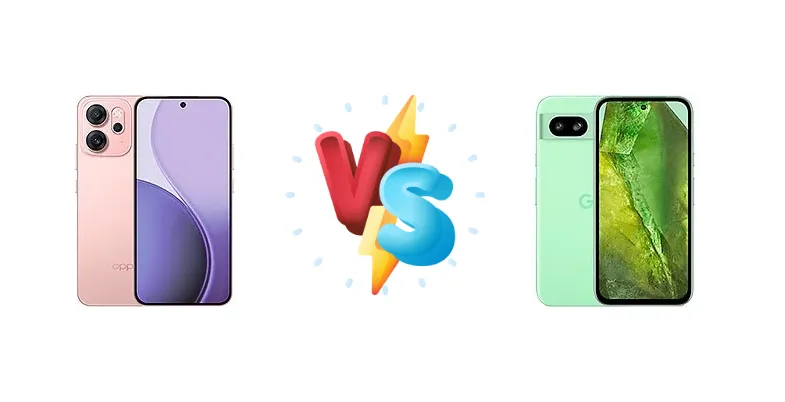
|
🏆 Quick Verdict
For users prioritizing all-day battery life and fast charging, the Oppo Reno14 F is the clear winner. However, the Google Pixel 8a’s superior processing power, brighter display, and Google’s software ecosystem make it the better choice for those valuing camera capabilities and AI-driven features.
| PHONES | ||
|---|---|---|
| Phone Names | Oppo Reno14 F | Google Pixel 8a |
| Network | ||
|---|---|---|
| 2G bands | GSM 850 / 900 / 1800 / 1900 | GSM 850 / 900 / 1800 / 1900 |
| 3G bands | HSDPA 800 / 850 / 900 / 1700(AWS) / 1900 / 2100 - version 1 | HSDPA 800 / 850 / 900 / 1700(AWS) / 1900 / 2100 |
| 4G bands | 1, 2, 3, 4, 5, 7, 8, 12, 17, 18, 19, 20, 26, 28, 38, 39, 40, 41, 42, 48, 66 - version 1 | 1, 2, 3, 4, 5, 7, 8, 12, 17, 18, 19, 20, 26, 28, 32, 38, 40, 41, 42, 66 - G6GPR (International) |
| 5G bands | 1, 2, 3, 5, 7, 8, 12, 20, 26, 28, 38, 40, 41, 66, 71, 77, 78 SA/NSA - version 1 | 1, 2, 3, 5, 7, 8, 12, 20, 26, 28, 38, 40, 41, 66, 75, 76, 77, 78 SA/NSA/Sub6 - G6GPR (International) |
| Speed | HSPA, LTE, 5G | HSPA, LTE, 5G |
| Technology | GSM / HSPA / LTE / 5G | GSM / HSPA / LTE / 5G |
| Launch | ||
|---|---|---|
| Announced | 2025, June 25 | 2024, May 07 |
| Status | Available. Released 2025, July 16 | Available. Released 2024, May 14 |
| Body | ||
|---|---|---|
| Build | - | Glass front (Gorilla Glass 3), aluminum frame, plastic back |
| Dimensions | 158.1 x 75 x 7.7 mm (6.22 x 2.95 x 0.30 in) | 152.1 x 72.7 x 8.9 mm (5.99 x 2.86 x 0.35 in) |
| SIM | · Nano-SIM + Nano-SIM· Nano-SIM + eSIM | Nano-SIM + eSIM |
| Weight | 180 g (6.35 oz) | 188 g (6.63 oz) |
| Display | ||
|---|---|---|
| Protection | AGC Dragontrail DT-Star D+, Mohs level 5 | Corning Gorilla Glass 3, Mohs level 5 |
| Resolution | 1080 x 2372 pixels (~397 ppi density) | 1080 x 2400 pixels, 20:9 ratio (~430 ppi density) |
| Size | 6.57 inches, 105.0 cm2 (~88.6% screen-to-body ratio) | 6.1 inches, 90.3 cm2 (~81.6% screen-to-body ratio) |
| Type | AMOLED, 1B colors, 120Hz, 600 nits (typ), 1400 nits (HBM) | OLED, HDR, 120Hz, 2000 nits (peak) |
| Platform | ||
|---|---|---|
| CPU | Octa-core (4x2.2 GHz Cortex-A78 & 4x1.8 GHz Cortex-A55) | Nona-core (1x3.0 GHz Cortex-X3 & 4x2.45 GHz Cortex-A715 & 4x2.15 GHz Cortex-A510) |
| Chipset | Qualcomm SM6450 Snapdragon 6 Gen 1 (4 nm) | Google Tensor G3 (4 nm) |
| GPU | Adreno 710 | Immortalis-G715s MC10 |
| OS | Android 15, ColorOS 15 | Android 14, upgradable to Android 16, up to 7 major Android upgrades |
| Memory | ||
|---|---|---|
| Card slot | microSDXC | No |
| Internal | 256GB 8GB RAM, 256GB 12GB RAM, 512GB 12GB RAM | 128GB 8GB RAM, 256GB 8GB RAM |
| Main Camera | ||
|---|---|---|
| Dual | - | 64 MP (16 MP eff.), f/1.9, 26mm (wide), 1/1.73", 0.8µm, dual pixel PDAF, OIS 13 MP, f/2.2, 120˚ (ultrawide), 1.12µm |
| Features | Color spectrum sensor, LED flash, HDR, panorama | Dual-LED flash, Pixel Shift, Ultra HDR, panorama, Best Take |
| Triple | 50 MP, f/1.8, 26mm (wide), 1/1.95", 0.8µm, PDAF, OIS 8 MP, f/2.2, 16mm, 112˚ (ultrawide), 1/4.0", 1.12µm, AF 2 MP (macro) | - |
| Video | 4K@30fps, 1080p@30/60/120fps, gyro-EIS, OIS | 4K@30/60fps, 1080p@30/60/120/240fps, OIS |
| Selfie camera | ||
|---|---|---|
| Features | Panorama | HDR, panorama |
| Single | 32 MP, f/2.0, 22mm (wide), 1/2.74", 0.8µm, AF | 13 MP, f/2.2, 20mm (ultrawide), 1.12µm |
| Video | 1080p@30fps | 4K@30fps, 1080p@30/60fps |
| Sound | ||
|---|---|---|
| 35mm jack | No | No |
| Loudspeaker | Yes, with stereo speakers | Yes, with stereo speakers |
| Comms | ||
|---|---|---|
| Bluetooth | 5.1, A2DP, LE, aptX HD, LHDC 5 | 5.3, A2DP, LE |
| NFC | Yes (market/region dependent) | Yes |
| Positioning | GPS, GLONASS, GALILEO, BDS, QZSS | GPS, GLONASS, GALILEO, BDS, QZSS, NavIC |
| Radio | Unspecified | No |
| USB | USB Type-C 2.0, OTG | USB Type-C 3.2 |
| WLAN | Wi-Fi 802.11 a/b/g/n/ac, dual-band | Wi-Fi 802.11 a/b/g/n/ac/6e, dual/tri-band (market/region dependent) |
| Features | ||
|---|---|---|
| Sensors | Fingerprint (under display, optical), accelerometer, gyro, proximity, compass | Fingerprint (under display, optical), accelerometer, gyro, proximity, compass, barometer |
| Battery | ||
|---|---|---|
| Charging | 45W wired, PD2, QC2.0, 44W PPS Reverse wired | 18W wired, PD3.0 7.5W wireless Bypass charging |
| Type | 6000 mAh | Li-Po 4492 mAh |
| Misc | ||
|---|---|---|
| Colors | Glossy Pink, Luminous Green, Opal Blue | Obsidian, Porcelain, Bay, Aloe |
| Models | CPH2743 | GKV4X, G6GPR, G8HHN, G576D |
| Price | $ 413.81 / £ 281.19 | $ 229.98 / C$ 417.99 / £ 279.00 / € 299.99 / ₹ 33,300 |
| EU LABEL | ||
|---|---|---|
| Battery | 63:00h endurance, 1600 cycles | 40:06h endurance, 1000 cycles |
| Energy | Class A | Class B |
| Free fall | Class A (300 falls) | Class A (270 falls) |
| Repairability | Class B | Class B |
Oppo Reno14 F
- Exceptional 63-hour battery life
- Ultra-fast 45W charging
- Efficient Snapdragon 6 Gen 1 processor
- Display brightness likely lower than Pixel 8a
- Camera performance likely trails Pixel 8a
Google Pixel 8a
- Brighter 1508 nit display
- Powerful Google Tensor G3 chip
- Superior camera and AI features
- Significantly shorter battery life (40:06h)
- Slower 18W charging
Display Comparison
The Google Pixel 8a boasts a significantly brighter display, reaching a measured 1508 nits, offering superior visibility in direct sunlight compared to the Reno14 F (brightness data unavailable). While the Reno14 F’s panel specifics are unknown, the Pixel 8a’s OLED panel delivers richer colors and deeper blacks. The Pixel 8a’s display is likely to have a higher refresh rate, contributing to smoother scrolling and animations, a feature not confirmed for the Reno14 F. This makes the Pixel 8a the better choice for media consumption and outdoor use.
Camera Comparison
While detailed camera specs for the Reno14 F are unavailable, the Pixel 8a’s strength lies in its computational photography capabilities powered by the Tensor G3. Google’s image processing excels in dynamic range, low-light performance, and overall image quality. The Pixel 8a likely features a larger main sensor and optical image stabilization (OIS), resulting in sharper, more detailed photos and videos. The Reno14 F may offer a competitive camera experience for its price point, but it’s unlikely to match the Pixel 8a’s consistently excellent results, particularly in challenging conditions.
Performance
The Google Pixel 8a’s Tensor G3, with its nona-core architecture (1x3.0 GHz Cortex-X3, 4x2.45 GHz Cortex-A715, 4x2.15 GHz Cortex-A510), offers a substantial performance advantage over the Oppo Reno14 F’s Snapdragon 6 Gen 1 (Octa-core 4x2.2 GHz Cortex-A78 & 4x1.8 GHz Cortex-A55). Both chips are built on a 4nm process, ensuring reasonable efficiency, but the Tensor G3’s more advanced core configuration and dedicated AI processing unit translate to faster app loading, smoother multitasking, and superior AI-powered features like Magic Eraser. The Reno14 F will handle everyday tasks well, but the Pixel 8a is better equipped for demanding games and applications.
Battery Life
The Oppo Reno14 F dominates in battery endurance, offering a remarkable 63-hour rating with 1600 charge cycles, significantly exceeding the Pixel 8a’s 40:06h endurance and 1000 cycles. This translates to multi-day battery life for typical users. The Reno14 F also supports 45W wired charging with PD2, QC2.0, and 44W PPS, enabling rapid charging. The Pixel 8a’s 18W wired charging and 7.5W wireless charging are considerably slower. While the Pixel 8a offers bypass charging, the Reno14 F’s superior battery capacity and faster charging speeds provide a more practical advantage for most users.
Buying Guide
Buy the Oppo Reno14 F if you need exceptional battery endurance, rapid 45W charging, and a reliable, efficient processor for everyday tasks. It’s ideal for users who frequently travel or rely heavily on their phone throughout the day. Buy the Google Pixel 8a if you prefer a brighter, more vibrant display, a more powerful processor for demanding apps and photography, and seamless integration with Google’s services and AI features. It’s best for content creators and those invested in the Google ecosystem.