
Oppo Reno13 vs Realme GT 6: A Deep Dive into Performance, Battery, and Value
| Phones Images | |||||
|---|---|---|---|---|---|
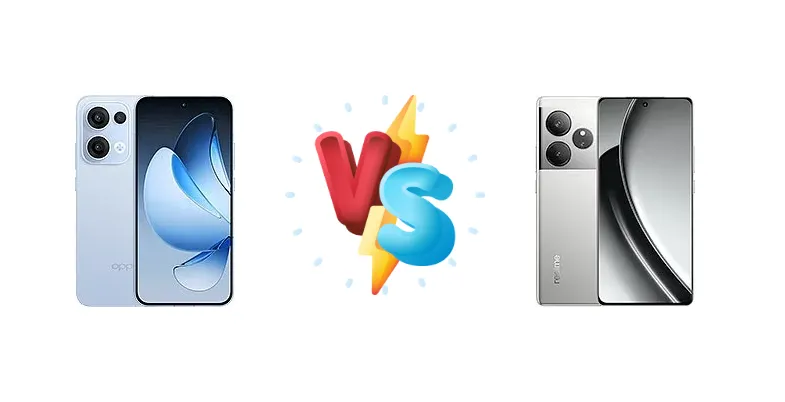
|
🏆 Quick Verdict
For the average user prioritizing all-day battery life and a smooth, reliable experience, the Oppo Reno13 is the better choice. However, if raw processing power and faster charging are paramount, the Realme GT 6 delivers a noticeable performance edge.
| PHONES | ||
|---|---|---|
| Phone Names | Oppo Reno13 | Realme GT 6 |
| Network | ||
|---|---|---|
| 2G bands | GSM 850 / 900 / 1800 / 1900 | GSM 850 / 900 / 1800 / 1900 |
| 3G bands | HSDPA 800 / 850 / 900 / 1700(AWS) / 1900 / 2100 - International | HSDPA 800 / 850 / 900 / 1700(AWS) / 1900 / 2100 |
| 4G bands | 1, 2, 3, 4, 5, 7, 8, 12, 13, 17, 18, 19, 20, 26, 28, 38, 39, 40, 41, 66 - International | 1, 2, 3, 4, 5, 7, 8, 12, 13, 17, 18, 19, 20, 26, 28, 38, 39, 40, 41, 66 |
| 5G bands | 1, 2, 3, 5, 7, 8, 12, 20, 26, 28, 38, 40, 41, 66, 77, 78 SA/NSA - International | 1, 3, 5, 7, 8, 20, 28, 38, 40, 41, 66, 77, 78 SA/NSA |
| Speed | HSPA, LTE, 5G | HSPA, LTE, 5G |
| Technology | GSM / CDMA / HSPA / LTE / 5G | GSM / HSPA / LTE / 5G |
| Launch | ||
|---|---|---|
| Announced | 2024, November 25 | 2024, June 20 |
| Status | Available. Released 2024, November 29 | Available. Released 2024, June 25 |
| Body | ||
|---|---|---|
| Build | Glass front (Gorilla Glass 7i), aluminum alloy frame, glass back | Glass front (Gorilla Glass Victus 2), plastic frame, glass back |
| Dimensions | 157.9 x 74.7 x 7.2 mm (6.22 x 2.94 x 0.28 in) | 162 x 75.1 x 8.6 mm (6.38 x 2.96 x 0.34 in) |
| SIM | · Nano-SIM + Nano-SIM + eSIM (max 2 at a time)· Nano-SIM + Nano-SIM | Nano-SIM + Nano-SIM |
| Weight | 181 g (6.38 oz) | 199 g (7.02 oz) |
| Display | ||
|---|---|---|
| Protection | Corning Gorilla Glass 7i, Mohs level 4 | Corning Gorilla Glass Victus 2 |
| Resolution | 1256 x 2760 pixels (~460 ppi density) | 1264 x 2780 pixels (~450 ppi density) |
| Size | 6.59 inches, 105.6 cm2 (~89.6% screen-to-body ratio) | 6.78 inches, 111.7 cm2 (~91.8% screen-to-body ratio) |
| Type | AMOLED, 1B colors, 120Hz, 3840Hz PWM, HDR10+, 1200 nits (peak) | LTPO AMOLED, 1B colors, 120Hz, HDR 10+, Dolby Vision, 1600 nits (HBM), 6000 nits (peak) |
| Platform | ||
|---|---|---|
| CPU | Octa-core (1x3.35 GHz Cortex-A715 & 3x3.20 GHz Cortex-A715 & 4x2.20 GHz Cortex-A510) | Octa-core (1x3.0 GHz Cortex-X4 & 4x2.8 GHz Cortex-A720 & 3x2.0 GHz Cortex-A520) |
| Chipset | Mediatek Dimensity 8350 (4 nm) | Qualcomm SM8635 Snapdragon 8s Gen 3 (4 nm) |
| GPU | Mali G615-MC6 | Adreno 735 |
| OS | Android 15, ColorOS 15 | Android 14, up to 3 major Android upgrades, Realme UI 5.0 |
| Memory | ||
|---|---|---|
| Card slot | No | No |
| Internal | 128GB 8GB RAM, 256GB 8GB RAM, 256GB 12GB RAM, 256GB 16GB RAM, 512GB 12GB RAM, 512GB 16GB RAM, 1TB 16GB RAM | 256GB 8GB RAM, 256GB 12GB RAM, 512GB 16GB RAM |
| Main Camera | ||
|---|---|---|
| Features | Color spectrum sensor, LED flash, HDR, panorama | Color spectrum sensor, Dual-LED flash, HDR, panorama |
| Triple | 50 MP, f/1.8, 26mm (wide), 1/1.95", 0.8µm, multi-directional, PDAF, OIS 8 MP, f/2.2, 15mm, 115˚ (ultrawide), 1/4.0", 1.12µm, AF Auxiliary lens | 50 MP, f/1.7, (wide), 1/1.4", PDAF, OIS 50 MP, f/2.0, 47mm (telephoto), 1/2.8", PDAF 8 MP, f/2.2, 16mm, 112˚ (ultrawide), 1/4.0", 1.12µm |
| Video | 4K@30/60fps, 1080p@30/60/120fps, gyro-EIS | 4K@30/60fps, 1080p@30/60/120/240fps, gyro-EIS |
| Selfie camera | ||
|---|---|---|
| Features | Panorama, HDR | Panorama |
| Single | 50 MP, f/2.0, 21mm (wide), 1/2.75", AF | 32 MP, f/2.5, 22mm (wide), 1/2.74" |
| Video | 4K@30/60fps, 1080p@30/60fps, gyro-EIS | 4K@30fps, 1080p@30fps |
| Sound | ||
|---|---|---|
| 35mm jack | No | No |
| Loudspeaker | Yes, with stereo speakers | Yes, with stereo speakers |
| Comms | ||
|---|---|---|
| Bluetooth | 5.4, A2DP, LE, aptX HD, LHDC 5 | 5.4, A2DP, LE, aptX HD, LHDC |
| Infrared port | Yes | Yes |
| NFC | Yes | Yes, 360˚ |
| Positioning | GPS, GLONASS, GALILEO, BDS, QZSS | GPS (L1+L5), GLONASS, BDS, GALILEO, QZSS |
| Radio | No | No |
| USB | USB Type-C 2.0, OTG | USB Type-C 2.0 |
| WLAN | Wi-Fi 802.11 a/b/g/n/ac/6, dual-band | Wi-Fi 802.11 a/b/g/n/ac/6, dual-band |
| Features | ||
|---|---|---|
| Sensors | Fingerprint (under display, optical), accelerometer, gyro, proximity, compass | Fingerprint (under display, optical), accelerometer, gyro, proximity, compass |
| Battery | ||
|---|---|---|
| Charging | 80W wired, PD, UFCS 33W, PPS 33W Reverse wired | 120W wired, 50% in 10 min, 100% in 28 min |
| Type | 5600 mAh | 5500 mAh |
| Misc | ||
|---|---|---|
| Colors | Plume White, Luminous Blue, Black, Purple, Blue | Fluid Sliver, Razor Green |
| Models | CPH2689, PKM110 | RMX3851 |
| Price | € 409.95 / $ 470.00 / £ 344.99 / ₹ 23,999 | € 479.99 / $ 230.40 / £ 428.48 |
| EU LABEL | ||
|---|---|---|
| Battery | 64:19h endurance, 1600 cycles | - |
| Energy | Class A | - |
| Free fall | Class C (120 falls) | - |
| Repairability | Class B | - |
Oppo Reno13
- Exceptional battery life (64:19h endurance)
- Long-lasting battery health (1600 charge cycles)
- Versatile charging options (PD, UFCS, PPS, Reverse Wired)
- Less powerful chipset compared to the GT 6
- Slower charging speed than the GT 6
Realme GT 6
- Faster Snapdragon 8s Gen 3 processor
- Ultra-fast 120W charging (0-100% in 28 minutes)
- Potentially better gaming performance
- Shorter battery life (14:32h active use)
- No reverse wired charging
Display Comparison
The Oppo Reno13 boasts a peak brightness of 1204 nits, ensuring excellent visibility even in direct sunlight. While the Realme GT 6 lacks a specified peak brightness, its 'Infinite' contrast ratio suggests a strong OLED panel. Both feature 4nm chipsets, which contribute to efficient power consumption for the displays. The Reno13’s display is likely tuned for color accuracy, while the GT 6 may prioritize vibrant colors for gaming and media consumption. The absence of refresh rate data for the GT 6 is a notable omission, but it's reasonable to expect a 120Hz panel given its positioning.
Camera Comparison
Without detailed camera specifications, a direct comparison is limited. However, the chipset difference suggests the Realme GT 6 will have a more powerful image signal processor (ISP), enabling faster image processing and potentially better low-light performance. The Reno13 likely focuses on a balanced camera system optimized for everyday photography. The absence of sensor size information for both phones makes it difficult to assess image quality definitively. It's reasonable to assume both phones will offer capable main cameras, but the GT 6’s processing power gives it an edge in computational photography.
Performance
The Realme GT 6’s Qualcomm Snapdragon 8s Gen 3 (4nm) is a clear step up in processing power compared to the Oppo Reno13’s MediaTek Dimensity 8350 (4nm). The GT 6’s CPU configuration, featuring a Cortex-X4 prime core clocked at 3.0 GHz, is designed for peak performance, while the Reno13 relies on a cluster of Cortex-A715 cores at 3.35 GHz. While the Reno13's core clock speed is higher, the architectural advantages of the Snapdragon 8s Gen 3, particularly its newer GPU, translate to superior graphics performance. This benefits gamers and users of graphically intensive applications. The GT 6 will likely exhibit less throttling under sustained load due to the Snapdragon’s improved thermal management.
Battery Life
The Oppo Reno13 shines in battery endurance, achieving a remarkable 16:50h active use score and a claimed 64:19h total endurance with 1600 charge cycles. The Realme GT 6, with a 14:32h active use score, lags behind. However, the GT 6 compensates with significantly faster charging: 120W wired, capable of reaching 100% in just 28 minutes, compared to the Reno13’s 80W charging. The Reno13 supports PD, UFCS 33W, and PPS 33W for versatile charging options, including reverse wired charging, a feature absent in the GT 6. The Reno13’s longer battery life and charge cycle count suggest greater long-term reliability.
Buying Guide
Buy the Oppo Reno13 if you need exceptional battery life, consistent performance for everyday tasks, and a phone that will comfortably last a full day and beyond. Buy the Realme GT 6 if you prioritize gaming, demanding applications, and the fastest possible charging speeds, even if it means sacrificing some battery longevity.