
Oppo Reno13 vs Nothing Phone (2a) Plus: A Deep Dive into Mid-Range Power
| Phones Images | |||||
|---|---|---|---|---|---|
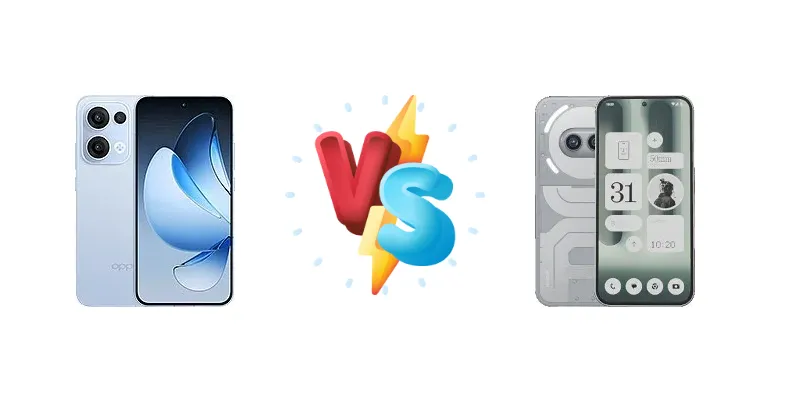
|
🏆 Quick Verdict
For most users, the Oppo Reno13 emerges as the stronger contender. Its Mediatek Dimensity 8350 chipset provides a noticeable performance edge, and the 80W charging significantly reduces downtime. While the Nothing Phone (2a) Plus offers a unique aesthetic, it can't match the Reno13's overall speed and convenience.
| PHONES | ||
|---|---|---|
| Phone Names | Oppo Reno13 | Nothing Phone (2a) Plus |
| Network | ||
|---|---|---|
| 2G bands | GSM 850 / 900 / 1800 / 1900 | GSM 850 / 900 / 1800 / 1900 |
| 3G bands | HSDPA 800 / 850 / 900 / 1700(AWS) / 1900 / 2100 - International | HSDPA 800 / 850 / 900 / 1700(AWS) / 1900 / 2100 |
| 4G bands | 1, 2, 3, 4, 5, 7, 8, 12, 13, 17, 18, 19, 20, 26, 28, 38, 39, 40, 41, 66 - International | 1, 3, 4, 5, 7, 8, 18, 19, 20, 26, 28, 38, 39, 40, 41, 42, 66 |
| 5G bands | 1, 2, 3, 5, 7, 8, 12, 20, 26, 28, 38, 40, 41, 66, 77, 78 SA/NSA - International | 1, 3, 5, 7, 8, 20, 28, 38, 40, 41, 66, 77, 78 SA/NSA |
| Speed | HSPA, LTE, 5G | HSPA, LTE, 5G |
| Technology | GSM / CDMA / HSPA / LTE / 5G | GSM / HSPA / LTE / 5G |
| Launch | ||
|---|---|---|
| Announced | 2024, November 25 | 2024, July 31 |
| Status | Available. Released 2024, November 29 | Available. Released 2024, August 03 |
| Body | ||
|---|---|---|
| Build | Glass front (Gorilla Glass 7i), aluminum alloy frame, glass back | Glass front (Gorilla Glass 5), plastic frame, plastic back |
| Dimensions | 157.9 x 74.7 x 7.2 mm (6.22 x 2.94 x 0.28 in) | 161.7 x 76.3 x 8.5 mm (6.37 x 3.00 x 0.33 in) |
| SIM | · Nano-SIM + Nano-SIM + eSIM (max 2 at a time)· Nano-SIM + Nano-SIM | Nano-SIM + Nano-SIM |
| Weight | 181 g (6.38 oz) | 190 g (6.70 oz) |
| Display | ||
|---|---|---|
| Protection | Corning Gorilla Glass 7i, Mohs level 4 | Corning Gorilla Glass 5 |
| Resolution | 1256 x 2760 pixels (~460 ppi density) | 1080 x 2412 pixels, 20:9 ratio (~395 ppi density) |
| Size | 6.59 inches, 105.6 cm2 (~89.6% screen-to-body ratio) | 6.7 inches, 107.5 cm2 (~87.1% screen-to-body ratio) |
| Type | AMOLED, 1B colors, 120Hz, 3840Hz PWM, HDR10+, 1200 nits (peak) | AMOLED, 1B colors, 120Hz, 2160Hz PWM, HDR10+, 700 nits (typ), 1100 nits (HBM), 1300 nits (peak) |
| Platform | ||
|---|---|---|
| CPU | Octa-core (1x3.35 GHz Cortex-A715 & 3x3.20 GHz Cortex-A715 & 4x2.20 GHz Cortex-A510) | Octa-core (2x3.0 GHz Cortex-A715 & 6x 2.0 GHz Cortex-A510) |
| Chipset | Mediatek Dimensity 8350 (4 nm) | Mediatek Dimensity 7350 Pro (4 nm) |
| GPU | Mali G615-MC6 | Mali-G610 MC4 |
| OS | Android 15, ColorOS 15 | Android 14, up to 3 major Android upgrades, Nothing OS 3.0 |
| Memory | ||
|---|---|---|
| Card slot | No | No |
| Internal | 128GB 8GB RAM, 256GB 8GB RAM, 256GB 12GB RAM, 256GB 16GB RAM, 512GB 12GB RAM, 512GB 16GB RAM, 1TB 16GB RAM | 256GB 8GB RAM, 256GB 12GB RAM |
| Main Camera | ||
|---|---|---|
| Dual | - | 50 MP, f/1.9, 24mm (wide), 1/1.57", 1.0µm, PDAF, OIS 50 MP, f/2.2, 114˚ (ultrawide), 1/2.76", 0.64µm |
| Features | Color spectrum sensor, LED flash, HDR, panorama | LED flash, panorama, HDR |
| Triple | 50 MP, f/1.8, 26mm (wide), 1/1.95", 0.8µm, multi-directional, PDAF, OIS 8 MP, f/2.2, 15mm, 115˚ (ultrawide), 1/4.0", 1.12µm, AF Auxiliary lens | - |
| Video | 4K@30/60fps, 1080p@30/60/120fps, gyro-EIS | 4K@30fps, 1080p@60/120fps, gyro-EIS |
| Selfie camera | ||
|---|---|---|
| Features | Panorama, HDR | HDR |
| Single | 50 MP, f/2.0, 21mm (wide), 1/2.75", AF | 50 MP, f/2.2, (wide), 1/2.76" |
| Video | 4K@30/60fps, 1080p@30/60fps, gyro-EIS | 4K@30fps |
| Sound | ||
|---|---|---|
| 35mm jack | No | No |
| Loudspeaker | Yes, with stereo speakers | Yes, with stereo speakers |
| Comms | ||
|---|---|---|
| Bluetooth | 5.4, A2DP, LE, aptX HD, LHDC 5 | 5.3, A2DP, LE |
| Infrared port | Yes | - |
| NFC | Yes | Yes, 360˚ |
| Positioning | GPS, GLONASS, GALILEO, BDS, QZSS | GPS, GALILEO, GLONASS, BDS, QZSS |
| Radio | No | No |
| USB | USB Type-C 2.0, OTG | USB Type-C 2.0, OTG |
| WLAN | Wi-Fi 802.11 a/b/g/n/ac/6, dual-band | Wi-Fi 802.11 a/b/g/n/ac/6, dual-band, Wi-Fi Direct |
| Features | ||
|---|---|---|
| Sensors | Fingerprint (under display, optical), accelerometer, gyro, proximity, compass | Fingerprint (under display, optical), accelerometer, gyro, proximity, compass |
| Battery | ||
|---|---|---|
| Charging | 80W wired, PD, UFCS 33W, PPS 33W Reverse wired | 50W wired, 50% in 21 min, 100% in 56 min |
| Type | 5600 mAh | 5000 mAh |
| Misc | ||
|---|---|---|
| Colors | Plume White, Luminous Blue, Black, Purple, Blue | Black, Grey |
| Models | CPH2689, PKM110 | A142P |
| Price | € 409.95 / $ 470.00 / £ 344.99 / ₹ 23,999 | € 269.90 / ₹ 22,599 |
| EU LABEL | ||
|---|---|---|
| Battery | 64:19h endurance, 1600 cycles | - |
| Energy | Class A | - |
| Free fall | Class C (120 falls) | - |
| Repairability | Class B | - |
Oppo Reno13
- Faster processor for smoother performance
- Significantly faster 80W charging
- Higher peak display brightness for better outdoor visibility
- Potentially less distinctive design
- Software experience may not appeal to all users
Nothing Phone (2a) Plus
- Unique and minimalist design aesthetic
- Clean and streamlined software experience
- Competitive battery life
- Slower processor compared to the Reno13
- Slower 50W charging
Display Comparison
Both phones feature 4nm chipsets, but the display experience differs. The Oppo Reno13 boasts a peak brightness of 1204 nits, significantly outshining the Nothing Phone (2a) Plus’s 1097 nits. This translates to better visibility outdoors under direct sunlight. While both likely utilize OLED panels, the Reno13’s higher brightness suggests a more advanced panel capable of delivering a more vibrant and punchy image. The absence of LTPO information for either device suggests neither offers adaptive refresh rate technology for optimal power efficiency, relying instead on a fixed 120Hz or similar.
Camera Comparison
Without detailed camera specs, a direct comparison is limited. However, the chipset difference suggests the Reno13 has more processing power available for image signal processing (ISP), potentially leading to better dynamic range and noise reduction. The absence of information regarding sensor sizes makes it difficult to assess image quality definitively. It's reasonable to assume both phones will offer competent camera systems for everyday photography, but the Reno13’s superior processing capabilities give it an edge in challenging lighting conditions. We can safely ignore the presence of typical 2MP macro lenses on either device, as their utility is minimal.
Performance
The core difference lies in the chipsets. The Oppo Reno13’s Mediatek Dimensity 8350, with its 1x3.35 GHz Cortex-A715 core and 3x3.20 GHz Cortex-A715 cores, offers a clear advantage over the Nothing Phone (2a) Plus’s Dimensity 7350 Pro (2x3.0 GHz Cortex-A715 & 6x 2.0 GHz Cortex-A510). The Reno13’s more powerful CPU configuration, combined with a potentially faster GPU, will result in smoother multitasking, quicker app loading times, and superior gaming performance. While both utilize a 4nm process, the architectural differences favor the Reno13. The Nothing Phone (2a) Plus’s six efficiency cores may contribute to slightly better sustained performance under heavy load, but the Reno13’s peak performance is higher.
Battery Life
The Oppo Reno13 delivers a measured battery endurance of 64:19h, while the Nothing Phone (2a) Plus achieves 63:40h. However, the real differentiator is charging speed. The Reno13’s 80W wired charging is significantly faster than the Nothing Phone (2a) Plus’s 50W charging. The Reno13 can fully charge in under 30 minutes, while the Nothing Phone (2a) Plus takes over an hour. The Reno13 also supports PD, UFCS 33W, and PPS 33W, offering broader compatibility with chargers. The Reno13’s 1600 charge cycles suggest a focus on long-term battery health.
Buying Guide
Buy the Oppo Reno13 if you prioritize raw performance for gaming and demanding applications, and value the convenience of incredibly fast charging. You'll benefit from a smoother experience and less time tethered to a wall outlet. Buy the Nothing Phone (2a) Plus if you prefer a minimalist design aesthetic, a clean software experience, and are willing to trade some processing power for a unique user interface and potentially longer-term software support.