
vivo iQOO 12 Pro vs Oppo Reno13 Pro: A Deep Dive into Performance and Value
| Phones Images | |||||
|---|---|---|---|---|---|
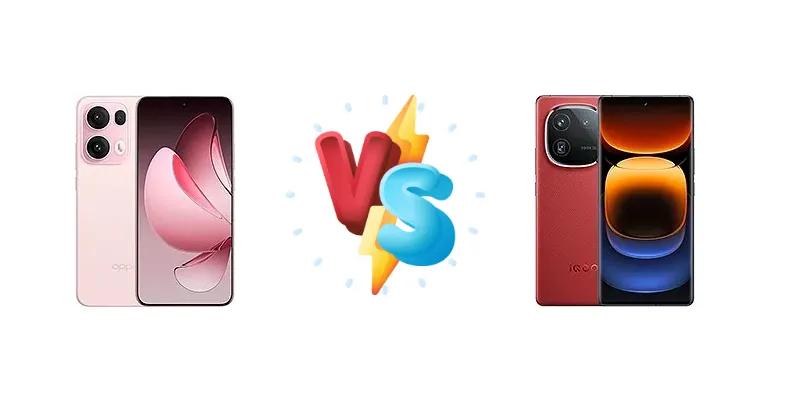
|
🏆 Quick Verdict
For users prioritizing raw power and the fastest possible charging, the vivo iQOO 12 Pro is the clear winner. However, the Oppo Reno13 Pro offers a compelling alternative with its exceptional 57:36h battery endurance and balanced feature set, making it ideal for everyday users who value longevity.
| PHONES | ||
|---|---|---|
| Phone Names | Oppo Reno13 Pro | vivo iQOO 12 Pro |
| Network | ||
|---|---|---|
| 2G bands | GSM 850 / 900 / 1800 / 1900 | GSM 850 / 900 / 1800 / 1900 |
| 3G bands | HSDPA 800 / 850 / 900 / 1700(AWS) / 1900 / 2100 - International | HSDPA 800 / 850 / 900 / 1700(AWS) / 1900 / 2100 |
| 4G bands | 1, 2, 3, 4, 5, 7, 8, 12, 13, 17, 18, 19, 20, 26, 28, 32, 34, 38, 39, 40, 41, 66 - International | 1, 2, 3, 4, 5, 7, 8, 12, 17, 18, 19, 20, 25, 26, 28, 34, 38, 39, 40, 41, 42, 66 |
| 5G bands | 1, 2, 3, 5, 7, 8, 12, 20, 26, 28, 66, 38, 40, 41, 77, 78 SA/NSA - International | 1, 2, 3, 5, 7, 8, 12, 20, 25, 26, 28, 66, 38, 40, 41, 77, 78 SA/NSA |
| Speed | HSPA, LTE, 5G | HSPA, LTE, 5G |
| Technology | GSM / CDMA / HSPA / LTE / 5G | GSM / CDMA / HSPA / CDMA2000 / LTE / 5G |
| Launch | ||
|---|---|---|
| Announced | 2024, November 25 | 2023, November 07 |
| Status | Available. Released 2024, November 29 | Available. Released 2023, November 14 |
| Body | ||
|---|---|---|
| Build | Glass front (Gorilla Glass 7i), aluminum alloy frame, glass back | - |
| Dimensions | 162.8 x 76.6 x 7.6 mm (6.41 x 3.02 x 0.30 in) | 164.6 x 75.4 x 8.6 mm or 8.8 mm |
| SIM | · Nano-SIM + Nano-SIM + eSIM (max 2 at a time)· Nano-SIM + Nano-SIM | Nano-SIM + Nano-SIM |
| Weight | 195 g or 197 g (6.88 oz) | 205 g or 210 g (7.23 oz) |
| Display | ||
|---|---|---|
| Protection | Corning Gorilla Glass 7i, Mohs level 4 | - |
| Resolution | 1272 x 2800 pixels (~450 ppi density) | 1440 x 3200 pixels, 20:9 ratio (~518 ppi density) |
| Size | 6.83 inches, 113.3 cm2 (~90.9% screen-to-body ratio) | 6.78 inches, 111.0 cm2 (~89.4% screen-to-body ratio) |
| Type | AMOLED, 1B colors, 120Hz, 3840Hz PWM, HDR10+, 1200 nits (peak) | LTPO AMOLED, 1B colors, 144Hz, HDR10+, 1600 nits (HBM), 3000 nits (peak) |
| Platform | ||
|---|---|---|
| CPU | Octa-core (1x3.35 GHz Cortex-A715 & 3x3.20 GHz Cortex-A715 & 4x2.20 GHz Cortex-A510) | Octa-core (1x3.3 GHz Cortex-X4 & 3x3.2 GHz Cortex-A720 & 2x3.0 GHz Cortex-A720 & 2x2.3 GHz Cortex-A520) |
| Chipset | Mediatek Dimensity 8350 (4 nm) | Qualcomm SM8650-AB Snapdragon 8 Gen 3 (4 nm) |
| GPU | Mali G615-MC6 | Adreno 750 |
| OS | Android 15, ColorOS 15 | Android 14, up to 2 major Android upgrades, Funtouch 14 (International), OriginOS 4 (China) |
| Memory | ||
|---|---|---|
| Card slot | No | No |
| Internal | 256GB 12GB RAM, 512GB 12GB RAM, 512GB 16GB RAM, 1TB 16GB RAM | 256GB 16GB RAM, 512GB 16GB RAM, 1TB 16GB RAM |
| Main Camera | ||
|---|---|---|
| Features | Color spectrum sensor, LED flash, HDR, panorama | Color spectrum sensor, Dual-LED flash, HDR, panorama |
| Triple | 50 MP, f/1.8, 24mm (wide), 1/1.56", 1.0µm, multi-directional PDAF, OIS 50 MP, f/2.8, 85mm (telephoto), PDAF, OIS, 3.5x optical zoom 8 MP, f/2.2, 15mm, 116˚ (ultrawide), 1/4.0", 1.12µm | 50 MP, f/1.7, 23mm (wide), 1/1.3", 1.2µm, ulti-directional PDAF, OIS 64 MP, f/2.6, 70mm (periscope telephoto), 1/2.0", PDAF, OIS, 3x optical zoom 50 MP, f/2.0, 15mm, 119˚ (ultrawide), AF |
| Video | 4K@30/60fps, 1080p@30/60/120fps, gyro-EIS | 8K@30fps, 4K@24/30/60fps, 1080p@30/60/120/240fps, gyro-EIS |
| Selfie camera | ||
|---|---|---|
| Features | Panorama, HDR | HDR |
| Single | 50 MP, f/2.0, 21mm (wide), AF | 16 MP, f/2.5, (wide) |
| Video | 4K@30/60fps, 1080p@30/60fps, gyro-EIS | 1080p@30fps, gyro-EIS |
| Sound | ||
|---|---|---|
| 35mm jack | No | No |
| Loudspeaker | Yes, with stereo speakers | Yes, with stereo speakers |
| Comms | ||
|---|---|---|
| Bluetooth | 5.4, A2DP, LE, aptX HD, LHDC 5 | 5.4, A2DP, LE, aptX HD, aptX Adaptive, aptX Lossless |
| Infrared port | Yes | Yes |
| NFC | Yes | Yes |
| Positioning | GPS, GLONASS, GALILEO, BDS, QZSS | GPS (L1+L5), GLONASS (G1), BDS (B1I+B1c+B2a), GALILEO (E1+E5a), QZSS (L1+L5) |
| Radio | No | No |
| USB | USB Type-C 2.0, OTG | USB Type-C 2.0, OTG |
| WLAN | Wi-Fi 802.11 a/b/g/n/ac/6e, dual-band | Wi-Fi 802.11 a/b/g/n/ac/6/7, tri-band, Wi-Fi Direct |
| Features | ||
|---|---|---|
| Sensors | Fingerprint (under display, optical), accelerometer, gyro, proximity, compass | Fingerprint (under display, ultrasonic), accelerometer, gyro, proximity, compass |
| Battery | ||
|---|---|---|
| Charging | 80W wired, PD, UFCS 33W, PPS 33W 50W wireless (China only) Reverse wired | 120W wired 50W wireless 10W reverse wireless |
| Type | 5800 mAh | 5100 mAh |
| Misc | ||
|---|---|---|
| Colors | Graphite Grey, Plume Purple, Pink | Black, Red, White (BMW M branding) |
| Models | CPH2697, PKK110 | V2329A |
| Price | $ 739.00 / £ 469.99 / € 479.99 / ₹ 35,999 | About 650 EUR |
| EU LABEL | ||
|---|---|---|
| Battery | 57:36h endurance, 1600 cycles | - |
| Energy | Class B | - |
| Free fall | Class C (120 falls) | - |
| Repairability | Class B | - |
Oppo Reno13 Pro
- Exceptional 57:36h battery endurance
- 80W wired charging with multiple standards
- High peak display brightness (1168 nits)
- Less powerful chipset than the iQOO 12 Pro
- May not offer the same level of gaming performance
vivo iQOO 12 Pro
- Snapdragon 8 Gen 3 provides top-tier performance
- Blazing-fast 120W wired charging
- Likely superior camera hardware
- Battery endurance likely lower than the Reno13 Pro
- May run hotter under sustained load
Display Comparison
The Oppo Reno13 Pro boasts a display capable of reaching 1168 nits of peak brightness, ensuring excellent visibility even in direct sunlight. While the iQOO 12 Pro’s display specs aren’t provided, iQOO phones typically prioritize high refresh rates for gaming. The Reno13 Pro’s brightness advantage is significant, and without knowing the iQOO 12 Pro’s panel technology (LTPO or not), it’s difficult to assess power efficiency. Color accuracy is likely comparable between the two, given both brands’ focus on display quality, but the Reno13 Pro’s higher peak brightness gives it an edge for outdoor use.
Camera Comparison
Without detailed camera specifications, a direct comparison is limited. However, iQOO phones often prioritize camera hardware, and the 12 Pro likely features a flagship-level sensor. The Reno13 Pro’s camera performance will be solid, but likely won’t match the iQOO 12 Pro’s potential for detail and low-light performance. Image processing styles will also differ; Oppo typically aims for more vibrant, social media-friendly images, while iQOO may lean towards a more natural look. The absence of information on sensor sizes and OIS makes a definitive judgment impossible, but the iQOO 12 Pro’s positioning suggests a more advanced camera system.
Performance
The core difference lies in the chipsets: the vivo iQOO 12 Pro is powered by the Qualcomm Snapdragon 8 Gen 3 (4nm), while the Oppo Reno13 Pro utilizes the MediaTek Dimensity 8350 (4nm). The Snapdragon 8 Gen 3, with its Cortex-X4 prime core clocked at 3.3 GHz, offers a substantial performance uplift over the Dimensity 8350’s Cortex-A715 configuration. The iQOO 12 Pro’s CPU architecture (1x X4, 3x A720, 2x A720, 2x A520) is more modern and efficient than the Reno13 Pro’s (1x A715, 3x A715, 4x A510). This translates to faster app loading, smoother multitasking, and superior gaming performance on the iQOO 12 Pro. While both are 4nm chips, the Snapdragon 8 Gen 3’s architectural improvements and higher clock speeds provide a clear advantage.
Battery Life
The Oppo Reno13 Pro shines in battery endurance, achieving a remarkable 57:36h rating with 1600 charge cycles, and 16:42h of active use. The iQOO 12 Pro, while offering 120W wired charging (significantly faster than the Reno13 Pro’s 80W), doesn’t have endurance data. The iQOO 12 Pro’s 120W charging can replenish the battery from 0-100% much faster, but the Reno13 Pro’s superior endurance means fewer charging cycles are needed. The Reno13 Pro also supports 33W PD/UFCS/PPS and 50W wireless (China only), while the iQOO 12 Pro offers 50W wireless and 10W reverse wireless.
Buying Guide
Buy the Oppo Reno13 Pro if you need a phone that will comfortably last a full day and beyond, even with heavy use, and appreciate a more balanced feature set. You'll benefit from its impressive battery life and efficient charging. Buy the vivo iQOO 12 Pro if you're a gamer, power user, or simply demand the fastest performance available, and are willing to trade some battery life for the Snapdragon 8 Gen 3's capabilities and 120W charging.