
Oppo Reno13 Pro vs Samsung Galaxy S24 FE: A Deep Dive into Performance and Value
| Phones Images | |||||
|---|---|---|---|---|---|
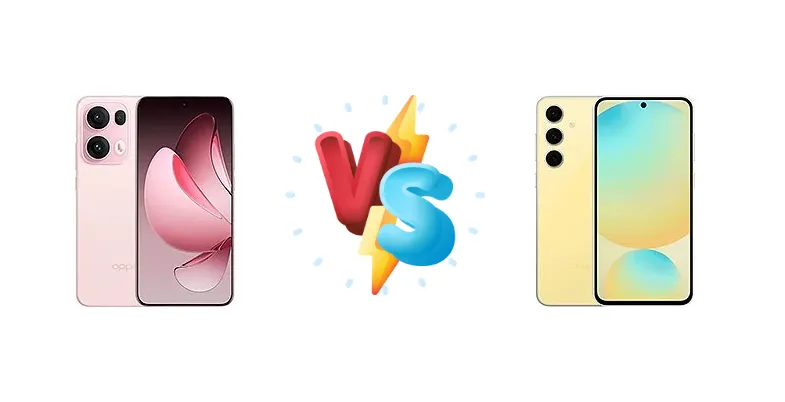
|
🏆 Quick Verdict
For the average user prioritizing battery longevity and incredibly fast charging, the Oppo Reno13 Pro emerges as the winner. Its 57:36h endurance and 80W charging significantly outperform the S24 FE’s 42:00h and 25W, despite the S24 FE’s slightly brighter display.
| PHONES | ||
|---|---|---|
| Phone Names | Oppo Reno13 Pro | Samsung Galaxy S24 FE |
| Network | ||
|---|---|---|
| 2G bands | GSM 850 / 900 / 1800 / 1900 | GSM 850 / 900 / 1800 / 1900 |
| 3G bands | HSDPA 800 / 850 / 900 / 1700(AWS) / 1900 / 2100 - International | HSDPA 850 / 900 / 1700(AWS) / 1900 / 2100 |
| 4G bands | 1, 2, 3, 4, 5, 7, 8, 12, 13, 17, 18, 19, 20, 26, 28, 32, 34, 38, 39, 40, 41, 66 - International | 1, 2, 3, 4, 5, 7, 8, 12, 17, 18, 19, 20, 25, 26, 28, 32, 38, 40, 41, 66 - International |
| 5G bands | 1, 2, 3, 5, 7, 8, 12, 20, 26, 28, 66, 38, 40, 41, 77, 78 SA/NSA - International | 1, 2, 3, 5, 7, 8, 12, 20, 25, 26, 28, 38, 40, 41, 66, 75, 77, 78 SA/NSA/Sub6 - International |
| Speed | HSPA, LTE, 5G | HSPA, LTE, 5G |
| Technology | GSM / CDMA / HSPA / LTE / 5G | GSM / HSPA / LTE / 5G |
| Launch | ||
|---|---|---|
| Announced | 2024, November 25 | 2024, September 26 |
| Status | Available. Released 2024, November 29 | Available. Released 2024, October 03 |
| Body | ||
|---|---|---|
| Build | Glass front (Gorilla Glass 7i), aluminum alloy frame, glass back | Glass front (Gorilla Glass Victus+), glass back (Gorilla Glass Victus+), aluminum frame |
| Dimensions | 162.8 x 76.6 x 7.6 mm (6.41 x 3.02 x 0.30 in) | 162 x 77.3 x 8 mm (6.38 x 3.04 x 0.31 in) |
| SIM | · Nano-SIM + Nano-SIM + eSIM (max 2 at a time)· Nano-SIM + Nano-SIM | · Nano-SIM· Nano-SIM + Nano-SIM· Nano-SIM + eSIM· eSIM + eSIM |
| Weight | 195 g or 197 g (6.88 oz) | 213 g (7.51 oz) |
| Display | ||
|---|---|---|
| Protection | Corning Gorilla Glass 7i, Mohs level 4 | Corning Gorilla Glass Victus+, Mohs level 5 |
| Resolution | 1272 x 2800 pixels (~450 ppi density) | 1080 x 2340 pixels, 19.5:9 ratio (~385 ppi density) |
| Size | 6.83 inches, 113.3 cm2 (~90.9% screen-to-body ratio) | 6.7 inches, 110.2 cm2 (~88.0% screen-to-body ratio) |
| Type | AMOLED, 1B colors, 120Hz, 3840Hz PWM, HDR10+, 1200 nits (peak) | Dynamic AMOLED 2X, 120Hz, HDR10+, 1900 nits (peak) |
| Platform | ||
|---|---|---|
| CPU | Octa-core (1x3.35 GHz Cortex-A715 & 3x3.20 GHz Cortex-A715 & 4x2.20 GHz Cortex-A510) | 10-core (1x3.1 GHz + 2x2.9 GHz + 3x2.6 GHz + 4x1.95 GHz) |
| Chipset | Mediatek Dimensity 8350 (4 nm) | Exynos 2400e (4 nm) |
| GPU | Mali G615-MC6 | Xclipse 940 |
| OS | Android 15, ColorOS 15 | Android 14, up to 7 major Android upgrades, One UI 8.0 |
| Memory | ||
|---|---|---|
| Card slot | No | No |
| Internal | 256GB 12GB RAM, 512GB 12GB RAM, 512GB 16GB RAM, 1TB 16GB RAM | 128GB 8GB RAM, 256GB 8GB RAM, 512GB 8GB RAM |
| Main Camera | ||
|---|---|---|
| Features | Color spectrum sensor, LED flash, HDR, panorama | LED flash, HDR, panorama |
| Triple | 50 MP, f/1.8, 24mm (wide), 1/1.56", 1.0µm, multi-directional PDAF, OIS 50 MP, f/2.8, 85mm (telephoto), PDAF, OIS, 3.5x optical zoom 8 MP, f/2.2, 15mm, 116˚ (ultrawide), 1/4.0", 1.12µm | 50 MP, f/1.8, 24mm (wide), 1/1.57", 1.0µm, dual pixel PDAF, OIS 8 MP, f/2.4, 75mm (telephoto), 1/4.4", 1.0µm, PDAF, OIS, 3x optical zoom 12 MP, f/2.2, 13mm, 123˚ (ultrawide), 1/3.0", 1.12µm |
| Video | 4K@30/60fps, 1080p@30/60/120fps, gyro-EIS | 8K@30fps, 4K@30/60/120fps, 1080p@30/60/120/240fps |
| Selfie camera | ||
|---|---|---|
| Features | Panorama, HDR | - |
| Single | 50 MP, f/2.0, 21mm (wide), AF | 10 MP, f/2.4, 26mm (wide), 1/3.0", 1.22µm |
| Video | 4K@30/60fps, 1080p@30/60fps, gyro-EIS | 4K@30/60fps, 1080p@30/60fps; gyro-EIS |
| Sound | ||
|---|---|---|
| 35mm jack | No | No |
| Loudspeaker | Yes, with stereo speakers | Yes, with stereo speakers |
| Comms | ||
|---|---|---|
| Bluetooth | 5.4, A2DP, LE, aptX HD, LHDC 5 | 5.3, A2DP, LE |
| Infrared port | Yes | - |
| NFC | Yes | Yes |
| Positioning | GPS, GLONASS, GALILEO, BDS, QZSS | GPS, GLONASS, GALILEO, BDS |
| Radio | No | Unspecified |
| USB | USB Type-C 2.0, OTG | USB Type-C 3.2, OTG |
| WLAN | Wi-Fi 802.11 a/b/g/n/ac/6e, dual-band | Wi-Fi 802.11 a/b/g/n/ac/6e, dual-band or tri-band (market/region dependent), Wi-Fi Direct |
| Features | ||
|---|---|---|
| Sensors | Fingerprint (under display, optical), accelerometer, gyro, proximity, compass | Fingerprint (under display, optical), accelerometer, gyro, compass |
| Battery | ||
|---|---|---|
| Charging | 80W wired, PD, UFCS 33W, PPS 33W 50W wireless (China only) Reverse wired | 25W wired, PD, QC2, 50% in 30 min 15W wireless Reverse wireless |
| Type | 5800 mAh | 4700 mAh |
| Misc | ||
|---|---|---|
| Colors | Graphite Grey, Plume Purple, Pink | Blue, Graphite, Gray, Mint, Yellow |
| Models | CPH2697, PKK110 | SM-S721B, SM-S721B/DS, SM-S721U1, SM-S721U, SM-S721W, SM-S7210, SM-S721N |
| Price | $ 739.00 / £ 469.99 / € 479.99 / ₹ 35,999 | $ 249.74 / C$ 498.99 / £ 335.00 / € 387.00 / ₹ 34,180 |
| SAR | - | 0.94 W/kg (head) 0.71 W/kg (body) |
| SAR EU | - | 0.86 W/kg (head) 1.29 W/kg (body) |
| EU LABEL | ||
|---|---|---|
| Battery | 57:36h endurance, 1600 cycles | 42:00h endurance, 2000 cycles |
| Energy | Class B | Class B |
| Free fall | Class C (120 falls) | Class A (270 falls) |
| Repairability | Class B | Class C |
Oppo Reno13 Pro
- Incredibly fast 80W wired charging
- Superior battery endurance (57:36h)
- Potentially better sustained performance due to Dimensity 8350’s efficiency
- Wireless charging limited to China market
- Software support may be shorter than Samsung
Samsung Galaxy S24 FE
- Brighter display (1372 nits)
- Samsung ecosystem integration
- Longer battery cycle life (2000 cycles)
- Slower charging speed (25W)
- Lower battery endurance (42:00h)
- Potential for Exynos 2400e throttling
Display Comparison
The Samsung Galaxy S24 FE boasts a brighter display at 1372 nits peak brightness compared to the Oppo Reno13 Pro’s 1168 nits. While noticeable, the difference isn’t massive, and both are perfectly usable outdoors. Neither specification details refresh rate or panel technology (LTPO), but given the price points, it's likely both utilize standard OLED panels. The S24 FE’s higher peak brightness will benefit users consuming HDR content, while the Reno13 Pro’s display remains excellent for everyday use. Bezels appear comparable based on available imagery, suggesting a similar immersive experience.
Camera Comparison
Detailed camera specifications are absent, but the focus should be on the main sensors. Without knowing megapixel counts or sensor sizes, it’s difficult to make a definitive judgment. However, the presence of OIS (Optical Image Stabilization) on both devices is crucial for stable video recording and low-light photography. The S24 FE’s image processing is likely tuned for Samsung’s signature vibrant colors, while the Reno13 Pro may lean towards a more natural look. The 2MP macro cameras on both devices are largely marketing fluff and offer limited practical benefit.
Performance
The chipset battle pits MediaTek’s Dimensity 8350 (4nm) against Samsung’s Exynos 2400e (4nm). The Exynos 2400e utilizes a 10-core architecture, while the Dimensity 8350 employs an octa-core setup. While core count isn’t everything, the Exynos’s configuration suggests a focus on multi-tasking, while the Dimensity 8350’s Cortex-A715 cores are optimized for sustained performance. The S24 FE’s more complex CPU architecture doesn’t necessarily translate to real-world speed advantages; thermal management will be crucial. The Reno13 Pro’s 4nm process should offer good efficiency, but the Exynos 2400e’s potential for throttling under sustained load is a concern. Both devices likely utilize LPDDR5x RAM, but specific speeds aren’t provided.
Battery Life
Battery life is a clear win for the Oppo Reno13 Pro. Its 57:36h endurance rating significantly surpasses the Samsung Galaxy S24 FE’s 42:00h. This translates to a real-world active use score of 16:42h for the Reno13 Pro versus 11:48h for the S24 FE. The Reno13 Pro’s 80W wired charging is a game-changer, offering significantly faster top-ups than the S24 FE’s 25W. The Reno13 Pro also supports 50W wireless charging (China only), a feature absent on the S24 FE. The Reno13 Pro also boasts 1600 battery cycles, while the S24 FE has 2000, suggesting the S24 FE's battery will degrade slower over time.
Buying Guide
Buy the Oppo Reno13 Pro if you need a phone that can easily last a full day and charges from 0-100% in under an hour, and value a streamlined, efficient software experience. Buy the Samsung Galaxy S24 FE if you prefer the Samsung ecosystem, prioritize a slightly brighter display, and anticipate needing the longer software support and broader feature set Samsung provides.