
Oppo Reno13 Pro vs Honor Magic6 Pro: A Deep Dive into Flagship Features
| Phones Images | |||||
|---|---|---|---|---|---|
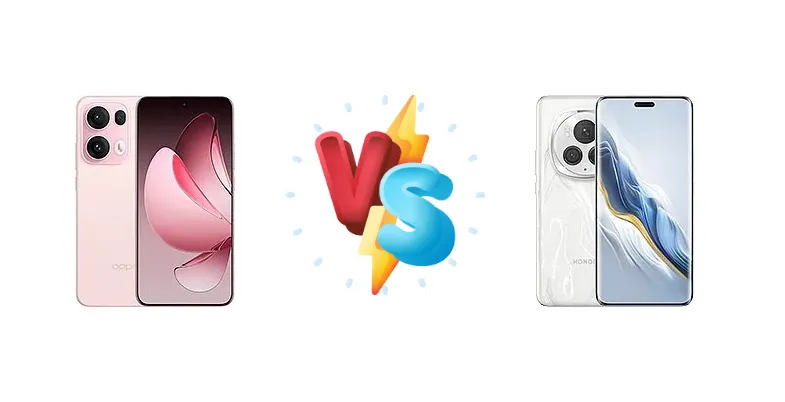
|
🏆 Quick Verdict
For most users, the Honor Magic6 Pro is the superior choice, thanks to its significantly more powerful Snapdragon 8 Gen 3 chipset and brighter display. While the Reno13 Pro offers excellent battery endurance and fast charging, it can't match the raw processing power of its rival.
| PHONES | ||
|---|---|---|
| Phone Names | Oppo Reno13 Pro | Honor Magic6 Pro |
| Network | ||
|---|---|---|
| 2G bands | GSM 850 / 900 / 1800 / 1900 | GSM 850 / 900 / 1800 / 1900 |
| 3G bands | HSDPA 800 / 850 / 900 / 1700(AWS) / 1900 / 2100 - International | HSDPA 800 / 850 / 900 / 1700(AWS) / 1900 / 2100 |
| 4G bands | 1, 2, 3, 4, 5, 7, 8, 12, 13, 17, 18, 19, 20, 26, 28, 32, 34, 38, 39, 40, 41, 66 - International | LTE |
| 5G bands | 1, 2, 3, 5, 7, 8, 12, 20, 26, 28, 66, 38, 40, 41, 77, 78 SA/NSA - International | SA/NSA |
| Speed | HSPA, LTE, 5G | HSPA, LTE, 5G |
| Technology | GSM / CDMA / HSPA / LTE / 5G | GSM / CDMA / HSPA / CDMA2000 / LTE / 5G |
| Launch | ||
|---|---|---|
| Announced | 2024, November 25 | 2024, January 11 |
| Status | Available. Released 2024, November 29 | Available. Released 2024, January 18 |
| Body | ||
|---|---|---|
| Build | Glass front (Gorilla Glass 7i), aluminum alloy frame, glass back | Glass front (NanoCrystal Shield), glass back or silicone polymer back (eco leather) |
| Dimensions | 162.8 x 76.6 x 7.6 mm (6.41 x 3.02 x 0.30 in) | 162.5 x 75.8 x 8.9 mm (6.40 x 2.98 x 0.35 in) |
| SIM | · Nano-SIM + Nano-SIM + eSIM (max 2 at a time)· Nano-SIM + Nano-SIM | · Nano-SIM + eSIM· Nano-SIM + Nano-SIM |
| Weight | 195 g or 197 g (6.88 oz) | 225 g or 229 g (7.94 oz) |
| Display | ||
|---|---|---|
| Protection | Corning Gorilla Glass 7i, Mohs level 4 | NanoCrystal Shield |
| Resolution | 1272 x 2800 pixels (~450 ppi density) | 1280 x 2800 pixels, 19.5:9 ratio (~453 ppi density) |
| Size | 6.83 inches, 113.3 cm2 (~90.9% screen-to-body ratio) | 6.8 inches, 112.8 cm2 (~91.6% screen-to-body ratio) |
| Type | AMOLED, 1B colors, 120Hz, 3840Hz PWM, HDR10+, 1200 nits (peak) | LTPO OLED, 1B colors, 120Hz, Dolby Vision, HDR, 1600 nits (HBM), 5000 nits (peak) |
| Platform | ||
|---|---|---|
| CPU | Octa-core (1x3.35 GHz Cortex-A715 & 3x3.20 GHz Cortex-A715 & 4x2.20 GHz Cortex-A510) | Octa-core (1x3.3 GHz Cortex-X4 & 3x3.2 GHz Cortex-A720 & 2x3.0 GHz Cortex-A720 & 2x2.3 GHz Cortex-A520) |
| Chipset | Mediatek Dimensity 8350 (4 nm) | Qualcomm SM8650-AB Snapdragon 8 Gen 3 (4 nm) |
| GPU | Mali G615-MC6 | Adreno 750 |
| OS | Android 15, ColorOS 15 | Android 14, up to 4 major Android upgrades, MagicOS 8 |
| Memory | ||
|---|---|---|
| Card slot | No | No |
| Internal | 256GB 12GB RAM, 512GB 12GB RAM, 512GB 16GB RAM, 1TB 16GB RAM | 256GB 12GB RAM, 256GB 16GB RAM, 512GB 12GB RAM, 512GB 16GB RAM, 1TB 16GB RAM |
| Main Camera | ||
|---|---|---|
| Features | Color spectrum sensor, LED flash, HDR, panorama | Laser AF, color spectrum sensor, LED flash, HDR, panorama |
| Triple | 50 MP, f/1.8, 24mm (wide), 1/1.56", 1.0µm, multi-directional PDAF, OIS 50 MP, f/2.8, 85mm (telephoto), PDAF, OIS, 3.5x optical zoom 8 MP, f/2.2, 15mm, 116˚ (ultrawide), 1/4.0", 1.12µm | 50 MP, f/1.4-2.0, 23mm (wide), 1/1.3", 1.2µm, PDAF, OIS 180 MP, f/2.6, (periscope telephoto), 1/1.49", 0.56µm, PDAF, OIS, 2.5x optical zoom 50 MP, f/2.0, 13mm, 122˚ (ultrawide), 1/2.88", 0.61µm, AF |
| Video | 4K@30/60fps, 1080p@30/60/120fps, gyro-EIS | 4K@24/30/60fps, 1080p@30/60/120/240fps, gyro-EIS, OIS, HDR, 10-bit video |
| Selfie camera | ||
|---|---|---|
| Features | Panorama, HDR | - |
| Single | 50 MP, f/2.0, 21mm (wide), AF | 50 MP, f/2.0, 22mm (wide), 1/2.93", 0.6µm, AF TOF 3D, (depth/biometrics sensor) |
| Video | 4K@30/60fps, 1080p@30/60fps, gyro-EIS | 4K@30fps, 1080p@30/60fps, gyro-EIS |
| Sound | ||
|---|---|---|
| 35mm jack | No | No |
| Loudspeaker | Yes, with stereo speakers | Yes, with stereo speakers |
| Comms | ||
|---|---|---|
| Bluetooth | 5.4, A2DP, LE, aptX HD, LHDC 5 | 5.3, A2DP, LE, aptX HD |
| Infrared port | Yes | Yes |
| NFC | Yes | Yes |
| Positioning | GPS, GLONASS, GALILEO, BDS, QZSS | GPS (L1+L5), GLONASS, BDS (B1I+B1c+B2a), GALILEO (E1+E5a) |
| Radio | No | No |
| USB | USB Type-C 2.0, OTG | USB Type-C 3.2, DisplayPort 1.2, OTG |
| WLAN | Wi-Fi 802.11 a/b/g/n/ac/6e, dual-band | Wi-Fi 802.11 a/b/g/n/ac/6/7, dual-band, Wi-Fi Direct |
| Features | ||
|---|---|---|
| Sensors | Fingerprint (under display, optical), accelerometer, gyro, proximity, compass | Fingerprint (under display, optical), Face ID, accelerometer, gyro, proximity, compass |
| Battery | ||
|---|---|---|
| Charging | 80W wired, PD, UFCS 33W, PPS 33W 50W wireless (China only) Reverse wired | 80W wired 66W wireless Reverse wireless 5W reverse wired |
| Type | 5800 mAh | Si/C Li-Ion 5600 mAh |
| Misc | ||
|---|---|---|
| Colors | Graphite Grey, Plume Purple, Pink | Black, Green, Blue, Purple, White |
| Models | CPH2697, PKK110 | BVL-AN16, BVL-N49 |
| Price | $ 739.00 / £ 469.99 / € 479.99 / ₹ 35,999 | € 455.54 / $ 899.00 / £ 598.99 |
| EU LABEL | ||
|---|---|---|
| Battery | 57:36h endurance, 1600 cycles | - |
| Energy | Class B | - |
| Free fall | Class C (120 falls) | - |
| Repairability | Class B | - |
Oppo Reno13 Pro
- Exceptional battery life (57:36h endurance)
- Fast 80W wired charging
- Competitive price (likely)
- Less powerful chipset (Dimensity 8350)
- Dimmer display (1168 nits)
Honor Magic6 Pro
- Flagship Snapdragon 8 Gen 3 performance
- Brighter display (1578 nits)
- Faster 66W wireless charging
- Shorter battery life (14:06h active use)
- Potentially higher price
Display Comparison
The Honor Magic6 Pro boasts a significantly brighter display, reaching a measured 1578 nits compared to the Reno13 Pro’s 1168 nits. This translates to superior visibility in direct sunlight. While both utilize 4nm chipsets, the brighter display of the Magic6 Pro will likely draw more power. Neither specification details refresh rate or panel type, but given the flagship positioning, both are expected to feature LTPO OLED panels for adaptive refresh rates and power efficiency. The difference in peak brightness is the most notable distinction, benefiting outdoor users.
Camera Comparison
Without detailed camera specifications, a direct comparison is limited. However, the chipset difference indirectly impacts camera performance. The Snapdragon 8 Gen 3’s superior ISP (Image Signal Processor) will likely result in faster image processing, better low-light performance, and more advanced computational photography features on the Honor Magic6 Pro. The Reno13 Pro will still deliver good image quality, but may struggle to match the Magic6 Pro’s capabilities in challenging conditions. We can assume both phones will feature multi-camera systems, but sensor size and lens apertures are crucial details missing from the provided data.
Performance
The core difference lies in the chipsets: the Honor Magic6 Pro features the Qualcomm Snapdragon 8 Gen 3, while the Oppo Reno13 Pro utilizes the Mediatek Dimensity 8350. The Snapdragon 8 Gen 3, with its Cortex-X4 prime core clocked at 3.3 GHz, offers a substantial performance advantage over the Dimensity 8350’s Cortex-A715 configuration. The Snapdragon’s architecture, including the 3x Cortex-A720 cores, is designed for sustained performance, potentially leading to less thermal throttling during extended gaming sessions. The Reno13 Pro’s Dimensity 8350 is still a capable chip, but it’s positioned a tier below the flagship Snapdragon.
Battery Life
The Oppo Reno13 Pro demonstrates impressive battery endurance with a measured 57:36 hours, and an active use score of 16:42 hours, exceeding the Honor Magic6 Pro’s 14:06 hours active use score. However, the Magic6 Pro compensates with faster wireless charging at 66W compared to the Reno13 Pro’s 50W (China only) and 33W (PD/PPS). Both support 80W wired charging, offering quick top-ups. The Reno13 Pro’s longer endurance suggests more efficient power management, potentially offsetting the Magic6 Pro’s brighter display and more powerful chipset.
Buying Guide
Buy the Oppo Reno13 Pro if you prioritize exceptional battery life (57:36h endurance) and a well-rounded feature set at a potentially lower price point. It’s ideal for users who consume a lot of media and need a phone that lasts all day. Buy the Honor Magic6 Pro if you demand the absolute best performance for gaming, demanding applications, and future-proofing, and value a brighter, more vibrant display. It’s the phone for power users and mobile gamers.