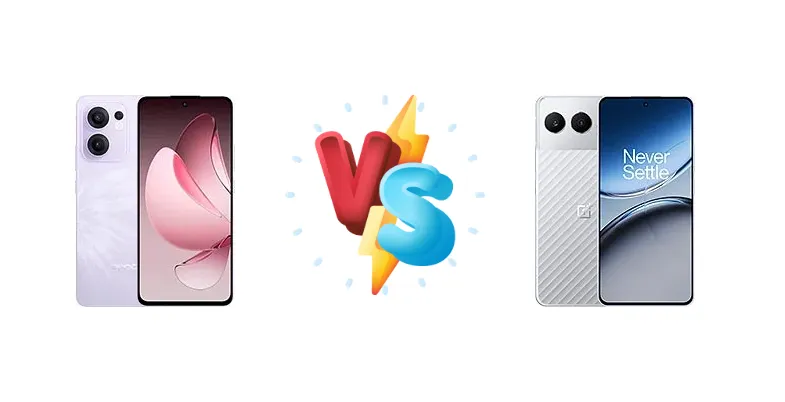
The Oppo Reno13 F 4G and the OnePlus Nord 4 represent distinct approaches to the mid-range smartphone market. The Reno13 F focuses on delivering a balanced experience at a competitive price, while the Nord 4 aims for a more premium feel with a focus on performance and rapid charging. This comparison dissects their key differences to determine which device best suits your needs.
🏆 Quick Verdict
For the average user prioritizing performance and future-proofing, the OnePlus Nord 4 is the clear winner. Its Snapdragon 7+ Gen 3 chipset and 100W charging significantly outperform the Reno13 F's Helio G100 and 45W charging, justifying the likely price difference. However, the Reno13 F remains a compelling option for budget-conscious buyers.
| Network |
|---|
| 2G bands | GSM 850 / 900 / 1800 / 1900 | GSM 850 / 900 / 1800 / 1900 |
| 3G bands | HSDPA 850 / 900 / 2100 - version 1 | HSDPA 800 / 850 / 900 / 1700(AWS) / 1800 / 1900 / 2100 - International |
| 4G bands | 1, 3, 5, 7, 8, 20, 28, 38, 40, 41 - version 1 | 1, 2, 3, 4, 5, 7, 8, 12, 17, 18, 19, 20, 26, 28, 38, 39, 40, 41, 66 - International |
| 5G bands | - | 1, 2, 3, 5, 7, 8, 12, 20, 28, 38, 40, 41, 66, 77, 78 SA/NSA - International |
| Speed | HSPA, LTE | HSPA, LTE, 5G |
| Technology | GSM / HSPA / LTE | GSM / HSPA / LTE / 5G |
| Launch |
|---|
| Announced | 2025, January 04 | 2024, July 16 |
| Status | Available. Released 2025, January 10 | Available. Released 2024, August 08 |
| Body |
|---|
| Build | - | Glass front, aluminum back, aluminum frame |
| Dimensions | 162.2 x 75.1 x 7.8 mm (6.39 x 2.96 x 0.31 in) | 162.6 x 75 x 8 mm (6.40 x 2.95 x 0.31 in) |
| SIM | Nano-SIM + Nano-SIM | Nano-SIM + Nano-SIM |
| Weight | 192 g (6.77 oz) | 199.5 g (7.05 oz) |
| Display |
|---|
| Protection | Asahi Glass AGC DT-Star2 | - |
| Resolution | 1080 x 2400 pixels, 20:9 ratio (~395 ppi density) | 1240 x 2772 pixels, 20:9 ratio (~450 ppi density) |
| Size | 6.67 inches, 107.4 cm2 (~88.2% screen-to-body ratio) | 6.74 inches, 109.7 cm2 (~90.0% screen-to-body ratio) |
| Type | AMOLED, 120Hz, 600 nits (typ), 1200 nits (HMB), 2100 nits (peak) | Fluid AMOLED, 1B colors, 120Hz, HDR10+, 2150 nits (peak) |
| Platform |
|---|
| CPU | Octa-core (2x2.2 GHz Cortex-A76 & 6x2.0 GHz Cortex-A55) | Octa-core (1x2.8 GHz Cortex-X4 & 4x2.6 GHz Cortex-A720 & 3x1.9 GHz Cortex-A520) |
| Chipset | Mediatek Helio G100 (6 nm) | Qualcomm SM7675 Snapdragon 7+ Gen 3 (4 nm) |
| GPU | Mali-G57 MC2 | Adreno 732 |
| OS | Android 15, ColorOS 15 | Android 14, up to 4 major Android upgrades, OxygenOS 15 |
| Memory |
|---|
| Card slot | microSDXC | No |
| Internal | 256GB 8GB RAM, 512GB 8GB RAM | 128GB 8GB RAM, 256GB 8GB RAM, 256GB 12GB RAM, 512GB 16GB RAM |
| Main Camera |
|---|
| Dual | - | 50 MP, f/1.8, 25mm (wide), 1/1.95", 0.8µm, PDAF, OIS
8 MP, f/2.2, 112˚ (ultrawide), 1/4.0", 1.12µm |
| Features | LED flash, HDR, panorama | Dual-LED flash, HDR, panorama |
| Triple | 50 MP, f/1.8, 26mm (wide), PDAF, OIS
8 MP, f/2.2, 16mm, 112˚ (ultrawide), 1/4.0", 1.12µm
2 MP (macro) | - |
| Video | 1080p@30/60, gyro-EIS, OIS | 4K@30/60fps, 1080p@30/60/120fps, gyro-EIS |
| Selfie camera |
|---|
| Features | Panorama | Panorama |
| Single | 32 MP, f/2.4, 22mm (wide), 1/2.74", 0.8µm | 16 MP, f/2.4, 24mm (wide), 1.0µm |
| Video | 1080p@30fps | 1080p@30fps |
| Sound |
|---|
| 35mm jack | No | No |
| Loudspeaker | Yes, with stereo speakers | Yes, with stereo speakers |
| Comms |
|---|
| Bluetooth | 5.3, A2DP, LE, aptX HD | 5.4, A2DP, LE, aptX HD, LHDC |
| Infrared port | - | Yes |
| NFC | Yes (market/region dependent) | Yes |
| Positioning | GPS, GLONASS, GALILEO, BDS, QZSS | GPS, GALILEO, GLONASS, BDS, QZSS |
| Radio | Unspecified | No |
| USB | USB Type-C 2.0, OTG | USB Type-C 2.0 |
| WLAN | Wi-Fi 802.11 a/b/g/n/ac, dual-band | Wi-Fi 802.11 a/b/g/n/ac/6, dual-band, Wi-Fi Direct |
| Features |
|---|
| Sensors | Fingerprint (under display, optical), accelerometer, gyro, proximity, compass | Fingerprint (under display, optical), accelerometer, gyro, proximity, compass |
| Battery |
|---|
| Charging | 45W wired, PD, 45% in 30 min
Reverse wired | 100W wired, PPS, 100% in 28 min |
| Type | 5800 mAh | 5500 mAh |
| Misc |
|---|
| Colors | Graphite Grey, Skyline Blue, Plume Purple | Obsidian Midnight, Mercurial Silver, Oasis Green |
| Models | CPH2701 | CPH2663, CPH2661 |
| Price | - | € 410.27 / £ 423.17 |
| SAR | - | 1.18 W/kg (head) 1.06 W/kg (body) |
Oppo Reno13 F 4G
- More affordable price point
- Decent performance for everyday tasks
- Reverse wired charging capability
- Slower charging speed (45W)
- Less powerful chipset (Helio G100)
- Limited display brightness information
OnePlus Nord 4
- Significantly faster charging (100W)
- More powerful chipset (Snapdragon 7+ Gen 3)
- Brighter display (1163 nits)
- Likely higher price
- May require a separate charger for full 100W speed
- No reverse wireless charging
Display Comparison
The OnePlus Nord 4 boasts a significantly brighter display, reaching a measured peak of 1163 nits, compared to an unspecified brightness for the Reno13 F. This higher brightness translates to better visibility outdoors under direct sunlight. While both likely utilize AMOLED panels, the Nord 4’s superior brightness and potential for higher refresh rates (not specified, but common in this segment) offer a more immersive viewing experience. The Reno13 F’s display specs are currently limited, making a direct comparison difficult, but it’s likely to be tuned for power efficiency rather than peak performance.
Camera Comparison
Without detailed camera specifications for the Reno13 F, a direct comparison is challenging. However, the OnePlus Nord 4 is expected to feature a more advanced camera system, leveraging the ISP capabilities of the Snapdragon 7+ Gen 3. The focus should be on the main sensor resolution and aperture. Image processing algorithms on the Nord 4 will likely deliver more dynamic range and better low-light performance. The Reno13 F will likely rely on software optimizations to compensate for potentially less capable hardware. We anticipate the Nord 4 to offer more consistent and higher-quality results across various shooting conditions.
Performance
The core difference lies in the chipsets. The OnePlus Nord 4’s Qualcomm SM7675 Snapdragon 7+ Gen 3 (4nm) is a substantial upgrade over the Oppo Reno13 F’s MediaTek Helio G100 (6nm). The Snapdragon 7+ Gen 3 features a Cortex-X4 prime core clocked at 2.8 GHz, alongside Cortex-A720 and A520 cores, offering significantly improved CPU and GPU performance. The 4nm process node also contributes to better thermal efficiency, reducing throttling during sustained workloads. The Reno13 F’s Helio G100, while capable, is geared towards more moderate tasks. The Snapdragon’s architecture will provide a smoother experience in demanding games and multitasking scenarios.
Battery Life
The OnePlus Nord 4 shines in battery and charging. Its 100W wired charging, utilizing PPS, can fully charge the device in just 28 minutes – a massive advantage over the Reno13 F’s 45W charging, which takes 30 minutes to reach 45%. While the Nord 4’s battery capacity isn’t specified, its active use score of 14:41h demonstrates excellent battery life. The Reno13 F’s battery capacity is also unknown, but the slower charging speed suggests a focus on preserving battery health rather than rapid replenishment. The Nord 4’s combination of fast charging and efficient chipset provides a superior user experience for those constantly on the go.
Buying Guide
Buy the Oppo Reno13 F 4G if you need a reliable daily driver with decent performance for everyday tasks and prioritize a lower price point. It's ideal for users who don't heavily game or require the fastest possible charging. Buy the OnePlus Nord 4 if you prefer a smoother, more responsive experience, especially for gaming and demanding applications, and value incredibly fast 100W charging to minimize downtime. This is the phone for power users who want a premium feel without a flagship price.
Frequently Asked Questions
❓ Does the Helio G100 in the Reno13 F struggle with graphically intensive games like Genshin Impact?
The Helio G100 is capable of running Genshin Impact, but you'll likely need to lower the graphics settings to medium or low to maintain a stable frame rate. The Snapdragon 7+ Gen 3 in the Nord 4 will provide a significantly smoother experience at higher settings, with less frame rate fluctuation.
❓ How much faster is the 100W charging on the Nord 4 compared to the 45W charging on the Reno13 F in real-world use?
The 100W charging on the Nord 4 can fully charge the phone in approximately 28 minutes, while the Reno13 F takes longer to reach even 45% charge in 30 minutes. This means you can get a substantial charge in a very short amount of time with the Nord 4, ideal for users who need to quickly top up their battery.
❓ Is the lack of 5G connectivity on the Reno13 F a significant drawback?
If you live in an area with widespread 5G coverage and frequently use data-intensive applications, the lack of 5G on the Reno13 F could be a limitation. However, if 5G isn't readily available or you primarily use Wi-Fi, it may not be a major concern.