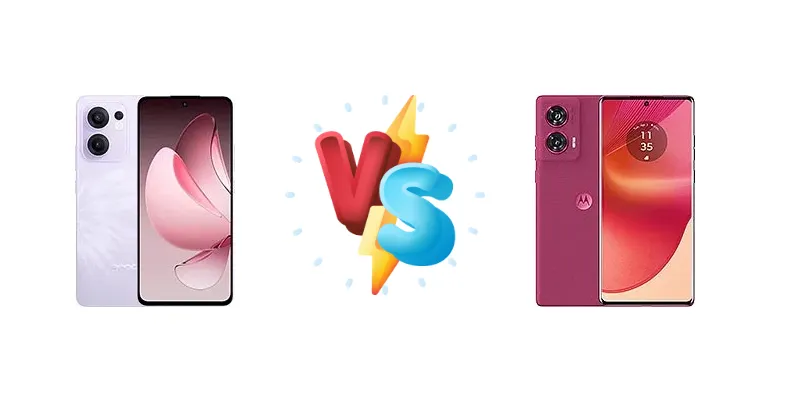
The Oppo Reno13 F 4G and Motorola Edge 50 Fusion represent compelling options in the increasingly competitive mid-range smartphone market. The Reno13 F aims for affordability with a Mediatek Helio G100, while the Edge 50 Fusion leverages Qualcomm’s Snapdragon 7s Gen 2 (or 6 Gen 1 in LATAM) and a brighter display, creating a clear divergence in target user profiles.
🏆 Quick Verdict
For the average user prioritizing display quality and faster charging, the Motorola Edge 50 Fusion is the stronger choice. Its Snapdragon 7s Gen 2 (International) chipset delivers a performance edge, and the 68W charging significantly reduces downtime. However, the Reno13 F remains a viable option for budget-conscious buyers.
| Network |
|---|
| 2G bands | GSM 850 / 900 / 1800 / 1900 | GSM 850 / 900 / 1800 / 1900 |
| 3G bands | HSDPA 850 / 900 / 2100 - version 1 | HSDPA 850 / 900 / 1900 / 2100 |
| 4G bands | 1, 3, 5, 7, 8, 20, 28, 38, 40, 41 - version 1 | 1, 2, 3, 5, 7, 8, 18, 19, 20, 26, 28, 32, 38, 40, 41, 42, 71 - International |
| 5G bands | - | 1, 3, 5, 7, 8, 20, 26, 28, 38, 40, 41, 77, 78 SA/NSA |
| Speed | HSPA, LTE | HSPA, LTE, 5G |
| Technology | GSM / HSPA / LTE | GSM / HSPA / LTE / 5G |
| Launch |
|---|
| Announced | 2025, January 04 | 2024, April 16 |
| Status | Available. Released 2025, January 10 | Available. Released 2024, May 15 |
| Body |
|---|
| Build | - | Glass front, silicone polymer back (eco leather), plastic frame |
| Dimensions | 162.2 x 75.1 x 7.8 mm (6.39 x 2.96 x 0.31 in) | 161.9 x 73.1 x 7.9 mm (6.37 x 2.88 x 0.31 in) |
| SIM | Nano-SIM + Nano-SIM | · Nano-SIM + eSIM· Nano-SIM + Nano-SIM |
| Weight | 192 g (6.77 oz) | 174.9 g (6.17 oz) |
| Display |
|---|
| Protection | Asahi Glass AGC DT-Star2 | Corning Gorilla Glass 5 |
| Resolution | 1080 x 2400 pixels, 20:9 ratio (~395 ppi density) | 1080 x 2400 pixels, 20:9 ratio (~393 ppi density) |
| Size | 6.67 inches, 107.4 cm2 (~88.2% screen-to-body ratio) | 6.7 inches, 108.4 cm2 (~91.6% screen-to-body ratio) |
| Type | AMOLED, 120Hz, 600 nits (typ), 1200 nits (HMB), 2100 nits (peak) | P-OLED, 1B colors, 120Hz (LATAM), 144Hz (INT), 1600 nits (peak) |
| Platform |
|---|
| CPU | Octa-core (2x2.2 GHz Cortex-A76 & 6x2.0 GHz Cortex-A55) | Octa-core (4x2.40 GHz Cortex-A78 & 4x1.95 GHz Cortex-A55) - InternationalOcta-core (4x2.2 GHz Cortex-A78 & 4x1.8 GHz Cortex-A55) - LATAM |
| Chipset | Mediatek Helio G100 (6 nm) | Qualcomm SM7435-AB Snapdragon 7s Gen 2 (4 nm) - InternationalQualcomm SM6450 Snapdragon 6 Gen 1 (4 nm) - LATAM |
| GPU | Mali-G57 MC2 | Adreno 710 |
| OS | Android 15, ColorOS 15 | Android 14, upgradable to Android 15, up to 3 major Android upgrades |
| Memory |
|---|
| Card slot | microSDXC | No |
| Internal | 256GB 8GB RAM, 512GB 8GB RAM | 128GB 8GB RAM, 256GB 8GB RAM, 256GB 12GB RAM, 512GB 8GB RAM, 512GB 12GB RAM |
| Main Camera |
|---|
| Dual | - | 50 MP, f/1.9, (wide), 1/1.56", 1.0µm, multi-directional PDAF, OIS
13 MP, f/2.2, 120˚ (ultrawide), 1/3.0", 1.12µm, AF |
| Features | LED flash, HDR, panorama | LED flash, HDR, panorama |
| Triple | 50 MP, f/1.8, 26mm (wide), PDAF, OIS
8 MP, f/2.2, 16mm, 112˚ (ultrawide), 1/4.0", 1.12µm
2 MP (macro) | - |
| Video | 1080p@30/60, gyro-EIS, OIS | 4K@30fps, 1080p@30/60/120fps, gyro-EIS |
| Selfie camera |
|---|
| Features | Panorama | HDR |
| Single | 32 MP, f/2.4, 22mm (wide), 1/2.74", 0.8µm | 32 MP, f/2.5, (wide), 1/3.14", 0.7µm |
| Video | 1080p@30fps | 4K@30fps, 1080p@30fps |
| Sound |
|---|
| 35mm jack | No | No |
| Loudspeaker | Yes, with stereo speakers | Yes, with stereo speakers |
| Comms |
|---|
| Bluetooth | 5.3, A2DP, LE, aptX HD | 5.2, A2DP, LE |
| NFC | Yes (market/region dependent) | Yes |
| Positioning | GPS, GLONASS, GALILEO, BDS, QZSS | GPS, GLONASS, GALILEO |
| Radio | Unspecified | No |
| USB | USB Type-C 2.0, OTG | USB Type-C 2.0, OTG |
| WLAN | Wi-Fi 802.11 a/b/g/n/ac, dual-band | Wi-Fi 802.11 a/b/g/n/ac, dual-band |
| Features |
|---|
| Sensors | Fingerprint (under display, optical), accelerometer, gyro, proximity, compass | Fingerprint (under display, optical), accelerometer, gyro, proximity, compass |
| Battery |
|---|
| Charging | 45W wired, PD, 45% in 30 min
Reverse wired | 68W wired, 50% in 15 min |
| Type | 5800 mAh | 5000 mAh |
| Misc |
|---|
| Colors | Graphite Grey, Skyline Blue, Plume Purple | Forest Blue, Marshmallow Blue, Hot Pink |
| Models | CPH2701 | XT2429-1 |
| Price | - | € 208.99 / $ 245.00 / ₹ 18,667 |
Oppo Reno13 F 4G
- Potentially lower price point
- Functional and reliable performance for basic tasks
- 45W fast charging with reverse wired charging
- Less powerful chipset compared to Snapdragon 7s Gen 2
- Likely lower display brightness and quality
- Limited information available on camera capabilities
Motorola Edge 50 Fusion
- Faster Snapdragon 7s Gen 2 (International) or 6 Gen 1 (LATAM) chipset
- Significantly brighter 1322 nit display
- 68W ultra-fast charging
- Potentially higher price
- LATAM variant uses a less powerful Snapdragon 6 Gen 1
- Software support longevity may be shorter than Oppo
Display Comparison
The Motorola Edge 50 Fusion boasts a significantly brighter display, reaching a measured 1322 nits. This is a substantial advantage for outdoor visibility compared to the Reno13 F, which lacks published brightness data but is expected to be lower. While both likely utilize OLED panels, the Fusion’s higher peak brightness and potentially better color calibration (based on Motorola’s recent displays) provide a superior viewing experience. The Reno13 F’s display specs are currently unknown, making a detailed comparison difficult, but the Fusion clearly leads in this category.
Camera Comparison
Detailed camera specs are missing for both devices, making a direct comparison challenging. However, focusing on the chipsets, the Snapdragon 7s Gen 2 in the Edge 50 Fusion offers a more powerful ISP (Image Signal Processor) capable of faster image processing and potentially better low-light performance. Without knowing sensor sizes or aperture values, it’s difficult to definitively declare a winner, but the Fusion’s chipset gives it an inherent advantage in image quality. We can assume both phones will include standard features like portrait modes and night modes, but the Fusion is likely to deliver more refined results.
Performance
The core difference lies in the chipsets. The Motorola Edge 50 Fusion, in its international variant, features the Qualcomm Snapdragon 7s Gen 2 (4nm), built on a more efficient process node than the Oppo Reno13 F’s Mediatek Helio G100 (6nm). The Snapdragon 7s Gen 2’s Cortex-A78 cores (2.40 GHz) offer a performance uplift over the Reno13 F’s Cortex-A76 cores (2.2 GHz). The LATAM version of the Edge 50 Fusion uses the Snapdragon 6 Gen 1, which is a step down in performance, but still likely comparable to the Helio G100. The 4nm process of the Snapdragon allows for better thermal management, potentially reducing throttling during sustained workloads. This translates to a smoother experience for gaming and demanding applications on the Fusion.
Battery Life
The Motorola Edge 50 Fusion excels in charging speed with its 68W wired charging, capable of reaching 50% charge in just 15 minutes. The Oppo Reno13 F’s 45W charging, while respectable, is noticeably slower. The Edge 50 Fusion also demonstrates strong battery life, achieving an active use score of 12 hours and 40 minutes. While the Reno13 F’s battery capacity is unknown, the Fusion’s combination of efficient chipset and fast charging provides a significant advantage for users who prioritize minimizing downtime.
Buying Guide
Buy the Oppo Reno13 F 4G if you need a functional, everyday smartphone with a focus on value and aren't demanding in terms of gaming or intensive tasks. Buy the Motorola Edge 50 Fusion if you prioritize a brighter, more vibrant display, faster charging speeds, and a more capable processor for smoother multitasking and gaming, even if it means spending a bit more.
Frequently Asked Questions
❓ Does the Snapdragon 7s Gen 2 in the Motorola Edge 50 Fusion handle demanding games like Genshin Impact well?
Yes, the Snapdragon 7s Gen 2 is capable of running Genshin Impact at medium to high settings with playable frame rates. While it won't match the performance of flagship chipsets, it provides a significantly smoother gaming experience than the Helio G100 in the Reno13 F, especially during prolonged gaming sessions due to its superior thermal efficiency.
❓ What are the real-world differences between the Snapdragon 7s Gen 2 and Snapdragon 6 Gen 1 versions of the Motorola Edge 50 Fusion?
The Snapdragon 7s Gen 2 offers a noticeable performance boost over the Snapdragon 6 Gen 1, particularly in CPU-intensive tasks and gaming. Expect slightly slower app loading times and less responsive multitasking on the 6 Gen 1 variant. However, for everyday use like browsing and social media, the difference will be less pronounced.
❓ Is the 45W charging on the Oppo Reno13 F slow compared to the 68W on the Motorola Edge 50 Fusion?
Yes, the 68W charging on the Edge 50 Fusion is considerably faster. While 45W is still considered fast charging, it takes significantly longer to fully charge the device. The Fusion can reach 50% charge in 15 minutes, while the Reno13 F will take closer to 30 minutes to reach 45%.