
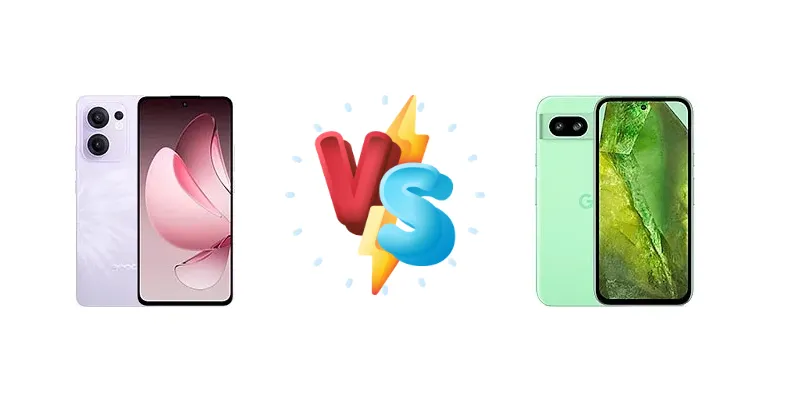
Google Pixel 8a vs Oppo Reno13 F 4G: A Detailed Comparison of Mid-Range Champions
| Phones Images | |||||
|---|---|---|---|---|---|
|
🏆 Quick Verdict
For the average user prioritizing long-term software support, superior camera capabilities, and all-day battery life, the Google Pixel 8a is the clear winner. While the Oppo Reno13 F 4G boasts impressively fast 45W charging, it can't match the Pixel 8a's overall refinement and longevity.
| PHONES | ||
|---|---|---|
| Phone Names | Oppo Reno13 F 4G | Google Pixel 8a |
| Network | ||
|---|---|---|
| 2G bands | GSM 850 / 900 / 1800 / 1900 | GSM 850 / 900 / 1800 / 1900 |
| 3G bands | HSDPA 850 / 900 / 2100 - version 1 | HSDPA 800 / 850 / 900 / 1700(AWS) / 1900 / 2100 |
| 4G bands | 1, 3, 5, 7, 8, 20, 28, 38, 40, 41 - version 1 | 1, 2, 3, 4, 5, 7, 8, 12, 17, 18, 19, 20, 26, 28, 32, 38, 40, 41, 42, 66 - G6GPR (International) |
| 5G bands | - | 1, 2, 3, 5, 7, 8, 12, 20, 26, 28, 38, 40, 41, 66, 75, 76, 77, 78 SA/NSA/Sub6 - G6GPR (International) |
| Speed | HSPA, LTE | HSPA, LTE, 5G |
| Technology | GSM / HSPA / LTE | GSM / HSPA / LTE / 5G |
| Launch | ||
|---|---|---|
| Announced | 2025, January 04 | 2024, May 07 |
| Status | Available. Released 2025, January 10 | Available. Released 2024, May 14 |
| Body | ||
|---|---|---|
| Build | - | Glass front (Gorilla Glass 3), aluminum frame, plastic back |
| Dimensions | 162.2 x 75.1 x 7.8 mm (6.39 x 2.96 x 0.31 in) | 152.1 x 72.7 x 8.9 mm (5.99 x 2.86 x 0.35 in) |
| SIM | Nano-SIM + Nano-SIM | Nano-SIM + eSIM |
| Weight | 192 g (6.77 oz) | 188 g (6.63 oz) |
| Display | ||
|---|---|---|
| Protection | Asahi Glass AGC DT-Star2 | Corning Gorilla Glass 3, Mohs level 5 |
| Resolution | 1080 x 2400 pixels, 20:9 ratio (~395 ppi density) | 1080 x 2400 pixels, 20:9 ratio (~430 ppi density) |
| Size | 6.67 inches, 107.4 cm2 (~88.2% screen-to-body ratio) | 6.1 inches, 90.3 cm2 (~81.6% screen-to-body ratio) |
| Type | AMOLED, 120Hz, 600 nits (typ), 1200 nits (HMB), 2100 nits (peak) | OLED, HDR, 120Hz, 2000 nits (peak) |
| Platform | ||
|---|---|---|
| CPU | Octa-core (2x2.2 GHz Cortex-A76 & 6x2.0 GHz Cortex-A55) | Nona-core (1x3.0 GHz Cortex-X3 & 4x2.45 GHz Cortex-A715 & 4x2.15 GHz Cortex-A510) |
| Chipset | Mediatek Helio G100 (6 nm) | Google Tensor G3 (4 nm) |
| GPU | Mali-G57 MC2 | Immortalis-G715s MC10 |
| OS | Android 15, ColorOS 15 | Android 14, upgradable to Android 16, up to 7 major Android upgrades |
| Memory | ||
|---|---|---|
| Card slot | microSDXC | No |
| Internal | 256GB 8GB RAM, 512GB 8GB RAM | 128GB 8GB RAM, 256GB 8GB RAM |
| Main Camera | ||
|---|---|---|
| Dual | - | 64 MP (16 MP eff.), f/1.9, 26mm (wide), 1/1.73", 0.8µm, dual pixel PDAF, OIS 13 MP, f/2.2, 120˚ (ultrawide), 1.12µm |
| Features | LED flash, HDR, panorama | Dual-LED flash, Pixel Shift, Ultra HDR, panorama, Best Take |
| Triple | 50 MP, f/1.8, 26mm (wide), PDAF, OIS 8 MP, f/2.2, 16mm, 112˚ (ultrawide), 1/4.0", 1.12µm 2 MP (macro) | - |
| Video | 1080p@30/60, gyro-EIS, OIS | 4K@30/60fps, 1080p@30/60/120/240fps, OIS |
| Selfie camera | ||
|---|---|---|
| Features | Panorama | HDR, panorama |
| Single | 32 MP, f/2.4, 22mm (wide), 1/2.74", 0.8µm | 13 MP, f/2.2, 20mm (ultrawide), 1.12µm |
| Video | 1080p@30fps | 4K@30fps, 1080p@30/60fps |
| Sound | ||
|---|---|---|
| 35mm jack | No | No |
| Loudspeaker | Yes, with stereo speakers | Yes, with stereo speakers |
| Comms | ||
|---|---|---|
| Bluetooth | 5.3, A2DP, LE, aptX HD | 5.3, A2DP, LE |
| NFC | Yes (market/region dependent) | Yes |
| Positioning | GPS, GLONASS, GALILEO, BDS, QZSS | GPS, GLONASS, GALILEO, BDS, QZSS, NavIC |
| Radio | Unspecified | No |
| USB | USB Type-C 2.0, OTG | USB Type-C 3.2 |
| WLAN | Wi-Fi 802.11 a/b/g/n/ac, dual-band | Wi-Fi 802.11 a/b/g/n/ac/6e, dual/tri-band (market/region dependent) |
| Features | ||
|---|---|---|
| Sensors | Fingerprint (under display, optical), accelerometer, gyro, proximity, compass | Fingerprint (under display, optical), accelerometer, gyro, proximity, compass, barometer |
| Battery | ||
|---|---|---|
| Charging | 45W wired, PD, 45% in 30 min Reverse wired | 18W wired, PD3.0 7.5W wireless Bypass charging |
| Type | 5800 mAh | Li-Po 4492 mAh |
| Misc | ||
|---|---|---|
| Colors | Graphite Grey, Skyline Blue, Plume Purple | Obsidian, Porcelain, Bay, Aloe |
| Models | CPH2701 | GKV4X, G6GPR, G8HHN, G576D |
| Price | - | $ 229.98 / C$ 417.99 / £ 279.00 / € 299.99 / ₹ 33,300 |
| EU LABEL | ||
|---|---|---|
| Battery | - | 40:06h endurance, 1000 cycles |
| Energy | - | Class B |
| Free fall | - | Class A (270 falls) |
| Repairability | - | Class B |
Oppo Reno13 F 4G
- Superior camera quality and AI features
- Long-term software support from Google
- Excellent battery life and longevity
- Slower charging speed (18W)
- Potentially higher price point
Google Pixel 8a
- Extremely fast 45W charging
- More affordable price
- Reverse wired charging
- Inferior chipset performance
- Shorter software support lifespan
Display Comparison
The Pixel 8a’s display shines with a measured peak brightness of 1508 nits, significantly outperforming what we’d expect from the Reno13 F 4G, which lacks published brightness data. While the Reno13 F 4G’s panel specifics are unknown, the Pixel 8a’s high brightness ensures excellent visibility outdoors. The Pixel 8a likely benefits from OLED technology, offering superior contrast compared to the Reno13 F 4G, which is likely LCD. The Pixel 8a’s display is a clear advantage for media consumption and outdoor use.
Camera Comparison
The Pixel 8a’s camera system is a major strength, leveraging Google’s computational photography expertise. While specific sensor details are not provided in the context data, the Pixel 8a’s image processing is renowned for its dynamic range and accurate colors. The Reno13 F 4G’s camera capabilities are less defined, and likely rely more on hardware than software optimization. The Pixel 8a’s AI-powered features, such as Magic Eraser and Best Take, offer significant advantages for editing and enhancing photos. The Reno13 F 4G likely includes standard camera modes, but won’t match the Pixel 8a’s intelligent features.
Performance
The core difference lies in the chipsets: Google’s Tensor G3 (4nm) versus MediaTek’s Helio G100 (6nm). The Tensor G3’s nona-core architecture, featuring a Cortex-X3 prime core, provides a substantial performance advantage over the Helio G100’s octa-core setup. The 4nm fabrication process of the Tensor G3 also translates to improved thermal efficiency, reducing the likelihood of throttling during sustained workloads. While the Helio G100 is adequate for everyday tasks, the Tensor G3 offers a smoother experience with demanding apps and games. The Pixel 8a’s performance is geared towards AI tasks and image processing, while the Reno13 F 4G focuses on efficient power consumption.
Battery Life
The Pixel 8a boasts an impressive 40:06h endurance rating and 1000 charge cycles, indicating exceptional longevity. Its active use score of 11:25h suggests all-day battery life for most users. The Reno13 F 4G, while offering a rapid 45W wired charging (45% in 30 minutes), lacks the Pixel 8a’s overall endurance. The Pixel 8a’s 18W charging is slower, but its superior battery life and longevity offset this disadvantage. The Pixel 8a also supports bypass charging, allowing it to be used while charging, a feature not mentioned for the Reno13 F 4G.
Buying Guide
Buy the Oppo Reno13 F 4G if you prioritize extremely fast charging and a more affordable price point, and aren't heavily invested in the Google ecosystem. Buy the Google Pixel 8a if you value a consistently excellent camera experience, guaranteed software updates, and the benefits of Google’s Tensor G3 chip and AI features, even if it means slower charging.