
OnePlus 12R vs. Oppo Reno12: A Deep Dive into Performance and Value
| Phones Images | |||||
|---|---|---|---|---|---|
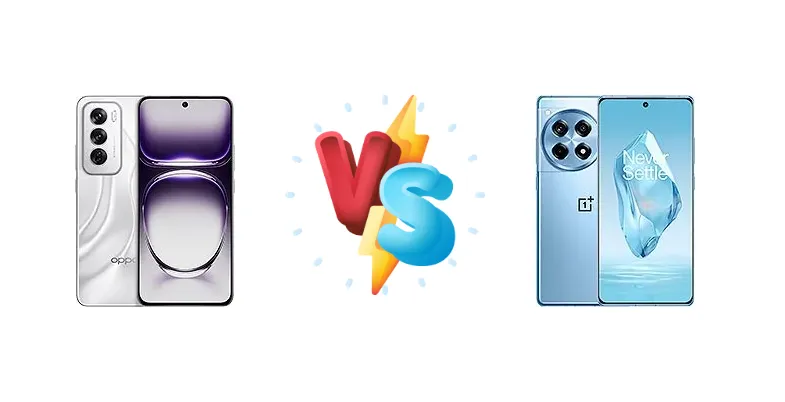
|
🏆 Quick Verdict
For users prioritizing peak performance and faster charging, the OnePlus 12R is the clear winner. Its Snapdragon 8 Gen 2 chipset delivers a noticeable performance edge. However, the Oppo Reno12 offers excellent battery life and a brighter display, making it a strong contender for everyday users.
| PHONES | ||
|---|---|---|
| Phone Names | Oppo Reno12 | OnePlus 12R |
| Network | ||
|---|---|---|
| 2G bands | GSM 850 / 900 / 1800 / 1900 | GSM 850 / 900 / 1800 / 1900 |
| 3G bands | HSDPA 800 / 850 / 900 / 1700(AWS) / 1900 / 2100 - version 1 | HSDPA 850 / 900 / 1700(AWS) / 1900 / 2100 |
| 4G bands | 1, 2, 3, 4, 5, 7, 8, 12, 13, 17, 18, 19, 20, 26, 28, 38, 39, 40, 41, 66 - version 1 | 1, 2, 3, 4, 5, 7, 8, 12, 17, 18, 19, 20, 26, 28, 32, 38, 39, 40, 41, 66 |
| 5G bands | 1, 2, 3, 5, 7, 8, 12, 20, 26, 28, 38, 40, 41, 66, 77, 78 SA/NSA - version 1 | 1, 2, 3, 5, 7, 8, 12, 20, 28, 38, 40, 41, 66, 77, 78 SA/NSA |
| Speed | HSPA, LTE, 5G | HSPA, LTE, 5G |
| Technology | GSM / HSPA / LTE / 5G | GSM / CDMA / HSPA / LTE / 5G |
| Launch | ||
|---|---|---|
| Announced | 2024, June 18 | 2024, January 23 |
| Status | Available. Released 2024, June 25 | Available. Released 2024, February 06 |
| Body | ||
|---|---|---|
| Build | Glass front (Gorilla Glass 7i), plastic frame, glass back | Glass front (Gorilla Glass Victus 2), aluminum frame, glass back |
| Dimensions | 161.4 x 74.1 x 7.6 mm (6.35 x 2.92 x 0.30 in) | 163.3 x 75.3 x 8.8 mm (6.43 x 2.96 x 0.35 in) |
| SIM | Nano-SIM + Nano-SIM | · Nano-SIM + Nano-SIM + eSIM (max 2 at a time)· Nano-SIM + Nano-SIM |
| Weight | 177 g (6.24 oz) | 207 g (7.30 oz) |
| Display | ||
|---|---|---|
| Protection | Corning Gorilla Glass 7i | Corning Gorilla Glass Victus 2 |
| Resolution | 1080 x 2412 pixels, 20:9 ratio (~394 ppi density) | 1264 x 2780 pixels (~450 ppi density) |
| Size | 6.7 inches, 108.0 cm2 (~90.3% screen-to-body ratio) | 6.78 inches, 111.7 cm2 (~90.9% screen-to-body ratio) |
| Type | AMOLED, 1B colors, 120Hz, HDR10+, 1200 nits (peak) | LTPO4 AMOLED, 1B colors, 120Hz, HDR10+, Dolby Vision, 1600 nits (HBM), 4500 nits (peak) |
| Platform | ||
|---|---|---|
| CPU | Octa-core (4x2.5 GHz Cortex-A78 & 4x2.0 GHz Cortex-A55) | Octa-core (1x3.2 GHz Cortex-X3 & 2x2.8 GHz Cortex-A715 & 2x2.8 GHz Cortex-A710 & 3x2.0 GHz Cortex-A510) |
| Chipset | Mediatek Dimensity 7300 Energy (4 nm) | Qualcomm SM8550-AB Snapdragon 8 Gen 2 (4 nm) |
| GPU | Mali-G615 MC2 | Adreno 740 |
| OS | Android 14, up to 3 major Android upgrades, ColorOS 14.1 | Android 14, up to 3 major Android upgrades, OxygenOS 15 |
| Memory | ||
|---|---|---|
| Card slot | microSDXC | No |
| Internal | 256GB 8GB RAM, 256GB 12GB RAM, 512GB 12GB RAM | 128GB 8GB RAM, 256GB 8GB RAM, 256GB 12GB RAM, 256GB 16GB RAM |
| Main Camera | ||
|---|---|---|
| Features | LED flash, HDR, panorama | Laser AF, color spectrum sensor, LED flash, HDR, panorama |
| Triple | 50 MP, f/1.8, 26mm (wide), 1/1.95", 0.8µm, multi-directional PDAF, OIS 8 MP, f/2.2, 16mm, 112˚ (ultrawide), 1/4.0", 1.12µm 2 MP (macro) | 50 MP, f/1.8, 24mm (wide), 1/1.56", 1.0µm, multi-directional PDAF, OIS 8 MP, f/2.2, 16mm, 112˚ (ultrawide), 1/4.0", 1.12µm 2 MP (macro) |
| Video | 4K@30fps, 1080p@30/60/120/480fps, 720p@960fps, gyro-EIS, OIS, HDR | 4K@30/60fps, 1080p@30/60/120/240fps, gyro-EIS, OIS |
| Selfie camera | ||
|---|---|---|
| Features | Panorama, HDR | HDR, panorama |
| Single | 32 MP, f/2.0, 21mm (wide), 1/3.1", PDAF | 16 MP, f/2.4, 26mm (wide), 1/3", 1.0µm |
| Video | 4K@30fps, 1080p@30fps, gyro-EIS | 1080p@30fps, gyro-EIS |
| Sound | ||
|---|---|---|
| 35mm jack | No | No |
| Loudspeaker | Yes, with stereo speakers | Yes, with stereo speakers |
| Comms | ||
|---|---|---|
| Bluetooth | 5.4, A2DP, LE, aptX HD, LHDC | 5.3, A2DP, LE, aptX HD |
| Infrared port | Yes | Yes |
| NFC | Yes, 360˚ (market/region dependent) | Yes |
| Positioning | GPS, GLONASS, GALILEO, BDS, QZSS | GPS, GALILEO, GLONASS, BDS, QZSS |
| Radio | No | No |
| USB | USB Type-C 2.0, OTG | USB Type-C 2.0 |
| WLAN | Wi-Fi 802.11 a/b/g/n/ac/6, dual-band | Wi-Fi 802.11 a/b/g/n/ac/6/7, dual-band |
| Features | ||
|---|---|---|
| Sensors | Fingerprint (under display, optical), accelerometer, gyro, proximity, compass | Fingerprint (under display, optical), accelerometer, gyro, proximity, compass |
| Battery | ||
|---|---|---|
| Charging | 80W wired, PD2.0, 47% in 18 min, 100% in 46 min, Reverse wired | 100W wired, 100% in 26 min |
| Type | 5000 mAh | Li-Ion 5500 mAh |
| Misc | ||
|---|---|---|
| Colors | Matte Brown, Sunset Pink, Astro Silver | Iron Gray, Cool Blue, Electric Violet, Sunset Dune |
| Models | CPH2625 | CPH2609, CPH2585, CPH2611 |
| Price | € 303.99 | € 410.84 / $ 399.95 / £ 649.00 |
| SAR | - | 1.19 W/kg (head) 0.82 W/kg (body) |
Oppo Reno12
- Brighter display for outdoor visibility
- Excellent all-day battery life
- Efficient Dimensity 7300 Energy chipset
- Less powerful CPU and GPU compared to the 12R
- Slower charging speed
OnePlus 12R
- Flagship-level Snapdragon 8 Gen 2 performance
- Significantly faster 100W charging
- Potentially better camera image processing
- Slightly shorter battery life
- May run warmer under heavy load
Display Comparison
The Oppo Reno12 boasts a brighter display, reaching a measured 1378 nits, compared to the OnePlus 12R’s 1181 nits. This translates to better visibility under direct sunlight. While both utilize 4nm chipsets, the Reno12’s higher peak brightness is a significant advantage for outdoor use. We lack panel technology details (LTPO, PWM frequency) but the brightness difference is a clear win for the Reno12. Bezels appear comparable based on available imagery, and color accuracy is assumed to be similar given both brands’ focus on display quality.
Camera Comparison
Without detailed camera specs, a direct comparison is limited. However, the chipset difference indirectly impacts camera processing. The Snapdragon 8 Gen 2’s superior ISP (Image Signal Processor) in the 12R will likely result in faster image processing and potentially better low-light performance. We can assume both phones will offer capable main cameras, but the 12R’s processing power gives it an edge. The presence of a 2MP macro lens on either device is unlikely to be a deciding factor for most users.
Performance
The OnePlus 12R’s Snapdragon 8 Gen 2 (SM8550-AB) is a substantial upgrade over the Oppo Reno12’s Mediatek Dimensity 7300 Energy. The 8 Gen 2 features a prime Cortex-X3 core clocked at 3.2 GHz, alongside high-performance A715 and A710 cores, offering significantly higher CPU and GPU performance. The Reno12’s Dimensity 7300 Energy, while efficient with its 4nm process, relies on older Cortex-A78 and A55 cores. This difference will be most noticeable in demanding games and multitasking. The 12R’s LPDDR5x RAM further enhances its performance capabilities. Thermal management will be crucial; the 8 Gen 2 is known to generate more heat, but the 12R’s larger chassis may mitigate this.
Battery Life
Both phones deliver impressive battery life, with the Oppo Reno12 achieving 14:53h of active use and the OnePlus 12R managing 14:32h. The Reno12’s slightly longer runtime is likely due to the more efficient Dimensity 7300 Energy chipset. However, the 12R compensates with significantly faster 100W charging, reaching 100% in just 26 minutes, compared to the Reno12’s 46 minutes. The Reno12 reaches 47% in 18 minutes, but the 12R’s full charge time is substantially quicker. The 12R’s charging speed is a major convenience factor.
Buying Guide
Buy the Oppo Reno12 if you prioritize all-day battery life, a vibrant and bright display for media consumption, and a more balanced thermal profile. Buy the OnePlus 12R if you demand the highest possible performance for gaming and demanding applications, and value the significantly faster 100W charging for quick top-ups. The 12R is the choice for power users, while the Reno12 caters to a broader audience.