
Oppo Reno12 vs Nothing Phone (2a) Plus: A Deep Dive into Battery, Performance, and Value
| Phones Images | |||||
|---|---|---|---|---|---|
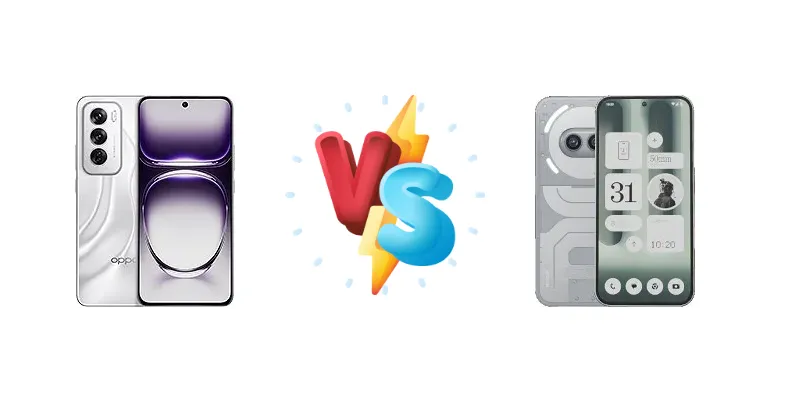
|
🏆 Quick Verdict
For the average user prioritizing all-day battery life, the Nothing Phone (2a) Plus emerges as the winner. Its 16:34 active use score significantly surpasses the Reno12’s 14:53h, and while charging is slower, the overall endurance advantage is substantial. However, the Reno12’s 80W charging is a compelling feature for those who need quick top-ups.
| PHONES | ||
|---|---|---|
| Phone Names | Oppo Reno12 | Nothing Phone (2a) Plus |
| Network | ||
|---|---|---|
| 2G bands | GSM 850 / 900 / 1800 / 1900 | GSM 850 / 900 / 1800 / 1900 |
| 3G bands | HSDPA 800 / 850 / 900 / 1700(AWS) / 1900 / 2100 - version 1 | HSDPA 800 / 850 / 900 / 1700(AWS) / 1900 / 2100 |
| 4G bands | 1, 2, 3, 4, 5, 7, 8, 12, 13, 17, 18, 19, 20, 26, 28, 38, 39, 40, 41, 66 - version 1 | 1, 3, 4, 5, 7, 8, 18, 19, 20, 26, 28, 38, 39, 40, 41, 42, 66 |
| 5G bands | 1, 2, 3, 5, 7, 8, 12, 20, 26, 28, 38, 40, 41, 66, 77, 78 SA/NSA - version 1 | 1, 3, 5, 7, 8, 20, 28, 38, 40, 41, 66, 77, 78 SA/NSA |
| Speed | HSPA, LTE, 5G | HSPA, LTE, 5G |
| Technology | GSM / HSPA / LTE / 5G | GSM / HSPA / LTE / 5G |
| Launch | ||
|---|---|---|
| Announced | 2024, June 18 | 2024, July 31 |
| Status | Available. Released 2024, June 25 | Available. Released 2024, August 03 |
| Body | ||
|---|---|---|
| Build | Glass front (Gorilla Glass 7i), plastic frame, glass back | Glass front (Gorilla Glass 5), plastic frame, plastic back |
| Dimensions | 161.4 x 74.1 x 7.6 mm (6.35 x 2.92 x 0.30 in) | 161.7 x 76.3 x 8.5 mm (6.37 x 3.00 x 0.33 in) |
| SIM | Nano-SIM + Nano-SIM | Nano-SIM + Nano-SIM |
| Weight | 177 g (6.24 oz) | 190 g (6.70 oz) |
| Display | ||
|---|---|---|
| Protection | Corning Gorilla Glass 7i | Corning Gorilla Glass 5 |
| Resolution | 1080 x 2412 pixels, 20:9 ratio (~394 ppi density) | 1080 x 2412 pixels, 20:9 ratio (~395 ppi density) |
| Size | 6.7 inches, 108.0 cm2 (~90.3% screen-to-body ratio) | 6.7 inches, 107.5 cm2 (~87.1% screen-to-body ratio) |
| Type | AMOLED, 1B colors, 120Hz, HDR10+, 1200 nits (peak) | AMOLED, 1B colors, 120Hz, 2160Hz PWM, HDR10+, 700 nits (typ), 1100 nits (HBM), 1300 nits (peak) |
| Platform | ||
|---|---|---|
| CPU | Octa-core (4x2.5 GHz Cortex-A78 & 4x2.0 GHz Cortex-A55) | Octa-core (2x3.0 GHz Cortex-A715 & 6x 2.0 GHz Cortex-A510) |
| Chipset | Mediatek Dimensity 7300 Energy (4 nm) | Mediatek Dimensity 7350 Pro (4 nm) |
| GPU | Mali-G615 MC2 | Mali-G610 MC4 |
| OS | Android 14, up to 3 major Android upgrades, ColorOS 14.1 | Android 14, up to 3 major Android upgrades, Nothing OS 3.0 |
| Memory | ||
|---|---|---|
| Card slot | microSDXC | No |
| Internal | 256GB 8GB RAM, 256GB 12GB RAM, 512GB 12GB RAM | 256GB 8GB RAM, 256GB 12GB RAM |
| Main Camera | ||
|---|---|---|
| Dual | - | 50 MP, f/1.9, 24mm (wide), 1/1.57", 1.0µm, PDAF, OIS 50 MP, f/2.2, 114˚ (ultrawide), 1/2.76", 0.64µm |
| Features | LED flash, HDR, panorama | LED flash, panorama, HDR |
| Triple | 50 MP, f/1.8, 26mm (wide), 1/1.95", 0.8µm, multi-directional PDAF, OIS 8 MP, f/2.2, 16mm, 112˚ (ultrawide), 1/4.0", 1.12µm 2 MP (macro) | - |
| Video | 4K@30fps, 1080p@30/60/120/480fps, 720p@960fps, gyro-EIS, OIS, HDR | 4K@30fps, 1080p@60/120fps, gyro-EIS |
| Selfie camera | ||
|---|---|---|
| Features | Panorama, HDR | HDR |
| Single | 32 MP, f/2.0, 21mm (wide), 1/3.1", PDAF | 50 MP, f/2.2, (wide), 1/2.76" |
| Video | 4K@30fps, 1080p@30fps, gyro-EIS | 4K@30fps |
| Sound | ||
|---|---|---|
| 35mm jack | No | No |
| Loudspeaker | Yes, with stereo speakers | Yes, with stereo speakers |
| Comms | ||
|---|---|---|
| Bluetooth | 5.4, A2DP, LE, aptX HD, LHDC | 5.3, A2DP, LE |
| Infrared port | Yes | - |
| NFC | Yes, 360˚ (market/region dependent) | Yes, 360˚ |
| Positioning | GPS, GLONASS, GALILEO, BDS, QZSS | GPS, GALILEO, GLONASS, BDS, QZSS |
| Radio | No | No |
| USB | USB Type-C 2.0, OTG | USB Type-C 2.0, OTG |
| WLAN | Wi-Fi 802.11 a/b/g/n/ac/6, dual-band | Wi-Fi 802.11 a/b/g/n/ac/6, dual-band, Wi-Fi Direct |
| Features | ||
|---|---|---|
| Sensors | Fingerprint (under display, optical), accelerometer, gyro, proximity, compass | Fingerprint (under display, optical), accelerometer, gyro, proximity, compass |
| Battery | ||
|---|---|---|
| Charging | 80W wired, PD2.0, 47% in 18 min, 100% in 46 min, Reverse wired | 50W wired, 50% in 21 min, 100% in 56 min |
| Type | 5000 mAh | 5000 mAh |
| Misc | ||
|---|---|---|
| Colors | Matte Brown, Sunset Pink, Astro Silver | Black, Grey |
| Models | CPH2625 | A142P |
| Price | € 303.99 | € 269.90 / ₹ 22,599 |
Oppo Reno12
- Significantly faster 80W wired charging.
- Brighter display for better outdoor visibility.
- Potentially more efficient chipset for sustained performance.
- Shorter battery life compared to the Nothing Phone (2a) Plus.
- Less distinctive design.
Nothing Phone (2a) Plus
- Longer battery life for all-day use.
- More powerful processor for demanding tasks.
- Unique and eye-catching design.
- Slower 50W wired charging.
- Lower peak display brightness.
Display Comparison
The Oppo Reno12 boasts a brighter display, reaching a measured peak of 1378 nits, compared to the Nothing Phone (2a) Plus’s 1097 nits. This translates to better visibility under direct sunlight for the Reno12. While both utilize 4nm chipsets, the display brightness difference is a tangible benefit for outdoor users. The Reno12’s panel likely benefits from more aggressive power delivery, impacting battery life slightly. We lack data on panel technology (LTPO vs standard OLED) which would further refine this comparison.
Camera Comparison
Without detailed camera specs, a direct comparison is limited. However, the chipset differences suggest the Nothing Phone (2a) Plus may have a slight advantage in image signal processing (ISP) capabilities due to the newer Dimensity 7350 Pro. The ISP handles noise reduction, dynamic range, and overall image quality. We can assume both phones will offer competent camera systems for social media and casual photography, but the Nothing Phone (2a) Plus’s processor could provide a marginal improvement in challenging lighting conditions. Ignoring the likely presence of low-resolution macro lenses on both devices, the main sensor and its associated OIS system will be the key differentiators.
Performance
Both phones utilize Mediatek Dimensity chipsets fabricated on a 4nm process, but differ in their core configurations. The Nothing Phone (2a) Plus features the Dimensity 7350 Pro with a 2x3.0 GHz Cortex-A715 core configuration, suggesting a slight edge in peak CPU performance compared to the Reno12’s Dimensity 7300 Energy and its 4x2.5 GHz Cortex-A78 cores. However, the Reno12’s chipset is specifically tuned for ‘Energy’ efficiency, potentially offering better sustained performance under load. The A715 cores in the Nothing Phone (2a) Plus are newer architecture, offering improved IPC (Instructions Per Clock) over the A78 cores in the Reno12. The impact of RAM speed (LPDDR5x is likely on both) is minimal in this comparison.
Battery Life
The Nothing Phone (2a) Plus demonstrably wins in battery endurance, achieving 16:34 hours of active use versus the Oppo Reno12’s 14:53 hours. This nearly 2-hour difference is significant for users who heavily rely on their smartphones throughout the day. While the Reno12 compensates with 80W wired charging (47% in 18 minutes, 100% in 46 minutes), the Nothing Phone (2a) Plus’s 50W charging (50% in 21 minutes, 100% in 56 minutes) is slower. The Reno12’s faster charging is ideal for quick top-ups, but the Nothing Phone (2a) Plus’s superior battery life reduces the need for frequent charging.
Buying Guide
Buy the Oppo Reno12 if you prioritize incredibly fast charging and a sleek, conventional design. It’s ideal for users who frequently need to quickly replenish their battery throughout the day. Buy the Nothing Phone (2a) Plus if you value exceptional battery life, a distinctive design, and a slightly more powerful processor for demanding tasks, even if it means sacrificing some charging speed.