
Oppo Reno12 vs Honor X9b: A Detailed Comparison of Mid-Range Contenders
| Phones Images | |||||
|---|---|---|---|---|---|
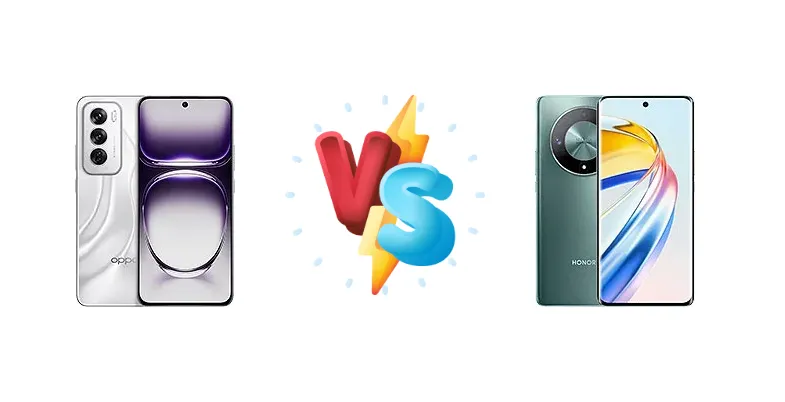
|
🏆 Quick Verdict
For the average user prioritizing sustained performance and faster charging, the Oppo Reno12 emerges as the stronger contender. Its Dimensity 7300 Energy chipset and 80W charging significantly outperform the Honor X9b’s Snapdragon 6 Gen 1 and 35W charging, making it ideal for demanding users.
| PHONES | ||
|---|---|---|
| Phone Names | Oppo Reno12 | Honor X9b |
| Network | ||
|---|---|---|
| 2G bands | GSM 850 / 900 / 1800 / 1900 | GSM 850 / 900 / 1800 / 1900 |
| 3G bands | HSDPA 800 / 850 / 900 / 1700(AWS) / 1900 / 2100 - version 1 | HSDPA 850 / 900 / 1900 / 2100 |
| 4G bands | 1, 2, 3, 4, 5, 7, 8, 12, 13, 17, 18, 19, 20, 26, 28, 38, 39, 40, 41, 66 - version 1 | 1, 2, 3, 4, 5, 7, 8, 20, 28, 32, 38, 40, 41 |
| 5G bands | 1, 2, 3, 5, 7, 8, 12, 20, 26, 28, 38, 40, 41, 66, 77, 78 SA/NSA - version 1 | 1, 3, 7, 8, 20, 28, 38, 40, 41, 77, 78 SA/NSA |
| Speed | HSPA, LTE, 5G | HSPA, LTE, 5G |
| Technology | GSM / HSPA / LTE / 5G | GSM / HSPA / LTE / 5G |
| Launch | ||
|---|---|---|
| Announced | 2024, June 18 | 2023, October 18 |
| Status | Available. Released 2024, June 25 | Available. Released 2023, October |
| Body | ||
|---|---|---|
| Build | Glass front (Gorilla Glass 7i), plastic frame, glass back | - |
| Dimensions | 161.4 x 74.1 x 7.6 mm (6.35 x 2.92 x 0.30 in) | 163.6 x 75.5 x 8 mm (6.44 x 2.97 x 0.31 in) |
| SIM | Nano-SIM + Nano-SIM | Nano-SIM + Nano-SIM |
| Weight | 177 g (6.24 oz) | 185 g (6.53 oz) |
| Display | ||
|---|---|---|
| Protection | Corning Gorilla Glass 7i | - |
| Resolution | 1080 x 2412 pixels, 20:9 ratio (~394 ppi density) | 1220 x 2652 pixels, 19.5:9 ratio (~431 ppi density) |
| Size | 6.7 inches, 108.0 cm2 (~90.3% screen-to-body ratio) | 6.78 inches, 112.6 cm2 (~91.2% screen-to-body ratio) |
| Type | AMOLED, 1B colors, 120Hz, HDR10+, 1200 nits (peak) | AMOLED, 1B colors, 120Hz, 1200 nits (peak) |
| Platform | ||
|---|---|---|
| CPU | Octa-core (4x2.5 GHz Cortex-A78 & 4x2.0 GHz Cortex-A55) | Octa-core (4x2.2 GHz Cortex-A78 & 4x1.8 GHz Cortex-A55) |
| Chipset | Mediatek Dimensity 7300 Energy (4 nm) | Qualcomm SM6450 Snapdragon 6 Gen 1 (4 nm) |
| GPU | Mali-G615 MC2 | Adreno 710 |
| OS | Android 14, up to 3 major Android upgrades, ColorOS 14.1 | Android 13, Magic OS 7.2 |
| Memory | ||
|---|---|---|
| Card slot | microSDXC | No |
| Internal | 256GB 8GB RAM, 256GB 12GB RAM, 512GB 12GB RAM | 256GB 8GB RAM, 256GB 12GB RAM, 512GB 8GB RAM, 512GB 12GB RAM |
| Main Camera | ||
|---|---|---|
| Features | LED flash, HDR, panorama | LED flash, panorama, HDR |
| Triple | 50 MP, f/1.8, 26mm (wide), 1/1.95", 0.8µm, multi-directional PDAF, OIS 8 MP, f/2.2, 16mm, 112˚ (ultrawide), 1/4.0", 1.12µm 2 MP (macro) | 108 MP, f/1.8, (wide), 1/1.67", PDAF 5 MP, f/2.2, (ultrawide) 2 MP (macro) |
| Video | 4K@30fps, 1080p@30/60/120/480fps, 720p@960fps, gyro-EIS, OIS, HDR | 4K@30fps, 1080p@30fps |
| Selfie camera | ||
|---|---|---|
| Features | Panorama, HDR | - |
| Single | 32 MP, f/2.0, 21mm (wide), 1/3.1", PDAF | 16 MP, f/2.5, (wide) |
| Video | 4K@30fps, 1080p@30fps, gyro-EIS | 1080p@30fps |
| Sound | ||
|---|---|---|
| 35mm jack | No | No |
| Loudspeaker | Yes, with stereo speakers | Yes |
| Comms | ||
|---|---|---|
| Bluetooth | 5.4, A2DP, LE, aptX HD, LHDC | 5.1, A2DP, LE |
| Infrared port | Yes | Yes |
| NFC | Yes, 360˚ (market/region dependent) | Yes (market/region dependent) |
| Positioning | GPS, GLONASS, GALILEO, BDS, QZSS | GPS, GLONASS, GALILEO, BDS |
| Radio | No | No |
| USB | USB Type-C 2.0, OTG | USB Type-C 2.0, OTG |
| WLAN | Wi-Fi 802.11 a/b/g/n/ac/6, dual-band | Wi-Fi 802.11 a/b/g/n/ac, dual-band, Wi-Fi Direct |
| Features | ||
|---|---|---|
| Sensors | Fingerprint (under display, optical), accelerometer, gyro, proximity, compass | Fingerprint (under display, optical), accelerometer, gyro, proximity, compass |
| Battery | ||
|---|---|---|
| Charging | 80W wired, PD2.0, 47% in 18 min, 100% in 46 min, Reverse wired | 35W wired Reverse wired |
| Type | 5000 mAh | Li-Po 5800 mAh |
| Misc | ||
|---|---|---|
| Colors | Matte Brown, Sunset Pink, Astro Silver | Sunrise Orange, Midnight Black, Emerald Green |
| Models | CPH2625 | ALI-NX1 |
| Price | € 303.99 | About 970 EUR |
Oppo Reno12
- Faster 80W charging significantly reduces downtime.
- More powerful Dimensity 7300 Energy chipset for smoother performance.
- Higher peak brightness display for better outdoor visibility.
- Battery capacity not specified, potentially smaller than X9b.
- Price may be slightly higher than the Honor X9b.
Honor X9b
- Snapdragon 6 Gen 1 offers a good balance of performance and efficiency.
- Potentially more affordable price point.
- Reverse wired charging for convenient accessory power.
- Slower 35W charging takes considerably longer to fully charge.
- Less powerful chipset may struggle with demanding tasks.
- Display likely has lower peak brightness.
Display Comparison
While both devices’ display specifications are absent, the Reno12’s measured peak brightness of 1378 nits suggests a significantly more visible screen outdoors compared to what’s typically found in the X9b’s price bracket. The Reno12 likely benefits from a more advanced panel technology, potentially offering better color accuracy and viewing angles. Without further data on the X9b, it’s reasonable to assume the Reno12 provides a superior visual experience, especially in bright ambient conditions.
Camera Comparison
Without detailed camera specifications, a direct comparison is limited. However, the chipset differences suggest the Reno12 has a processing advantage for image signal processing. The Dimensity 7300 Energy’s ISP is likely more capable of handling complex computational photography tasks, resulting in better dynamic range and noise reduction. The absence of information on sensor sizes and OIS makes it difficult to definitively declare a winner, but the Reno12’s more powerful chipset gives it a potential edge in image quality.
Performance
The Oppo Reno12’s Mediatek Dimensity 7300 Energy (4nm) chipset boasts a CPU configuration of 4x2.5 GHz Cortex-A78 and 4x2.0 GHz Cortex-A55 cores, offering a performance edge over the Honor X9b’s Qualcomm Snapdragon 6 Gen 1 (4nm) with its 4x2.2 GHz Cortex-A78 and 4x1.8 GHz Cortex-A55 cores. The higher clock speeds on the Reno12’s prime cores translate to snappier application launches and smoother multitasking. Both chips utilize a 4nm process, indicating comparable power efficiency, but the Dimensity 7300 Energy is generally considered more optimized for sustained performance, reducing the likelihood of thermal throttling during prolonged gaming.
Battery Life
The Oppo Reno12 demonstrates a clear advantage in charging speed with its 80W wired charging capability, achieving 47% charge in 18 minutes and 100% in 46 minutes. This is significantly faster than the Honor X9b’s 35W charging. While battery capacity isn’t specified for either device, the Reno12’s active use score of 14:53h indicates excellent battery life, likely achieved through the efficiency of the Dimensity 7300 Energy chipset. The faster charging of the Reno12 is a significant convenience factor for users who frequently need to top up their battery.
Buying Guide
Buy the Oppo Reno12 if you need a phone that can handle extended gaming sessions and benefit from incredibly fast charging – its Dimensity 7300 Energy chipset and 80W charging are key advantages. Buy the Honor X9b if you prioritize a more conservative power draw and are less concerned with peak performance or rapid replenishment of battery life; it’s a solid choice for everyday tasks and media consumption.