
Oppo Reno12 vs Google Pixel 8a: A Deep Dive into Mid-Range Excellence
| Phones Images | |||||
|---|---|---|---|---|---|
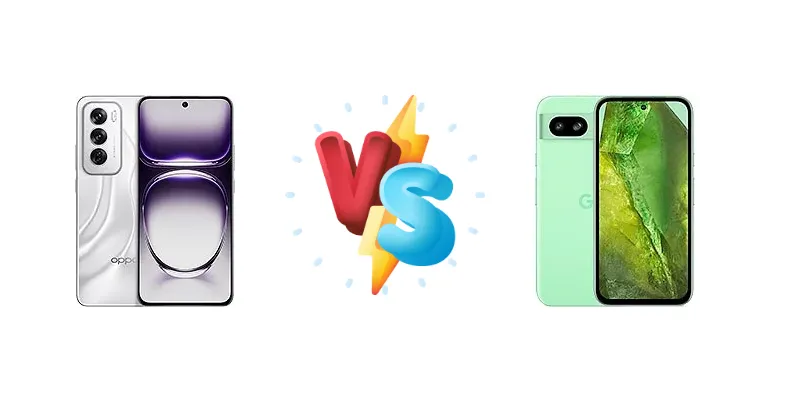
|
🏆 Quick Verdict
For the average user prioritizing longevity and software support, the Google Pixel 8a is the stronger choice. Its exceptional 40:06h endurance and guaranteed updates outweigh the Reno12’s faster charging. However, users who frequently need a quick power boost will appreciate the Reno12’s 80W charging.
| PHONES | ||
|---|---|---|
| Phone Names | Oppo Reno12 | Google Pixel 8a |
| Network | ||
|---|---|---|
| 2G bands | GSM 850 / 900 / 1800 / 1900 | GSM 850 / 900 / 1800 / 1900 |
| 3G bands | HSDPA 800 / 850 / 900 / 1700(AWS) / 1900 / 2100 - version 1 | HSDPA 800 / 850 / 900 / 1700(AWS) / 1900 / 2100 |
| 4G bands | 1, 2, 3, 4, 5, 7, 8, 12, 13, 17, 18, 19, 20, 26, 28, 38, 39, 40, 41, 66 - version 1 | 1, 2, 3, 4, 5, 7, 8, 12, 17, 18, 19, 20, 26, 28, 32, 38, 40, 41, 42, 66 - G6GPR (International) |
| 5G bands | 1, 2, 3, 5, 7, 8, 12, 20, 26, 28, 38, 40, 41, 66, 77, 78 SA/NSA - version 1 | 1, 2, 3, 5, 7, 8, 12, 20, 26, 28, 38, 40, 41, 66, 75, 76, 77, 78 SA/NSA/Sub6 - G6GPR (International) |
| Speed | HSPA, LTE, 5G | HSPA, LTE, 5G |
| Technology | GSM / HSPA / LTE / 5G | GSM / HSPA / LTE / 5G |
| Launch | ||
|---|---|---|
| Announced | 2024, June 18 | 2024, May 07 |
| Status | Available. Released 2024, June 25 | Available. Released 2024, May 14 |
| Body | ||
|---|---|---|
| Build | Glass front (Gorilla Glass 7i), plastic frame, glass back | Glass front (Gorilla Glass 3), aluminum frame, plastic back |
| Dimensions | 161.4 x 74.1 x 7.6 mm (6.35 x 2.92 x 0.30 in) | 152.1 x 72.7 x 8.9 mm (5.99 x 2.86 x 0.35 in) |
| SIM | Nano-SIM + Nano-SIM | Nano-SIM + eSIM |
| Weight | 177 g (6.24 oz) | 188 g (6.63 oz) |
| Display | ||
|---|---|---|
| Protection | Corning Gorilla Glass 7i | Corning Gorilla Glass 3, Mohs level 5 |
| Resolution | 1080 x 2412 pixels, 20:9 ratio (~394 ppi density) | 1080 x 2400 pixels, 20:9 ratio (~430 ppi density) |
| Size | 6.7 inches, 108.0 cm2 (~90.3% screen-to-body ratio) | 6.1 inches, 90.3 cm2 (~81.6% screen-to-body ratio) |
| Type | AMOLED, 1B colors, 120Hz, HDR10+, 1200 nits (peak) | OLED, HDR, 120Hz, 2000 nits (peak) |
| Platform | ||
|---|---|---|
| CPU | Octa-core (4x2.5 GHz Cortex-A78 & 4x2.0 GHz Cortex-A55) | Nona-core (1x3.0 GHz Cortex-X3 & 4x2.45 GHz Cortex-A715 & 4x2.15 GHz Cortex-A510) |
| Chipset | Mediatek Dimensity 7300 Energy (4 nm) | Google Tensor G3 (4 nm) |
| GPU | Mali-G615 MC2 | Immortalis-G715s MC10 |
| OS | Android 14, up to 3 major Android upgrades, ColorOS 14.1 | Android 14, upgradable to Android 16, up to 7 major Android upgrades |
| Memory | ||
|---|---|---|
| Card slot | microSDXC | No |
| Internal | 256GB 8GB RAM, 256GB 12GB RAM, 512GB 12GB RAM | 128GB 8GB RAM, 256GB 8GB RAM |
| Main Camera | ||
|---|---|---|
| Dual | - | 64 MP (16 MP eff.), f/1.9, 26mm (wide), 1/1.73", 0.8µm, dual pixel PDAF, OIS 13 MP, f/2.2, 120˚ (ultrawide), 1.12µm |
| Features | LED flash, HDR, panorama | Dual-LED flash, Pixel Shift, Ultra HDR, panorama, Best Take |
| Triple | 50 MP, f/1.8, 26mm (wide), 1/1.95", 0.8µm, multi-directional PDAF, OIS 8 MP, f/2.2, 16mm, 112˚ (ultrawide), 1/4.0", 1.12µm 2 MP (macro) | - |
| Video | 4K@30fps, 1080p@30/60/120/480fps, 720p@960fps, gyro-EIS, OIS, HDR | 4K@30/60fps, 1080p@30/60/120/240fps, OIS |
| Selfie camera | ||
|---|---|---|
| Features | Panorama, HDR | HDR, panorama |
| Single | 32 MP, f/2.0, 21mm (wide), 1/3.1", PDAF | 13 MP, f/2.2, 20mm (ultrawide), 1.12µm |
| Video | 4K@30fps, 1080p@30fps, gyro-EIS | 4K@30fps, 1080p@30/60fps |
| Sound | ||
|---|---|---|
| 35mm jack | No | No |
| Loudspeaker | Yes, with stereo speakers | Yes, with stereo speakers |
| Comms | ||
|---|---|---|
| Bluetooth | 5.4, A2DP, LE, aptX HD, LHDC | 5.3, A2DP, LE |
| Infrared port | Yes | - |
| NFC | Yes, 360˚ (market/region dependent) | Yes |
| Positioning | GPS, GLONASS, GALILEO, BDS, QZSS | GPS, GLONASS, GALILEO, BDS, QZSS, NavIC |
| Radio | No | No |
| USB | USB Type-C 2.0, OTG | USB Type-C 3.2 |
| WLAN | Wi-Fi 802.11 a/b/g/n/ac/6, dual-band | Wi-Fi 802.11 a/b/g/n/ac/6e, dual/tri-band (market/region dependent) |
| Features | ||
|---|---|---|
| Sensors | Fingerprint (under display, optical), accelerometer, gyro, proximity, compass | Fingerprint (under display, optical), accelerometer, gyro, proximity, compass, barometer |
| Battery | ||
|---|---|---|
| Charging | 80W wired, PD2.0, 47% in 18 min, 100% in 46 min, Reverse wired | 18W wired, PD3.0 7.5W wireless Bypass charging |
| Type | 5000 mAh | Li-Po 4492 mAh |
| Misc | ||
|---|---|---|
| Colors | Matte Brown, Sunset Pink, Astro Silver | Obsidian, Porcelain, Bay, Aloe |
| Models | CPH2625 | GKV4X, G6GPR, G8HHN, G576D |
| Price | € 303.99 | $ 229.98 / C$ 417.99 / £ 279.00 / € 299.99 / ₹ 33,300 |
| EU LABEL | ||
|---|---|---|
| Battery | - | 40:06h endurance, 1000 cycles |
| Energy | - | Class B |
| Free fall | - | Class A (270 falls) |
| Repairability | - | Class B |
Oppo Reno12
- Incredibly fast 80W wired charging
- Sleek and modern design (assumed based on Oppo's brand)
- Reverse wired charging for accessories
- Significantly shorter battery life compared to Pixel 8a
- Chipset may not match Pixel 8a's sustained performance
Google Pixel 8a
- Exceptional battery life (40:06h endurance)
- Google Tensor G3 chip for AI and performance
- Guaranteed software updates and clean Android experience
- Slower 18W wired charging
- May lack the design flair of the Reno12
Display Comparison
Both the Oppo Reno12 and Google Pixel 8a feature 4nm chipsets, but their displays differ significantly. The Pixel 8a boasts a slightly brighter panel at 1508 nits compared to the Reno12’s 1378 nits, offering better visibility in direct sunlight. While both are excellent, the Pixel 8a’s brightness advantage, combined with Google’s color calibration, provides a more vibrant and accurate viewing experience. Details regarding refresh rate and panel type (OLED vs AMOLED) are missing, but both are expected to offer good color reproduction for their price point.
Camera Comparison
The Pixel 8a is expected to leverage Google’s renowned computational photography, even without detailed sensor specifications. The Reno12’s camera specs are currently unavailable, making a direct sensor comparison impossible. However, Google’s image processing algorithms consistently deliver excellent dynamic range and detail, particularly in challenging lighting conditions. The Pixel 8a’s strength lies in its software, compensating for potentially smaller sensor sizes with intelligent processing. The Reno12 will likely focus on hardware features, but without specifics, it’s difficult to assess its camera capabilities.
Performance
The chipset choice defines the performance profiles of these phones. The Google Pixel 8a’s Tensor G3, with its nona-core configuration (1x3.0 GHz Cortex-X3, 4x2.45 GHz Cortex-A715, 4x2.15 GHz Cortex-A510), is designed for AI and machine learning tasks, excelling in areas like image processing and voice recognition. The Oppo Reno12 utilizes the Mediatek Dimensity 7300 Energy (4 nm) with an octa-core setup (4x2.5 GHz Cortex-A78 & 4x2.0 GHz Cortex-A55). While the Dimensity 7300 Energy is a capable chip, the Tensor G3’s Cortex-X3 core provides a performance edge in demanding applications. The Pixel 8a’s architecture suggests better sustained performance due to the more advanced core design.
Battery Life
Battery life is a key differentiator. The Google Pixel 8a’s endurance rating of 40:06h is significantly higher than the Oppo Reno12’s 14:53h active use score. This translates to a substantial real-world advantage for the Pixel 8a, allowing for multi-day usage for many users. While the Reno12 compensates with incredibly fast 80W wired charging (47% in 18 minutes, 100% in 46 minutes) compared to the Pixel 8a’s 18W charging, the Pixel 8a’s longevity reduces the need for frequent top-ups. The Pixel 8a also offers 7.5W wireless charging and 'bypass charging', while the Reno12 supports reverse wired charging.
Buying Guide
Buy the Oppo Reno12 if you need blazing-fast 80W charging and value a design-focused aesthetic. It’s ideal for users who frequently find themselves needing to top up their battery quickly throughout the day. Buy the Google Pixel 8a if you prioritize long-lasting battery life, a clean Android experience with guaranteed updates, and Google’s computational photography prowess. It’s the better choice for users who want a reliable, future-proof device.