
Xiaomi 14T Pro vs Oppo Reno12 Pro: A Deep Dive into Mid-Range Powerhouses
| Phones Images | |||||
|---|---|---|---|---|---|
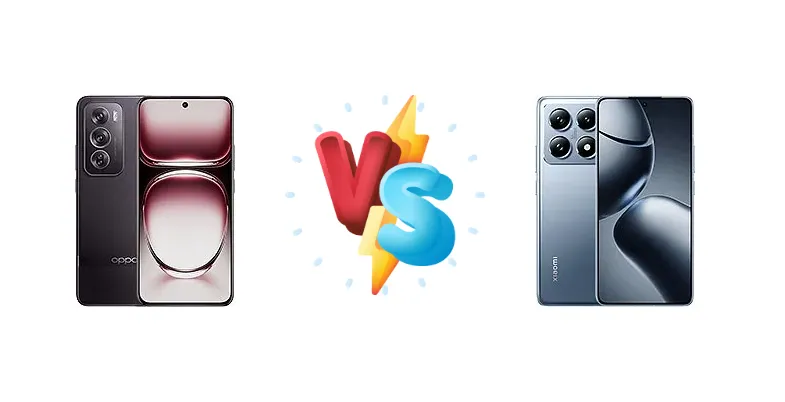
|
🏆 Quick Verdict
For the average user prioritizing sustained performance and rapid charging, the Xiaomi 14T Pro emerges as the winner. Its Dimensity 9300+ chipset offers a significant performance leap, and the 120W charging is unmatched. However, the Oppo Reno12 Pro excels in battery endurance, making it ideal for users who prioritize longevity over raw speed.
| PHONES | ||
|---|---|---|
| Phone Names | Oppo Reno12 Pro | Xiaomi 14T Pro |
| Network | ||
|---|---|---|
| 2G bands | GSM 850 / 900 / 1800 / 1900 | GSM 850 / 900 / 1800 / 1900 |
| 3G bands | HSDPA 800 / 850 / 900 / 1700(AWS) / 1900 / 2100 - version 1 | HSDPA 800 / 850 / 900 / 1700(AWS) / 1900 / 2100 |
| 4G bands | 1, 2, 3, 4, 5, 7, 8, 12, 13, 17, 18, 19, 20, 26, 28, 38, 39, 40, 41, 66 - version 1 | 1, 2, 3, 4, 5, 7, 8, 12, 13, 17, 18, 19, 20, 25, 26, 28, 32, 38, 39, 40, 41, 42, 48, 66 |
| 5G bands | 1, 2, 3, 5, 7, 8, 12, 20, 26, 28, 38, 40, 41, 66, 77, 78 SA/NSA - version 1 | 1, 2, 3, 5, 7, 8, 12, 20, 25, 26, 28, 38, 40, 41, 48, 66, 75, 77, 78 SA/NSA |
| Speed | HSPA, LTE, 5G | HSPA, LTE, 5G |
| Technology | GSM / HSPA / LTE / 5G | GSM / HSPA / LTE / 5G |
| Launch | ||
|---|---|---|
| Announced | 2024, June 18 | 2024, September 26 |
| Status | Available. Released 2024, June 18 | Available. Released 2024, September 26 |
| Body | ||
|---|---|---|
| Build | Glass front (Gorilla Glass Victus 2), plastic frame, glass back | Glass front (Gorilla Glass 5), aluminum frame, glass back (Panda X) |
| Dimensions | 161.5 x 74.8 x 7.4 mm (6.36 x 2.94 x 0.29 in) | 160.4 x 75.1 x 8.4 mm (6.31 x 2.96 x 0.33 in) |
| SIM | Nano-SIM + Nano-SIM | · Nano-SIM + eSIM· eSIM + eSIM· Nano-SIM + Nano-SIM |
| Weight | 180 g (6.35 oz) | 209 g (7.37 oz) |
| Display | ||
|---|---|---|
| Protection | Corning Gorilla Glass Victus 2 | Corning Gorilla Glass 5 |
| Resolution | 1080 x 2412 pixels, 20:9 ratio (~394 ppi density) | 1220 x 2712 pixels, 20:9 ratio (~446 ppi density) |
| Size | 6.7 inches, 108.0 cm2 (~89.4% screen-to-body ratio) | 6.67 inches, 107.4 cm2 (~89.1% screen-to-body ratio) |
| Type | AMOLED, 1B colors, 120Hz, HDR10+, 1200 nits (peak) | AMOLED, 68B colors, 144Hz, 3840Hz PWM, Dolby Vision, HDR10+, 1600 nits (HBM), 4000 nits (peak) |
| Platform | ||
|---|---|---|
| CPU | Octa-core (4x2.5 GHz Cortex-A78 & 4x2.0 GHz Cortex-A55) | Octa-core (1x3.4 GHz Cortex-X4 & 3x2.85 GHz Cortex-X4 & 4x2.0 GHz Cortex-A720) |
| Chipset | Mediatek Dimensity 7300 Energy (4 nm) | Mediatek Dimensity 9300+ (4 nm) |
| GPU | Mali-G615 MC2 | Immortalis-G720 MC12 |
| OS | Android 14, up to 3 major Android upgrades, ColorOS 14.1 | Android 14, HyperOS |
| Memory | ||
|---|---|---|
| Card slot | microSDXC | No |
| Internal | 256GB 12GB RAM, 512GB 12GB RAM | 256GB 12GB RAM, 512GB 12GB RAM, 512GB 16GB RAM, 1TB 12GB RAM |
| Main Camera | ||
|---|---|---|
| Features | LED flash, HDR, panorama | Leica lens, Ultra HDR, LED flash, HDR, panorama |
| Triple | 50 MP, f/1.8, 26mm (wide), 1/1.95", 0.8µm, multi-directional PDAF, OIS 50 MP, f/2.0, 47mm (telephoto), 1/2.75", PDAF, 2x optical zoom 8 MP, f/2.2, 16mm, 112˚ (ultrawide), 1/4.0", 1.12µm | 50 MP, f/1.6, 23mm (wide), 1/1.31", 1.2µm, PDAF, OIS 50 MP, f/2.0, 60mm (telephoto), 1/2.88", 0.61µm, PDAF, 2.6x optical zoom 12 MP, f/2.2, 15mm (ultrawide), 1/3.06", 1.12µm |
| Video | 4K@30fps, 1080p@30/60/120/480fps, 720p@960fps, gyro-EIS, OIS, HDR | 8K@24/30fps, 4K@24/30/60fps, 1080p@30/60/120/240/960fps, gyro-EIS, 10-bit Rec. 2020, HDR10+ |
| Selfie camera | ||
|---|---|---|
| Features | Panorama, HDR | HDR |
| Single | 50 MP, f/2.0, 21mm (wide), 1/2.75", PDAF | 32 MP, f/2.0, 25mm (wide), 1/3.44", 0.64µm |
| Video | 4K@30fps, 1080p@30/60fps, gyro-EIS | 4K@30fps, 1080p@30/60fps, HDR10+ |
| Sound | ||
|---|---|---|
| 35mm jack | No | No |
| Loudspeaker | Yes, with stereo speakers | Yes, with stereo speakers |
| Comms | ||
|---|---|---|
| Bluetooth | 5.4, A2DP, LE, aptX HD, LHDC | 5.4, A2DP, LE, LHDC |
| Infrared port | Yes | Yes |
| NFC | Yes, 360˚ (market/region dependent) | Yes (market/region dependent) |
| Positioning | GPS, GLONASS, GALILEO, BDS, QZSS | GPS (L1+L5), BDS (B1I+B1C+B2a+B2b), GALILEO (E1+E5a+E5b), QZSS (L1+L5), NavIC (L5), GLONASS |
| Radio | No | No |
| USB | USB Type-C 2.0, OTG | USB Type-C 2.0, OTG |
| WLAN | Wi-Fi 802.11 a/b/g/n/ac/6, dual-band | Wi-Fi 802.11 a/b/g/n/ac/6e/7, dual-band, Wi-Fi Direct |
| Features | ||
|---|---|---|
| Sensors | Fingerprint (under display, optical), accelerometer, gyro, proximity, compass | Fingerprint (under display, optical), accelerometer, gyro, proximity, compass |
| Battery | ||
|---|---|---|
| Charging | 80W wired, PD2.0, 47% in 18 min, 100% in 46 min, Reverse wired | 120W wired, PD3.0, QC4, 100% in 19 min 50W wireless, 100% in 45 min |
| Type | 5000 mAh | Li-Po 5000 mAh |
| Misc | ||
|---|---|---|
| Colors | Space Brown, Sunset Gold, Nebula Silver, Manish Malhotra | Titan Gray, Titan Blue, Titan Black |
| Models | CPH2629 | 2407FPN8EG |
| Price | € 379.99 / £ 329.00 | $ 550.00 / £ 498.00 / € 539.99 |
| SAR EU | - | 0.99 W/kg (head) 1.00 W/kg (body) |
Oppo Reno12 Pro
- Exceptional battery life (14:54h active use)
- High peak display brightness (1380 nits)
- Efficient Dimensity 7300 Energy chipset
- Slower charging speed (46 minutes to 100%)
- Less powerful chipset compared to the 14T Pro
Xiaomi 14T Pro
- Blazing-fast 120W wired charging (19 minutes to 100%)
- Powerful Dimensity 9300+ chipset for demanding tasks
- 50W wireless charging support
- Shorter battery life (12:32h active use)
- Lower peak display brightness (1228 nits)
Display Comparison
Both devices utilize 4nm chipsets, allowing for efficient display operation. The Oppo Reno12 Pro boasts a peak brightness of 1380 nits, exceeding the Xiaomi 14T Pro’s 1228 nits. This translates to better visibility in direct sunlight for the Oppo. While both likely employ AMOLED panels, the Reno12 Pro’s higher peak brightness provides a more vibrant and readable experience outdoors. Details regarding refresh rates and panel technology (LTPO) are missing, but the Reno12 Pro’s brightness advantage is a clear win.
Camera Comparison
Without detailed camera specifications, a direct comparison is limited. However, the chipset difference suggests the Xiaomi 14T Pro will have a more powerful ISP (Image Signal Processor), enabling faster image processing and potentially better low-light performance. The Dimensity 9300+’s superior processing capabilities will likely translate to more sophisticated computational photography features. The absence of sensor details makes it difficult to assess image quality definitively, but the 14T Pro’s chipset gives it an edge in image processing.
Performance
The performance gap is significant. The Xiaomi 14T Pro’s Dimensity 9300+ features a 1x3.4 GHz Cortex-X4 core alongside three additional Cortex-X4 cores, and four Cortex-A720 cores, representing a substantial upgrade over the Oppo Reno12 Pro’s Dimensity 7300 Energy. The Reno12 Pro’s CPU configuration of 4x2.5 GHz Cortex-A78 and 4x2.0 GHz Cortex-A55 cores is geared towards efficiency, while the 14T Pro prioritizes raw power. This difference will be most noticeable in demanding games and resource-intensive applications. The 14T Pro will likely exhibit less throttling under sustained load due to the more advanced chipset architecture.
Battery Life
The Oppo Reno12 Pro demonstrates a clear advantage in battery life, achieving an active use score of 14:54h compared to the Xiaomi 14T Pro’s 12:32h. This suggests the Dimensity 7300 Energy’s efficiency, combined with software optimization, delivers superior stamina. However, the Xiaomi 14T Pro compensates with its incredibly fast 120W wired charging, reaching 100% in just 19 minutes, while the Reno12 Pro takes 46 minutes with its 80W charging. The 14T Pro also adds 50W wireless charging, a feature absent on the Reno12 Pro. The Reno12 Pro prioritizes longevity, while the 14T Pro prioritizes speed and convenience.
Buying Guide
Buy the Oppo Reno12 Pro if you need all-day battery life and a consistently smooth experience for everyday tasks. Its efficient Dimensity 7300 Energy chipset and optimized software deliver excellent stamina. Buy the Xiaomi 14T Pro if you prioritize gaming, demanding applications, and the convenience of incredibly fast charging. The Dimensity 9300+ provides a substantial performance boost, and the 120W charging gets you back to 100% in under 20 minutes.