
Oppo Reno12 Pro vs vivo X100 Pro: Which Dimensity-Powered Phone Reigns Supreme?
| Phones Images | |||||
|---|---|---|---|---|---|
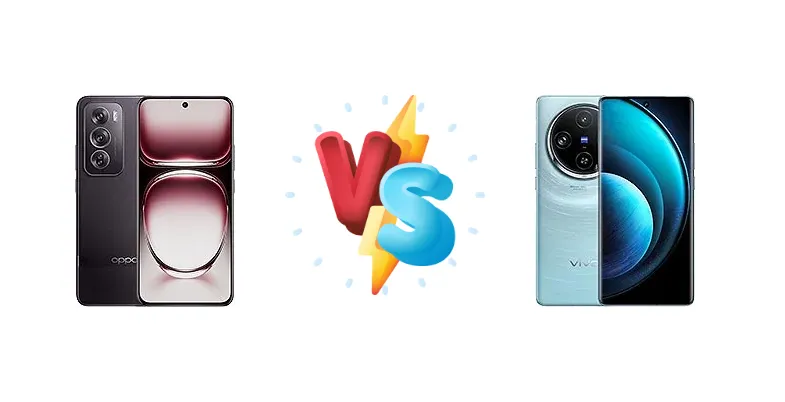
|
🏆 Quick Verdict
For most users, the vivo X100 Pro is the superior choice. Its Dimensity 9300 chipset provides a significant performance uplift, justifying the price premium. While the Reno12 Pro offers excellent battery life and a bright display, it can't match the X100 Pro's processing power and overall refinement.
| PHONES | ||
|---|---|---|
| Phone Names | Oppo Reno12 Pro | vivo X100 Pro |
| Network | ||
|---|---|---|
| 2G bands | GSM 850 / 900 / 1800 / 1900 | GSM 850 / 900 / 1800 / 1900 |
| 3G bands | HSDPA 800 / 850 / 900 / 1700(AWS) / 1900 / 2100 - version 1 | HSDPA 800 / 850 / 900 / 1700(AWS) / 1900 / 2100 |
| 4G bands | 1, 2, 3, 4, 5, 7, 8, 12, 13, 17, 18, 19, 20, 26, 28, 38, 39, 40, 41, 66 - version 1 | 1, 2, 3, 4, 5, 7, 8, 12, 17, 18, 19, 20, 26, 28, 32, 38, 39, 40, 41, 42, 66 - International |
| 5G bands | 1, 2, 3, 5, 7, 8, 12, 20, 26, 28, 38, 40, 41, 66, 77, 78 SA/NSA - version 1 | 1, 3, 5, 7, 8, 20, 28, 38, 40, 41, 66, 75, 77, 78, 79 SA/NSA - International |
| Speed | HSPA, LTE, 5G | HSPA, LTE, 5G |
| Technology | GSM / HSPA / LTE / 5G | GSM / CDMA / HSPA / LTE / 5G |
| Launch | ||
|---|---|---|
| Announced | 2024, June 18 | 2023, November 13 |
| Status | Available. Released 2024, June 18 | Available. Released 2023, November 21 |
| Body | ||
|---|---|---|
| Build | Glass front (Gorilla Glass Victus 2), plastic frame, glass back | Glass front, aluminum frame, glass back |
| Dimensions | 161.5 x 74.8 x 7.4 mm (6.36 x 2.94 x 0.29 in) | 164.1 x 75.3 x 8.9 mm or 9.1 mm |
| SIM | Nano-SIM + Nano-SIM | · Nano-SIM + eSIM· Nano-SIM + Nano-SIM |
| Weight | 180 g (6.35 oz) | 221 g or 225 g (7.80 oz) |
| Display | ||
|---|---|---|
| Protection | Corning Gorilla Glass Victus 2 | - |
| Resolution | 1080 x 2412 pixels, 20:9 ratio (~394 ppi density) | 1260 x 2800 pixels, 20:9 ratio (~452 ppi density) |
| Size | 6.7 inches, 108.0 cm2 (~89.4% screen-to-body ratio) | 6.78 inches, 111.5 cm2 (~90.2% screen-to-body ratio) |
| Type | AMOLED, 1B colors, 120Hz, HDR10+, 1200 nits (peak) | LTPO AMOLED, 1B colors, 120Hz, HDR10+, 3000 nits (peak) |
| Platform | ||
|---|---|---|
| CPU | Octa-core (4x2.5 GHz Cortex-A78 & 4x2.0 GHz Cortex-A55) | Octa-core (1x3.25 GHz Cortex-X4 & 3x2.85 GHz Cortex-X4 & 4x2.0 GHz Cortex-A720) |
| Chipset | Mediatek Dimensity 7300 Energy (4 nm) | Mediatek Dimensity 9300 (4 nm) |
| GPU | Mali-G615 MC2 | Immortalis-G720 MC12 |
| OS | Android 14, up to 3 major Android upgrades, ColorOS 14.1 | Android 14, upgradable to Android 15, Funtouch 15 (International), OriginOS 4 (China) |
| Memory | ||
|---|---|---|
| Card slot | microSDXC | No |
| Internal | 256GB 12GB RAM, 512GB 12GB RAM | 256GB 12GB RAM, 256GB 16GB RAM, 512GB 16GB RAM, 1TB 16GB RAM |
| Main Camera | ||
|---|---|---|
| Features | LED flash, HDR, panorama | Laser AF, color spectrum sensor, Zeiss optics, Zeiss T* lens coating, LED flash, panorama, HDR, 3D LUT import |
| Triple | 50 MP, f/1.8, 26mm (wide), 1/1.95", 0.8µm, multi-directional PDAF, OIS 50 MP, f/2.0, 47mm (telephoto), 1/2.75", PDAF, 2x optical zoom 8 MP, f/2.2, 16mm, 112˚ (ultrawide), 1/4.0", 1.12µm | 50 MP, f/1.8, 23mm (wide), 1/0.98", 1.6µm, dual pixel PDAF, OIS 50 MP, f/2.5, 100mm (periscope telephoto), 1/2.51", 0.7µm, PDAF (18cm - ∞), OIS, 4.3x optical zoom 50 MP, f/2.0, 15mm, 119˚ (ultrawide), 1/2.76", 0.64µm, AF |
| Video | 4K@30fps, 1080p@30/60/120/480fps, 720p@960fps, gyro-EIS, OIS, HDR | 8K@30fps, 4K@30/60fps, 1080p, gyro-EIS |
| Selfie camera | ||
|---|---|---|
| Features | Panorama, HDR | HDR |
| Single | 50 MP, f/2.0, 21mm (wide), 1/2.75", PDAF | 32 MP, f/2.0, 20mm (ultrawide) |
| Video | 4K@30fps, 1080p@30/60fps, gyro-EIS | 4K@30/60fps, 1080p@30/60fps |
| Sound | ||
|---|---|---|
| 35mm jack | No | No |
| Loudspeaker | Yes, with stereo speakers | Yes, with stereo speakers |
| Comms | ||
|---|---|---|
| Bluetooth | 5.4, A2DP, LE, aptX HD, LHDC | 5.4, A2DP, LE, aptX HD, LHDC |
| Infrared port | Yes | Yes |
| NFC | Yes, 360˚ (market/region dependent) | Yes |
| Positioning | GPS, GLONASS, GALILEO, BDS, QZSS | GPS (L1+L5), GLONASS (L1), BDS (B1I+B1c+B2a+B2b), GALILEO (E1+E5a+E5b), QZSS (L1+L5), NavIC (L5) |
| Radio | No | No |
| USB | USB Type-C 2.0, OTG | USB Type-C 3.2, OTG |
| WLAN | Wi-Fi 802.11 a/b/g/n/ac/6, dual-band | Wi-Fi 802.11 a/b/g/n/ac/6/7, tri-band, Wi-Fi Direct |
| Features | ||
|---|---|---|
| Sensors | Fingerprint (under display, optical), accelerometer, gyro, proximity, compass | Fingerprint (under display, optical), accelerometer, gyro, proximity, compass |
| Battery | ||
|---|---|---|
| Charging | 80W wired, PD2.0, 47% in 18 min, 100% in 46 min, Reverse wired | 100W wired, 50% in 14 min 50W wireless Reverse wired |
| Type | 5000 mAh | Li-Ion 5400 mAh |
| Misc | ||
|---|---|---|
| Colors | Space Brown, Sunset Gold, Nebula Silver, Manish Malhotra | Startrail Blue, Asteroid Black, Sunset Orange, White |
| Models | CPH2629 | V2324A, V2309 |
| Price | € 379.99 / £ 329.00 | ₹ 59,999 |
| SAR EU | - | 0.99 W/kg (head) 1.19 W/kg (body) |
Oppo Reno12 Pro
- Excellent battery life (14:54h active use)
- Fast 80W wired charging
- Bright 1380 nits display
- Less powerful Dimensity 7300 chipset
- Limited camera information available
vivo X100 Pro
- Flagship Dimensity 9300 performance
- Ultra-fast 100W wired and 50W wireless charging
- Higher peak display brightness (1472 nits)
- Slightly shorter battery life (13:53h active use)
- Higher price point
Display Comparison
Both phones feature vibrant displays, but the vivo X100 Pro boasts a higher peak brightness of 1472 nits compared to the Reno12 Pro’s 1380 nits. This translates to better visibility in direct sunlight. While both utilize 4nm chipsets, the display’s impact on overall power draw isn’t specified, but the X100 Pro’s higher brightness could slightly impact battery life. Neither specification details refresh rate or panel type (LTPO), but given the price points, both likely employ AMOLED technology. The X100 Pro’s higher brightness gives it a slight edge for outdoor usability.
Camera Comparison
The provided data only highlights 'Photo / Video' capabilities for the vivo X100 Pro, lacking specific sensor details. However, given vivo’s history, it’s reasonable to expect a larger main sensor and more advanced image processing compared to the Reno12 Pro. The Reno12 Pro’s camera specs are absent, making a direct comparison difficult. Without sensor size or aperture information, it’s impossible to assess low-light performance or dynamic range. The X100 Pro’s focus on 'Photo / Video' suggests a more robust camera system geared towards enthusiasts, while the Reno12 Pro likely prioritizes a more balanced camera experience.
Performance
The core difference lies in the chipsets. The vivo X100 Pro’s Dimensity 9300, with its 1x3.25 GHz Cortex-X4 prime core and 3x2.85 GHz Cortex-X4 performance cores, represents a substantial leap over the Reno12 Pro’s Dimensity 7300 Energy. The X100 Pro’s CPU architecture, utilizing the newer Cortex-X4, offers improved single-core and multi-core performance. The Reno12 Pro’s 4x2.5 GHz Cortex-A78 and 4x2.0 GHz Cortex-A55 configuration is competent, but will struggle with sustained, demanding workloads. The X100 Pro benefits from a more advanced CPU design, translating to faster app loading, smoother multitasking, and superior gaming performance. The X100 Pro’s GPU will also significantly outperform the Reno12 Pro’s.
Battery Life
The Oppo Reno12 Pro delivers a slightly longer active use battery score of 14:54h compared to the vivo X100 Pro’s 13:53h. However, this doesn’t tell the whole story. The X100 Pro compensates with significantly faster charging – 100W wired, reaching 50% in just 14 minutes, and 50W wireless. The Reno12 Pro’s 80W wired charging is still fast (47% in 18 minutes, 100% in 46 minutes), but slower overall. The X100 Pro’s faster charging mitigates the slightly shorter battery life, offering more convenient top-ups. Both phones support reverse wired charging.
Buying Guide
Buy the Oppo Reno12 Pro if you prioritize all-day battery life and a smooth, responsive experience for everyday tasks and light gaming. It’s ideal for users who don’t need the absolute fastest performance and want to save money. Buy the vivo X100 Pro if you demand top-tier performance for demanding games, video editing, or heavy multitasking, and if camera quality is a primary concern. It’s the phone for power users and photography enthusiasts.