
Oppo Reno12 Pro vs Honor Magic6 Pro: A Deep Dive into Flagship Performance and Value
| Phones Images | |||||
|---|---|---|---|---|---|
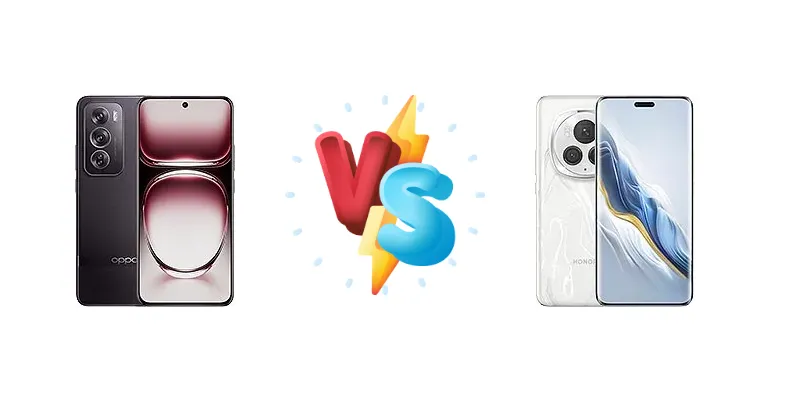
|
🏆 Quick Verdict
For the average user prioritizing raw power and a brighter display, the Honor Magic6 Pro is the clear winner. Its Snapdragon 8 Gen 3 chipset provides a significant performance advantage. However, the Oppo Reno12 Pro offers excellent battery life and efficient performance at a potentially lower price point, making it a compelling alternative.
| PHONES | ||
|---|---|---|
| Phone Names | Oppo Reno12 Pro | Honor Magic6 Pro |
| Network | ||
|---|---|---|
| 2G bands | GSM 850 / 900 / 1800 / 1900 | GSM 850 / 900 / 1800 / 1900 |
| 3G bands | HSDPA 800 / 850 / 900 / 1700(AWS) / 1900 / 2100 - version 1 | HSDPA 800 / 850 / 900 / 1700(AWS) / 1900 / 2100 |
| 4G bands | 1, 2, 3, 4, 5, 7, 8, 12, 13, 17, 18, 19, 20, 26, 28, 38, 39, 40, 41, 66 - version 1 | LTE |
| 5G bands | 1, 2, 3, 5, 7, 8, 12, 20, 26, 28, 38, 40, 41, 66, 77, 78 SA/NSA - version 1 | SA/NSA |
| Speed | HSPA, LTE, 5G | HSPA, LTE, 5G |
| Technology | GSM / HSPA / LTE / 5G | GSM / CDMA / HSPA / CDMA2000 / LTE / 5G |
| Launch | ||
|---|---|---|
| Announced | 2024, June 18 | 2024, January 11 |
| Status | Available. Released 2024, June 18 | Available. Released 2024, January 18 |
| Body | ||
|---|---|---|
| Build | Glass front (Gorilla Glass Victus 2), plastic frame, glass back | Glass front (NanoCrystal Shield), glass back or silicone polymer back (eco leather) |
| Dimensions | 161.5 x 74.8 x 7.4 mm (6.36 x 2.94 x 0.29 in) | 162.5 x 75.8 x 8.9 mm (6.40 x 2.98 x 0.35 in) |
| SIM | Nano-SIM + Nano-SIM | · Nano-SIM + eSIM· Nano-SIM + Nano-SIM |
| Weight | 180 g (6.35 oz) | 225 g or 229 g (7.94 oz) |
| Display | ||
|---|---|---|
| Protection | Corning Gorilla Glass Victus 2 | NanoCrystal Shield |
| Resolution | 1080 x 2412 pixels, 20:9 ratio (~394 ppi density) | 1280 x 2800 pixels, 19.5:9 ratio (~453 ppi density) |
| Size | 6.7 inches, 108.0 cm2 (~89.4% screen-to-body ratio) | 6.8 inches, 112.8 cm2 (~91.6% screen-to-body ratio) |
| Type | AMOLED, 1B colors, 120Hz, HDR10+, 1200 nits (peak) | LTPO OLED, 1B colors, 120Hz, Dolby Vision, HDR, 1600 nits (HBM), 5000 nits (peak) |
| Platform | ||
|---|---|---|
| CPU | Octa-core (4x2.5 GHz Cortex-A78 & 4x2.0 GHz Cortex-A55) | Octa-core (1x3.3 GHz Cortex-X4 & 3x3.2 GHz Cortex-A720 & 2x3.0 GHz Cortex-A720 & 2x2.3 GHz Cortex-A520) |
| Chipset | Mediatek Dimensity 7300 Energy (4 nm) | Qualcomm SM8650-AB Snapdragon 8 Gen 3 (4 nm) |
| GPU | Mali-G615 MC2 | Adreno 750 |
| OS | Android 14, up to 3 major Android upgrades, ColorOS 14.1 | Android 14, up to 4 major Android upgrades, MagicOS 8 |
| Memory | ||
|---|---|---|
| Card slot | microSDXC | No |
| Internal | 256GB 12GB RAM, 512GB 12GB RAM | 256GB 12GB RAM, 256GB 16GB RAM, 512GB 12GB RAM, 512GB 16GB RAM, 1TB 16GB RAM |
| Main Camera | ||
|---|---|---|
| Features | LED flash, HDR, panorama | Laser AF, color spectrum sensor, LED flash, HDR, panorama |
| Triple | 50 MP, f/1.8, 26mm (wide), 1/1.95", 0.8µm, multi-directional PDAF, OIS 50 MP, f/2.0, 47mm (telephoto), 1/2.75", PDAF, 2x optical zoom 8 MP, f/2.2, 16mm, 112˚ (ultrawide), 1/4.0", 1.12µm | 50 MP, f/1.4-2.0, 23mm (wide), 1/1.3", 1.2µm, PDAF, OIS 180 MP, f/2.6, (periscope telephoto), 1/1.49", 0.56µm, PDAF, OIS, 2.5x optical zoom 50 MP, f/2.0, 13mm, 122˚ (ultrawide), 1/2.88", 0.61µm, AF |
| Video | 4K@30fps, 1080p@30/60/120/480fps, 720p@960fps, gyro-EIS, OIS, HDR | 4K@24/30/60fps, 1080p@30/60/120/240fps, gyro-EIS, OIS, HDR, 10-bit video |
| Selfie camera | ||
|---|---|---|
| Features | Panorama, HDR | - |
| Single | 50 MP, f/2.0, 21mm (wide), 1/2.75", PDAF | 50 MP, f/2.0, 22mm (wide), 1/2.93", 0.6µm, AF TOF 3D, (depth/biometrics sensor) |
| Video | 4K@30fps, 1080p@30/60fps, gyro-EIS | 4K@30fps, 1080p@30/60fps, gyro-EIS |
| Sound | ||
|---|---|---|
| 35mm jack | No | No |
| Loudspeaker | Yes, with stereo speakers | Yes, with stereo speakers |
| Comms | ||
|---|---|---|
| Bluetooth | 5.4, A2DP, LE, aptX HD, LHDC | 5.3, A2DP, LE, aptX HD |
| Infrared port | Yes | Yes |
| NFC | Yes, 360˚ (market/region dependent) | Yes |
| Positioning | GPS, GLONASS, GALILEO, BDS, QZSS | GPS (L1+L5), GLONASS, BDS (B1I+B1c+B2a), GALILEO (E1+E5a) |
| Radio | No | No |
| USB | USB Type-C 2.0, OTG | USB Type-C 3.2, DisplayPort 1.2, OTG |
| WLAN | Wi-Fi 802.11 a/b/g/n/ac/6, dual-band | Wi-Fi 802.11 a/b/g/n/ac/6/7, dual-band, Wi-Fi Direct |
| Features | ||
|---|---|---|
| Sensors | Fingerprint (under display, optical), accelerometer, gyro, proximity, compass | Fingerprint (under display, optical), Face ID, accelerometer, gyro, proximity, compass |
| Battery | ||
|---|---|---|
| Charging | 80W wired, PD2.0, 47% in 18 min, 100% in 46 min, Reverse wired | 80W wired 66W wireless Reverse wireless 5W reverse wired |
| Type | 5000 mAh | Si/C Li-Ion 5600 mAh |
| Misc | ||
|---|---|---|
| Colors | Space Brown, Sunset Gold, Nebula Silver, Manish Malhotra | Black, Green, Blue, Purple, White |
| Models | CPH2629 | BVL-AN16, BVL-N49 |
| Price | € 379.99 / £ 329.00 | € 455.54 / $ 899.00 / £ 598.99 |
Oppo Reno12 Pro
- Excellent battery life (14:54h active use)
- Efficient Dimensity 7300 Energy chipset
- Fast 80W wired charging
- Less powerful processor than the Snapdragon 8 Gen 3
- Lower peak display brightness
Honor Magic6 Pro
- Top-tier Snapdragon 8 Gen 3 performance
- Significantly brighter display (1578 nits)
- 66W wireless charging and reverse wireless charging
- Slightly shorter battery life (14:06h active use)
- Potentially higher price
Display Comparison
The Honor Magic6 Pro boasts a brighter display, reaching a measured 1578 nits compared to the Reno12 Pro’s 1380 nits. This difference is immediately noticeable in direct sunlight, giving the Magic6 Pro a clear advantage for outdoor use. While both utilize 4nm chipsets, the display’s brightness impacts overall power draw. Neither specification details refresh rate or panel type, but given the flagship positioning, both are likely to employ LTPO technology for variable refresh rates and power efficiency. The Magic6 Pro’s higher peak brightness is a key differentiator for users who frequently consume content outdoors.
Camera Comparison
Without detailed camera specifications, a direct comparison is limited. However, the flagship positioning of both devices suggests high-quality camera systems. The Honor Magic6 Pro, leveraging the Snapdragon 8 Gen 3’s ISP, likely benefits from advanced image processing capabilities. The Reno12 Pro’s Dimensity 7300 Energy also includes a capable ISP, but may not match the Snapdragon’s processing power. Sensor size and lens apertures would be crucial factors, but are currently unknown. It’s reasonable to assume both phones will offer excellent image quality in good lighting conditions, with the Magic6 Pro potentially excelling in low-light scenarios due to its more powerful processor.
Performance
The core difference lies in the chipsets. The Honor Magic6 Pro’s Snapdragon 8 Gen 3 (SM8650-AB) is a significant step up from the Oppo Reno12 Pro’s Mediatek Dimensity 7300 Energy. The Snapdragon 8 Gen 3 features a 1x3.3 GHz Cortex-X4 prime core, alongside 3x3.2 GHz Cortex-A720 cores, and 2x3.0 GHz Cortex-A720 cores, and 2x2.3 GHz Cortex-A520 cores, offering superior multi-core and single-core performance. The Reno12 Pro’s Dimensity 7300 Energy, with its 4x2.5 GHz Cortex-A78 and 4x2.0 GHz Cortex-A55 cores, is more focused on efficiency. This translates to smoother multitasking and more demanding gaming on the Magic6 Pro, though potentially at the cost of slightly reduced battery life. Both are built on a 4nm process, but the architectural advantages of the Snapdragon 8 Gen 3 are substantial.
Battery Life
Both phones offer 80W wired charging, with the Reno12 Pro reaching 47% in 18 minutes and 100% in 46 minutes. The Magic6 Pro also supports 66W wireless charging and 5W reverse wired charging, adding versatility. Despite the Magic6 Pro’s more powerful processor, the Reno12 Pro edges out in active use battery life, achieving 14:54h compared to the Magic6 Pro’s 14:06h. This suggests the Dimensity 7300 Energy’s efficiency contributes to longer real-world usage, offsetting the Snapdragon 8 Gen 3’s higher power consumption.
Buying Guide
Buy the Oppo Reno12 Pro if you need a phone that prioritizes all-day battery life and efficient performance for everyday tasks and moderate gaming. It’s ideal for users who don’t demand the absolute highest frame rates in demanding titles. Buy the Honor Magic6 Pro if you prefer uncompromising performance for gaming, content creation, and power-user workflows, and value a significantly brighter display for outdoor visibility. It’s the choice for those who want the best possible Android experience, regardless of cost.